 RoofingCalculator.io
Common Roof Problems
By RoofingCalculator.io. Updated October 14, 2026. Prices, ratings and code references link to their sources.
Pricing your own roof? Get squares, materials and a 2026 cost range in about two minutes. Free, no sign-up.
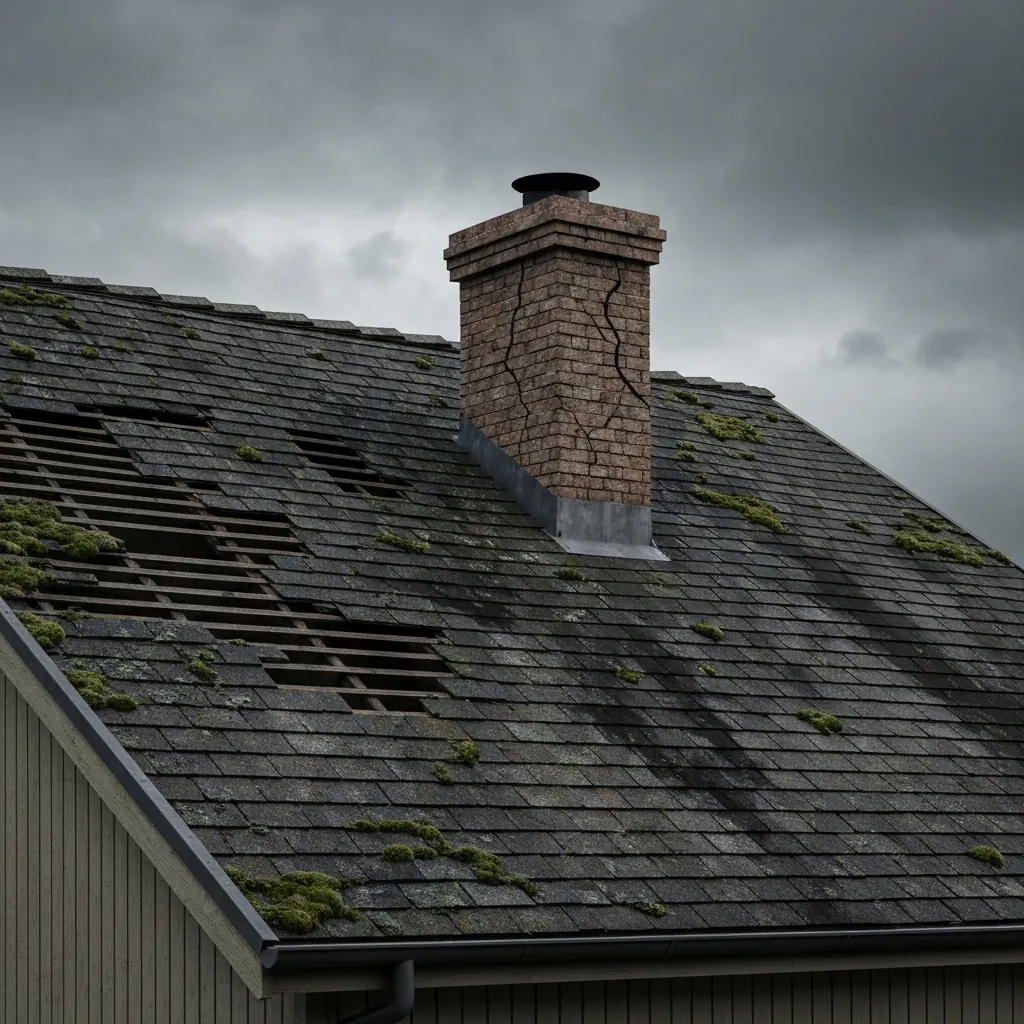
The most common roof problems are leaks at flashing and pipe boots, wind and hail damage, poor attic ventilation, ice dams, moss, clogged gutters and worn-out shingles. Most trace back to how the roof was installed or maintained rather than to the shingles themselves. Caught early, many are inexpensive to fix, with most leak repairs costing about $350 to $1,500; left until the deck rots, a repair can pass $3,000 before any shingles are replaced.
This guide covers each problem in turn, with typical costs and links to more detailed guides. Four principles apply to all of them.
- Check the weak points first. Leaks start at flashing, valleys, pipe boots and roof edges, not in the middle of the shingles.
- Act quickly after storms. Document damage, tarp openings and file insurance claims before signing with a contractor.
- Fix the attic, not just the roof. Ventilation and insulation prevent ice dams and premature shingle aging.
- Base repair-or-replace on age and extent. Localized damage on a younger roof is a repair; widespread damage on an aging roof is a replacement.
Leaks are the most common roof problem
Leaks are the most common roof problem, and they do their damage slowly. A drip too slow to hear can keep the deck damp for several seasons, long enough for mold to grow and plywood to soften. Water rarely comes through the middle of a shingle. It enters at seams and penetrations: pipes, chimneys, valleys, skylights and the joints where a roof meets a wall.
On many roofs, the pipe boots fail first. These rubber collars around plumbing vents break down in the sun and crack or shrink away from the pipe after about 10 to 12 years, letting rain run down the outside of the PVC into the attic insulation. Chimneys leak where mortar cracks or where the sealant behind the step and counter flashing dries out. Valleys carry the runoff from two roof planes into one narrow channel, so a valley lined without ice and water shield or a metal liner will eventually back water up under the shingles.
A ceiling stain is rarely directly below the hole. Water clings to the underside of the deck and runs along the rafters before it drips, so the actual entry point is often several feet upslope. How to find a roof leak explains the attic search and the hose test step by step. The roof leak repair cost guide breaks down prices: about $350 to $600 for a pipe boot or a few shingles, $700 to $1,800 for valley or chimney flashing, and more once rot reaches the decking.
Skylights are often blamed for leaks when the unit itself is fine. The usual cause is flashing installed in the wrong order, or condensation dripping from cold glass above a steamy shower. If you are considering adding one, are skylights worth it covers the cost, $1,500 to $3,500 per unit installed, and how to keep it watertight.
Most wind blow-offs trace back to high nailing
Most wind blow-offs trace back to high nailing rather than a weak shingle. Every shingle has a printed nail line, and a nail driven above it catches only one layer of asphalt, so wind can get under the tab and lift it over the nail heads. Four nails per shingle is standard, and manufacturers require six in high-wind zones. The sealant strip is the backup, but on a roof installed in midwinter it may not seal until spring unless the crew sealed the shingles by hand.
Check the eaves, rakes, corners and ridges, where air can get underneath. Look for missing tabs and for a straight crease across a tab with a line of missing granules. That crease means the tab has already been lifted and folded back once, and it will likely tear off in the next ordinary storm.
After a major storm, the order of steps matters.
- Inspect from the ground and photograph everything. Don't climb onto a damaged roof.
- Tarp any openings within a day or two. This limits further water damage.
- Open the insurance claim before signing with a contractor. Door-to-door crews often arrive in the week after a storm.
The storm damage roof repair guide covers the full sequence and how to recognize storm chasers. A small wind repair typically costs $500 to $1,500, while a full tear-off and replacement on a typical 20-square architectural shingle roof costs about $11,000 to $18,000.
Can hail damage be seen from the ground?
Hail damage often can't be seen from the yard. Up close, it shows as dark bruise-like spots where granules were knocked loose and as dents in gutters, vents and other soft metal. Asphalt shingles start to take real damage from hailstones around an inch across, about the size of a quarter. Golf-ball-size hail can crack shingles outright and dent metal panels.
The absence of a leak today means little. The shingle mat under a bruise is often cracked, and where granules are gone the sun breaks down the bare asphalt, so the spot may start leaking months later, after the claim window has closed. Many policies require hail claims within one to two years of the storm, and some allow less.
Patching a small area of 10 to 20 shingles usually costs $500 to $1,500. Once damage passes about 25 percent of a slope, full replacement is the normal recommendation. The hail damage roof guide explains how to check safely from the ground, how hail breaks a shingle and which impact-resistant shingles to consider for your next roof.
Insurance pays for sudden damage, not wear
Homeowners insurance pays when a covered event, usually wind, hail, fire or a falling tree, damages the roof suddenly and you can prove it. It does not cover wear from age, moss, rot or leaks caused by lack of maintenance.
How you are paid depends on your policy.
- Replacement cost value (RCV) usually pays in two checks: the depreciated amount first, then the withheld depreciation after the new roof is installed and you submit the invoice.
- Actual cash value (ACV) keeps the depreciation permanently, and on an older roof the difference can be large.
- Percentage deductibles are common in hail and hurricane regions. A 2% deductible on a $400,000 house means you pay the first $8,000.
A roofer cannot legally cover your deductible; in many states, waiving or rebating it is insurance fraud. How to get insurance to pay for a roof explains filing, what belongs in the adjuster's estimate, why claims are denied and how matching and code rules can turn a repair into a full replacement.
Poor ventilation ages a roof without warning
Poor ventilation damages a roof without visible warning. Cool air should enter low and hot, humid air should exit high, and when that flow is blocked a summer attic can reach 150 degrees Fahrenheit. The heat bakes the shingles from below, the asphalt turns brittle, granules fall off and the roof ages years ahead of schedule.
The baseline is the 1/150 rule. According to the Asphalt Roofing Manufacturers Association, an attic needs one square foot of net free vent area for every 150 square feet of attic floor, or 1 per 300 in some cases, such as a balanced system with intake low and exhaust high. Split the vent area roughly evenly between the soffits and the ridge.
An attic with exhaust but no intake draws conditioned air out of the house through recessed lights and ceiling gaps, and the deck stays just as hot. In winter, warm, humid indoor air reaches the cold underside of the deck, condenses and soaks the plywood until it rots. The most common cause is insulation pushed to the roof edge, burying the soffit vents. Baffles keep that channel open and cost about $10 to $15 per rafter bay.
What causes ice dams on a roof?
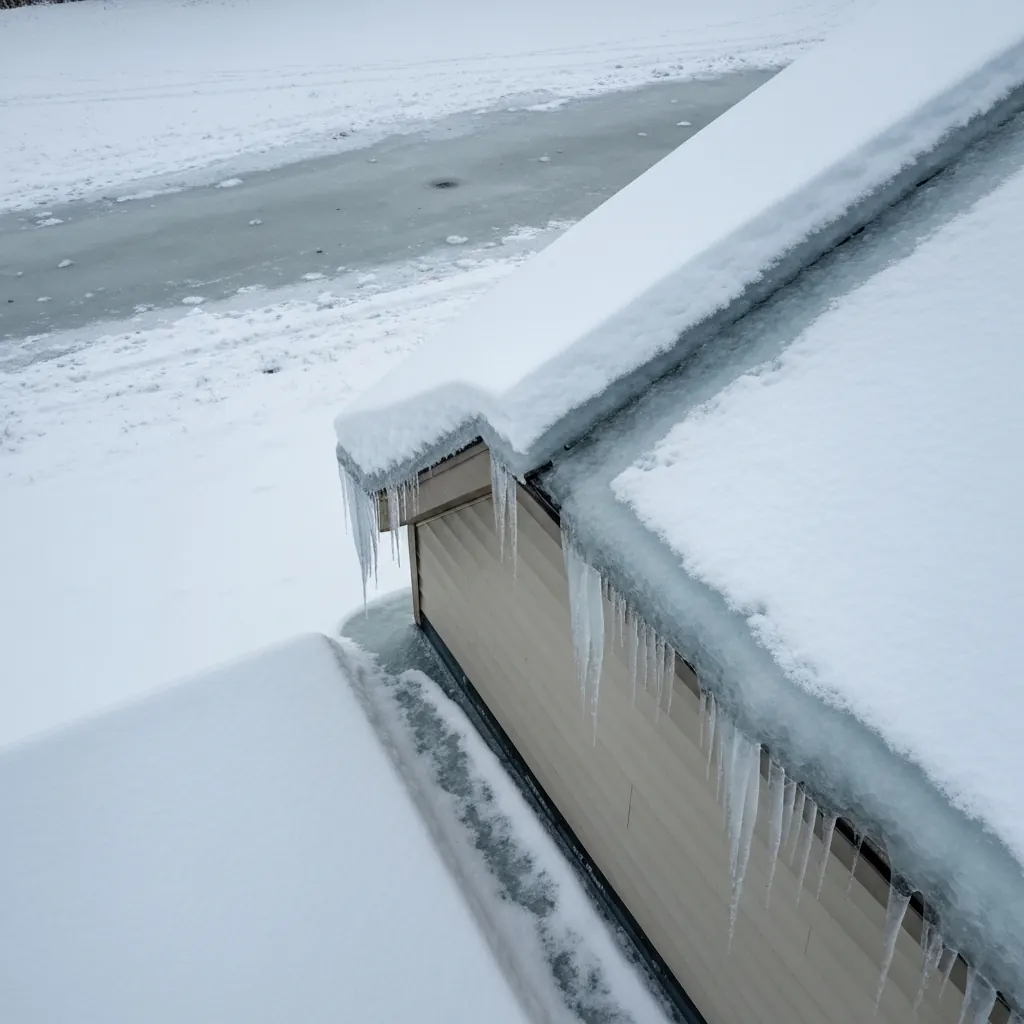
Ice dams form when heat escaping from the attic warms the upper roof. Snow there melts, runs down to the cold eaves and refreezes into a ridge of ice, and the next meltwater backs up behind it and under the shingles. Shingles shed water running downhill but can't stop water that pools and pushes upward, so it seeps into the soffits and inside the walls.
Salt, roof rakes and heat cables treat only the symptom. Real ice dam prevention happens in the attic, in this order: seal air leaks into the attic, add insulation (ENERGY STAR recommends bringing an uninsulated attic up to R-60 across most of the country), then make sure air can move from soffit to ridge. That work costs about $3,500 to $6,000 on a typical 1,500-square-foot house, often less than one winter of water damage.
Where ice dams are a known risk, code requires a backup. A self-adhering membrane, commonly called ice and water shield, goes down at the eaves and runs from the edge to at least 24 inches inside the exterior wall line. It keeps a backed-up ice dam out of the living space while the attic problems are fixed.
Moss does more harm than algae
Black streaks running down from the ridge are algae. They are mostly cosmetic, although a darker roof runs slightly warmer. Moss is more harmful: it grows in thick clumps that hold water against the shingles, and freeze-thaw cycles then lift the shingle edges. Lichen pits the surface. North-facing slopes and areas under large trees are affected first because they stay shady and damp.
Don't pressure wash a roof. The spray strips granules and can void the shingle warranty. The effective method is a low-pressure soft wash to kill the growth, a wait of a few weeks, then a gentle rinse or brushing. Crews usually charge about 30 to 90 cents a square foot, or roughly $600 to $1,800 on a 2,000-square-foot roof. Zinc or copper strips near the ridge prevent regrowth, because each rain washes a small amount of metal down the slope.
Roof moss and algae removal covers effective cleaning solutions, a do-it-yourself method and the point at which a roof is too far gone for cleaning to help.
Many slow leaks start at the roof edges
Some leaks take years to appear, and they often start at the roof edges. Kick-out flashing is frequently left out. This small bent piece sits at the bottom of a wall where the roof edge meets the siding, and without it water runs behind the siding and rots the sheathing and framing out of sight. Drip edge at the eaves directs water into the gutter so it doesn't curl back onto the fascia. Without it, fascia can rot in five to seven years, and replacement costs $6 to $12 a linear foot, plus removing and rehanging the gutters.
Gutters are not technically part of the roof, but when they fail the roof edge is damaged. A clogged gutter holds water against the fascia, feeds ice dams in winter and spills water at the foundation. Slope matters too: a gutter hung too flat holds water, which weighs 8.3 pounds a gallon. Gutter guards reduce leaf buildup but don't eliminate cleaning, and the gutter guards guide covers clearing clogs and matching a guard to the trees near your house.
Granule loss means shingles are wearing out
Every roof eventually wears out. The granules on an asphalt shingle act as its sunscreen, and once they wash off, ultraviolet light dries the asphalt until it curls, cracks and goes bald. A few granules in the gutters of a new roof are normal. An inch of granules five years in means the shingles are failing early, usually because of a defect or an attic that runs too hot.
The InterNACHI life expectancy chart puts 3-tab shingles at about 20 years, architectural shingles at about 30 and metal at 40 to 80. Climate, ventilation and installation quality move the real number up or down. How long does a roof last goes through each material and explains how to work out your roof's age from permits, closing documents and the shingles themselves.
Aging shows up in a consistent set of signs: curled edges, bald patches, granules in the gutters, missing shingles, daylight in the attic, a spongy deck and a leak that keeps coming back. The signs you need a new roof guide covers each one and how to check it without climbing onto the roof.
Standing water is the main flat roof problem
Flat and low-slope roofs work differently from shingled roofs. Instead of overlapping pieces, they use one continuous membrane, usually EPDM rubber, TPO or PVC. Standing water is their main problem. Water still present 48 hours after rain is called ponding: its weight sags the deck slightly, the sag holds more water and the seams wear out faster.
Most flat roofs leak at the seams. EPDM seams are glued or taped, and the adhesive dries out over time. TPO and PVC seams are heat-welded, which is much stronger when the weld is done correctly. Punctures are also common, especially where the roof serves as a walkway to HVAC equipment. Patching a hole is easy; finding it is difficult, because water on a flat roof can travel a long way before it shows on a ceiling. The flat roof guide covers membranes and drainage in more detail.
Early inspections keep repairs cheap
Nearly every problem above stays inexpensive if it is caught early. FEMA's guidance on sloped roofs says a roof "should be inspected at least twice per year, generally in the spring and fall," and again after high winds. Homeowners can do most of this themselves: use binoculars from the yard, then check the attic with a flashlight during heavy rain for damp rafters, wet spots on the deck and matted insulation.
A professional inspection goes further. The inspector walks the roof, checks the flashing, valleys and decking, inspects the attic and provides a photo report ranked by urgency, usually for $150 to $400 and in under two hours. The roof inspection checklist lists what the inspection should cover and how to read the report.
Routine maintenance keeps most problems small. Keep gutters and valleys clear, trim branches back six to ten feet, and fix minor issues such as dried sealant, lifted flashing or a missing shingle as soon as you find them. Most homeowners spend about $300 to $1,000 a year on upkeep, and regular roof maintenance breaks that work down by season.
An old, brittle roof usually needs replacing
The decision depends on the roof's age and how much of it is damaged. Damage in one area on a roof with plenty of life left should be repaired. A leak on a 20-year-old roof is different: the surrounding shingles are often brittle enough to snap when lifted, which makes it nearly impossible to weave in new flashing or shingles properly, and another weak spot is usually close behind.
Minor repairs usually cost $350 to $1,500. A full replacement with architectural shingles typically costs $450 to $750 a square installed, plus $100 to $150 a square for each old layer removed, which puts most average houses at about $10,000 to $25,000. Roof size drives most of that range, and the roofing calculator estimates your roof's size before anyone climbs up to measure.
The contractor matters more than the shingle brand. Before hiring, check for these.
- Insurance. Ask for proof of liability insurance and workers' compensation.
- Workmanship warranty. Get a written warranty of at least 5 to 10 years.
- New flashing. Every transition should get new metal, not reused flashing full of old nail holes.
- Lien waiver. Collect one with the final payment.
A premium shingle installed poorly will fail before a basic shingle installed correctly.
More roof problems & maintenance guides
Common roof problems questions
What is the most common roofing problem?
Leaks, by a wide margin. They rarely start in the middle of the shingles; they start at flashing, pipe boots, valleys and anything else that passes through the roof. A small leak can go unnoticed for months, until the ceiling stains or the deck turns soft underfoot.
What are the signs of a bad roof?
Curled, cracked or missing shingles are the most visible signs. Others include bald spots where granules have washed away, granules collecting in the gutter, a sagging roofline and water stains in the attic or on a ceiling. Daylight visible between the roof boards from inside the attic is a serious warning sign.
How often should a roof be inspected?
At least twice a year, according to FEMA, usually in spring and fall, plus once after any major windstorm. Homeowners can do most of it themselves, using binoculars from the yard and a flashlight in the attic during heavy rain.
Will insurance pay for roof problems?
Only when sudden, covered damage occurs, usually from wind, hail, fire or a falling tree. Standard policies exclude age, moss, rot and lack of maintenance. Older roofs are often paid at actual cash value, which deducts depreciation first.
Is it better to repair or replace a roof?
Repair one damaged area on a roof with years of life left. Replace the roof if it is near the end of its expected life, leaks keep returning or damage covers a large part of the surface, since replacement is then usually the better use of your money.
Prices are 2026 US national averages and building codes vary by town. Materials, warranties and code adoptions change, so confirm prices with local contractors and code rules with your building department before you sign anything.
Estimate Your Roof Cost
Use our free roofing calculator. No sign-up required.