 RoofingCalculator.io
How Long Does a Roof Last?
By RoofingCalculator.io. Updated October 14, 2026. Prices, ratings and code references link to their sources.
Pricing your own roof? Get squares, materials and a 2026 cost range in about two minutes. Free, no sign-up.
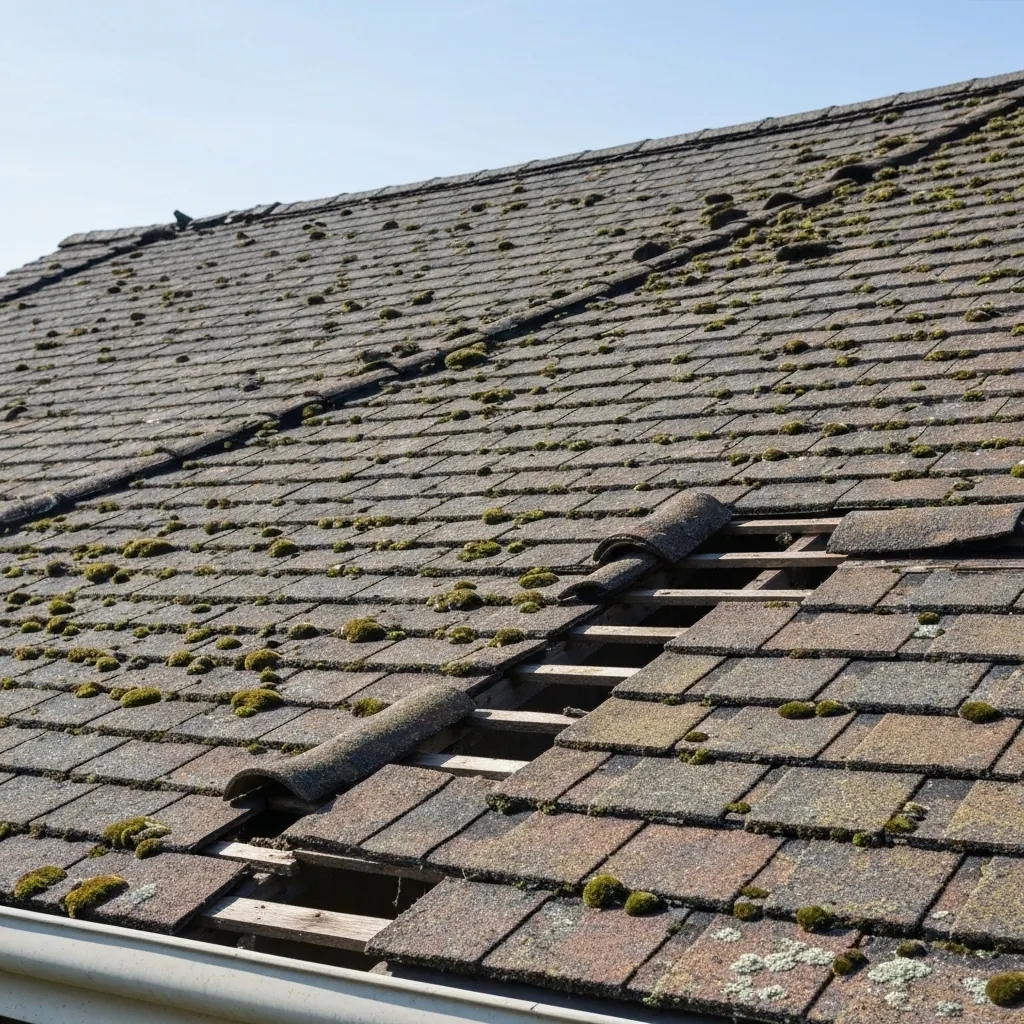
A roof lasts anywhere from about 15 years to well over 100, depending mostly on the material. The InterNACHI life expectancy chart gives 3-tab asphalt shingles about 20 years, architectural shingles 30, metal 40 to 80, and slate 60 to 150. Climate, attic ventilation and installation quality then raise each figure a little or lower it a lot.
Four points cover most of what decides a roof's real lifespan.
- Material sets the range. Asphalt sits at the low end, metal and tile in the middle, and slate and copper at the top.
- Climate and ventilation move it. Heat, wind, salt air and a hot attic all take years off.
- Installation decides whether you reach it. Poor installation is the top reason roofs fail early.
- Age affects insurance. Older roofs can lose replacement cost coverage, so know your roof's install date.
| Roof type | Typical lifespan | Installed cost per sq ft |
|---|---|---|
| 3-tab asphalt | 15 to 20 years | $3.80 to $5.50 |
| Architectural asphalt | 25 to 30 years | $4.50 to $7.50 |
| Premium asphalt | Up to 30 to 35 years | $8 to $12 |
| Exposed fastener metal | 20 to 30 years | $6 to $10 |
| Standing seam metal | 50 to 80 years | $10 to $16 |
| Copper | 100+ years | Over $30 |
| Clay tile | 50 to 100 years | $10 to $25 |
| Concrete tile | 30 to 50 years | $9 to $16 |
| Natural slate | 75 to 150 years (high grade) | $15 to $35 |
| Synthetic slate | About 50 years (maker claims) | $9 to $18 |
| Cedar shake | 20 to 30 years | $9 to $14 |
| Flat roofs (EPDM, TPO, mod bit) | 12 to 30 years | $5 to $14.50 |
Real roof life often falls short of the warranty
Real roof life often falls short of the warranty. The same shingle might last 25 years in a mild climate and fail at 14 on the humid, sunny Gulf Coast. A 30-year warranty is worth less than it sounds: if a factory defect causes the failure, the manufacturer pays a prorated amount, and nothing more.
A roof is also failing before it drips. Once the surface turns brittle, cracks or loses its seal, it can no longer reliably shed water or resist wind. The time to replace it is when patching costs more than the remaining years are worth, and knowing how each material wears out lets you estimate that date closely.
Asphalt shingles last 15 to 35 years
Asphalt shingles last about 15 to 35 years, depending on the grade, and they cover most roofs in the country because they are cheap and quick to install. Each shingle is a fiberglass mat soaked in asphalt, with ceramic granules on top that shield it from the sun. Rain washes the granules off over the years, the sun bakes the oils out of the asphalt, and the shingle shrinks, curls and cracks.
- Three-tab shingles last 15 to 20 years. They are a single thin layer cut to look like three pieces, and in stormy areas the adhesive strips let go and tabs blow off early. They cost about $3.80 to $5.50 a square foot installed ($380 to $550 a square).
- Architectural shingles last 25 to 30 years. Also called dimensional shingles, they are two bonded layers that hold up better in wind and sun. They cost roughly $4.50 to $7.50 a square foot installed ($450 to $750 a square) and carry 30-year or lifetime limited warranties.
- Premium or luxury shingles last up to 30 to 35 years. They are thicker and heavier, made to resemble slate or wood shake, and cost $8 to $12 a square foot.
Every asphalt roof eventually fails from thermal shock. Hot afternoons and cold nights make the shingle swell and shrink thousands of times until the fiberglass mat tears.
Metal roof life depends on the type of panel
Metal roofs outlast asphalt, but not forever, and the type of metal roof changes the answer considerably.
Exposed fastener (screw-down) panels usually last 20 to 30 years and cost around $6 to $10 a square foot. The corrugated panels themselves could last 50 years. The weak point is the EPDM rubber washer under each of the thousands of screws, which dries out and cracks within about 15 years. To prevent leaks, every screw needs replacing every 10 to 15 years.
Standing seam panels lock together at a raised rib with the fasteners hidden underneath, which lets the metal expand and contract freely. With 24-gauge steel and a Kynar 500 or Hylar 5000 paint finish, standing seam lasts 50 to 80 years and has excellent wind and fire ratings. It costs about $10 to $16 a square foot.
Near salt water, aluminum is the better choice because salt spray does not rust it the way it rusts steel, and it lasts 50 years or more. Copper can last more than 100 years, with its green patina protecting the metal underneath, but at over $30 a square foot few homeowners choose it.
How long does a tile roof last?
Clay tile lasts 50 to 100 years and concrete tile 30 to 50, which is why tile is common in the Southwest and Florida. Tile handles heat, sheds heavy rain quickly and lasts a long time, but it has one weak point that many owners do not know about.
Clay is fired earth. Insects and rot do not affect it, and the color runs all the way through, so it does not fade. Concrete tile, made of Portland cement, sand and water, is cheaper and more porous than clay, so over time it can absorb water or, near the coast, develop salt crystals.
The weak point is the underlayment, not the tile. Tile sheds water but is not waterproof, so some water always gets underneath, and the asphalt felt on many older tile roofs lasts only 20 to 25 years. When it fails, the roof leaks even though every tile is intact. The fix is to remove all the tile, install a new waterproof membrane and relay the same tile, which is expensive. Clay installs cost $10 to $25 a square foot, and concrete about $9 to $16.
How long does a slate roof last?
High-grade natural slate, such as S-1 slate from Vermont or parts of Virginia, realistically lasts 75 to 150 years. Slate is quarried stone split into thin pieces, and some buildings in Europe still wear slate roofs that are centuries old.
Fire, mold and insects do not affect slate, but walking on it cracks the stones. It is the heaviest roofing material, so the framing often needs reinforcement first. Softer slate from certain quarries can begin flaking and splitting after 30 to 50 years. Natural slate costs $15 to $35 a square foot.
Synthetic slate is molded polymer or rubber made to look like stone at a fraction of the weight. It has not been around long enough for long-term data, and manufacturers mostly claim about 50 years. It resists hail well, which makes it popular in hail country, and costs $9 to $18 a square foot.
Cedar shakes last 20 to 30 years with care
A well-maintained cedar shake roof lasts 20 to 30 years, but wood needs more care than any other roof here. Shingles are machine-sawn and smooth, shakes are hand-split and rough, and most of both are Western Red Cedar, whose natural oils resist rot.
In damp, shady locations, moss and lichen settle into the joints and hold water, which can rot the wood in as little as 15 years. In very dry climates, wood warps and splits. Preservative and fire-retardant treatments extend its life but wear off and must be reapplied.
Wood also needs an air gap behind the shakes so the back can dry, or it stays wet and decays quickly. Cedar costs about $9 to $14 a square foot. Some wildfire-prone areas prohibit wood unless it is treated to a Class A or Class B fire rating.
How long does a flat roof last?
Flat and low-slope roofs last about 12 to 30 years, less than sloped roofs, because water sits on them instead of running off. The whole roof depends on one continuous waterproof membrane. Flat roofs cost about $5 to $14.50 a square foot, depending on the material and the number of pipes, vents and curbs that pass through.
- EPDM lasts 20 to 30 years. EPDM (Ethylene Propylene Diene Monomer) is a tough synthetic rubber that handles sun well. Its glued or taped seams are the weak point and eventually dry out and peel, and its usual black color absorbs heat and can raise cooling bills.
- TPO lasts 15 to 20 years. TPO (Thermoplastic Polyolefin) is the white, reflective membrane. Its seams are heat-welded and end up stronger than the sheet. Early versions cracked under strong sun, but current products have largely fixed that.
- Modified bitumen lasts 12 to 20 years. Descended from tar-and-gravel built-up roofing, it uses two or three plies of asphalt reinforced with polyester or fiberglass. It handles foot traffic well but blisters if moisture is trapped between layers during installation.
Climate matters about as much as material
Climate matters about as much as material. Heat is the first factor: a dark roof in a sunny location can reach 160 degrees Fahrenheit, which drives oils out of asphalt faster and weakens the bonds in single-ply membranes.
Wind is the second. Repeated gusts vibrate shingles until the seal strip breaks, and then a strong gust lifts and creases the mat, leaving it ready to tear. Near the ocean, salt air rusts steel roofs quickly and can make some stone products spall or flake.
Growth on the roof is the third. Algae, the black streaks on asphalt, is mostly cosmetic. Moss is not: it pushes roots into shingles and under tiles, keeps the surface damp and eventually rots the deck. Overhanging trees make it worse with shade and wet leaves.
Poor attic ventilation takes years off a roof
A poorly ventilated attic can take years off a shingle roof without anyone noticing. In summer, heat builds up in the attic, cannot escape through ridge or gable vents, and cooks the shingles from below while the sun heats them from above. The result is brittle shingles and early granule loss.
In cold climates, poor ventilation causes ice dams. Warm air from the house melts snow on the roof, the water runs down to the cold eaves and freezes into a ridge of ice, and later meltwater backs up behind it and under the shingles, slowly rotting the fascia, soffit and deck. ENERGY STAR says winter airflow through a vented attic "helps keep it cold, which reduces the potential for ice damming." The goal is balance: intake at the soffits, exhaust at the ridge or static vents, and steady airflow that keeps the deck near the outdoor temperature.
A reroofing permit is the fastest way to date a roof
The fastest way to date a roof is a reroofing permit, which shows the date and the contractor who filed it. Many cities and counties let you search permits online by street address. If yours does not, a clerk at the building department can pull the permit history for your parcel.
The permit file often shows the scope of work too, including whether it was a full tear-off or a second layer over the first. A second layer tends to wear out sooner, because it holds heat and the new shingles cannot always lie flat and seal. If your town does not require roofing permits, check property tax assessment records, where a major improvement that raised the assessed value may appear.
Your closing documents are the next source. The seller's disclosure should list the roof's age, though it may be a guess if the seller did not hire the roofer. The home inspection report is more reliable: if a five-year-old report put the roof at about ten years, it is now around fifteen. If you find a roofing company's name, call it, since established companies often keep job records for ten to twenty years, including the install date, shingle line and warranty.
The neighborhood can also help. Subdivisions are usually built at once with the same shingles, so the original roofs age and fail together. Dumpsters in several driveways suggest those roofs are reaching 20 or 25 years, and yours may be close behind. A roofing inspector ($200 to $600) can narrow it further by finding a production date or batch code printed on the back of some shingles, counting layers at the gable ends, or cutting a small core sample. Old 15-pound felt underneath usually indicates an older install, since synthetic underlayment has been common for the past couple of decades.
An older roof can limit your insurance coverage
Some insurers will not write a new policy on an asphalt roof older than about 20 years. Others will, but only with Actual Cash Value (ACV) coverage instead of Replacement Cost Value (RCV), and ACV subtracts depreciation before it pays. If a storm damages a 20-year-old roof, the check might cover 20 percent of a new one, or $3,000 on a $15,000 replacement. Some carriers now review roofs from aerial photos, and visible wear or patches can lead to a non-renewal notice.
Documentation helps. Some insurers, especially in Florida, ask for a roof certification on older roofs, which is an inspector's written estimate of the remaining life. Florida has also long had a "25 percent rule" that can require a whole roof section to be replaced once more than a quarter of it needs repair, with exceptions for newer code-compliant roofs.
When buying a house, treat "new roof" in a listing with caution, because the phrase has no legal definition. It might mean five years old, recently repaired or recently coated. Coatings can stop leaks on flat and metal roofs, but they do not reset the roof's age. Sellers sometimes lay new shingles over old ones to avoid roughly $2,000 to $3,000 in tear-off and disposal on an average house, so run the permit search anyway.
Check the roof from the ground twice a year
Inspect the roof from the ground with binoculars twice a year. That matches FEMA's guidance of a spring check, a fall check and a look after high winds.
- Bald spots and granules. On asphalt, look for patches where granules have washed off and dark, sandy grit in the gutters and at the downspouts. Bald spots usually appear around year 12 to 18, or 20 to 25 on thicker architectural shingles. Shiny, smooth shingles show bare asphalt and are close to the end.
- Brittle or cracked shingles. Gently lift a shingle edge. A young shingle flexes, while an old one feels like dry cardboard and may crack. Long straight cracks across the face usually come from years of heating and cooling (thermal splitting), not hail.
- Curling or cupping. Curled edges mean the mat is shrinking with age.
- Metal and tile problems. On metal, check for loose screws or rust along the seams. On tile, look for cracked or slipped pieces with underlayment showing.
- Sagging. Any sag in the roofline points to a structural or deck problem and needs a professional right away.
Then check inside for stains on ceilings and walls, and in the attic for streaks on the underside of the deck and damp insulation. By the time a leak shows on a ceiling, it has usually soaked the insulation and started on the plywood. Caught early, a leak is a repair; caught late, it can mean a new roof.
Questions to ask your roofer
A roof reaches its expected life only if it is installed correctly, and poor installation is the top reason roofs fail early. Ask specific questions and listen to how the contractor answers.
- How many nails per shingle? Standard asphalt work uses four nails per shingle, and high-wind areas need six. Nails should be used, not staples, which do not hold up to years of wind.
- How will you build the valleys? An open metal valley usually outlasts a closed-cut shingle valley because it flushes water and debris better.
- What underlayment will you use? Old 15-pound felt works, but synthetic is tougher and tears less. For metal or tile, ask for high-temperature ice and water shield by name, because standard rubberized asphalt can melt and stick to the underside of metal panels, making later repairs very difficult.
- How will you ventilate the attic? The roofer should calculate the Net Free Area (NFA) of your intake and exhaust vents. Ridge exhaust must match eave intake, or the vents can pull rain or snow into the attic.
- Will you replace the flashing? Most leaks start at transitions such as chimneys, skylights and wall-to-roof joints. A new roof needs new flashing, and a good contractor weaves step flashing into the siding or masonry instead of relying on caulk.
The cheapest roof to install isn't the cheapest to own
The cheapest roof to install is not the cheapest to own. Asphalt costs the least up front and the most over time, since you would replace it three or four times in a century. Standing seam or clay tile costs more at the start, but spread over 50 to 80 years, the yearly cost is much lower.
The same math decides repairs on an old roof. A $12,000 asphalt roof that lasts 20 years costs $600 a year, so a $1,200 repair that buys only one more year costs twice as much as replacement. On a five-year-old roof, a leak usually has a single cause, such as a backed-out nail or a cracked pipe boot, and a $300 to $800 fix is money well spent.
To run your own numbers, enter the roof's length, width and pitch into the roofing calculator to get squares, then multiply by each material's price per square. If you plan to stay 30 years or longer, metal or synthetic slate makes financial sense. If you plan to sell in 5 to 10 years, architectural asphalt gives the best return, though a premium roof often adds to the sale price and lowers yearly upkeep.
A roof lasts only as long as all its parts work together: the deck, underlayment, ventilation and surface, chosen for your climate and installed carefully. Judge materials by how they actually wear, not by the brochure.
Roof lifespan questions
How long does a shingle roof last?
A shingle roof lasts about 20 to 30 years. InterNACHI's chart gives roughly 20 years for 3-tab and 30 for architectural shingles. Strong sun and a poorly ventilated attic both shorten that.
What roof lasts the longest?
Slate, clay tile and copper last longest when installed correctly, and all three can reach a century. Among the materials most homeowners actually price, standing seam metal lasts longest, commonly 50 years or more.
How do I know when my roof needs replacing?
Look for widespread curled or cracked shingles, bald spots, granules piling up in the gutters, a sagging ridge or a leak that keeps coming back. Then compare the roof's age with the normal lifespan of its material.
How can I find out how old my roof is?
Start with the building department and look for a reroofing permit, which shows the date and the contractor's name. If there is none on file, check your closing papers and inspection report, contact the previous owner or roofer, or hire an inspector to estimate the age.
Does roof age affect homeowners insurance?
Yes, and more each year. Some insurers will not write a new policy on an older asphalt roof, some require an inspection or roof certification first, and some move older roofs to actual cash value coverage, which pays less after depreciation.
Can you extend the life of a roof?
Yes, through routine maintenance. Ventilate the attic properly, clean the gutters, repair flashing and pipe boots as soon as they fail, and keep branches and moss off the roof.
Prices are 2026 US national averages and building codes vary by town. Materials, warranties and code adoptions change, so confirm prices with local contractors and code rules with your building department before you sign anything.
Estimate Your Roof Cost
Use our free roofing calculator. No sign-up required.