 RoofingCalculator.io
How to Find a Roof Leak
By RoofingCalculator.io. Updated October 14, 2026. Prices, ratings and code references link to their sources.
Pricing your own roof? Get squares, materials and a 2026 cost range in about two minutes. Free, no sign-up.
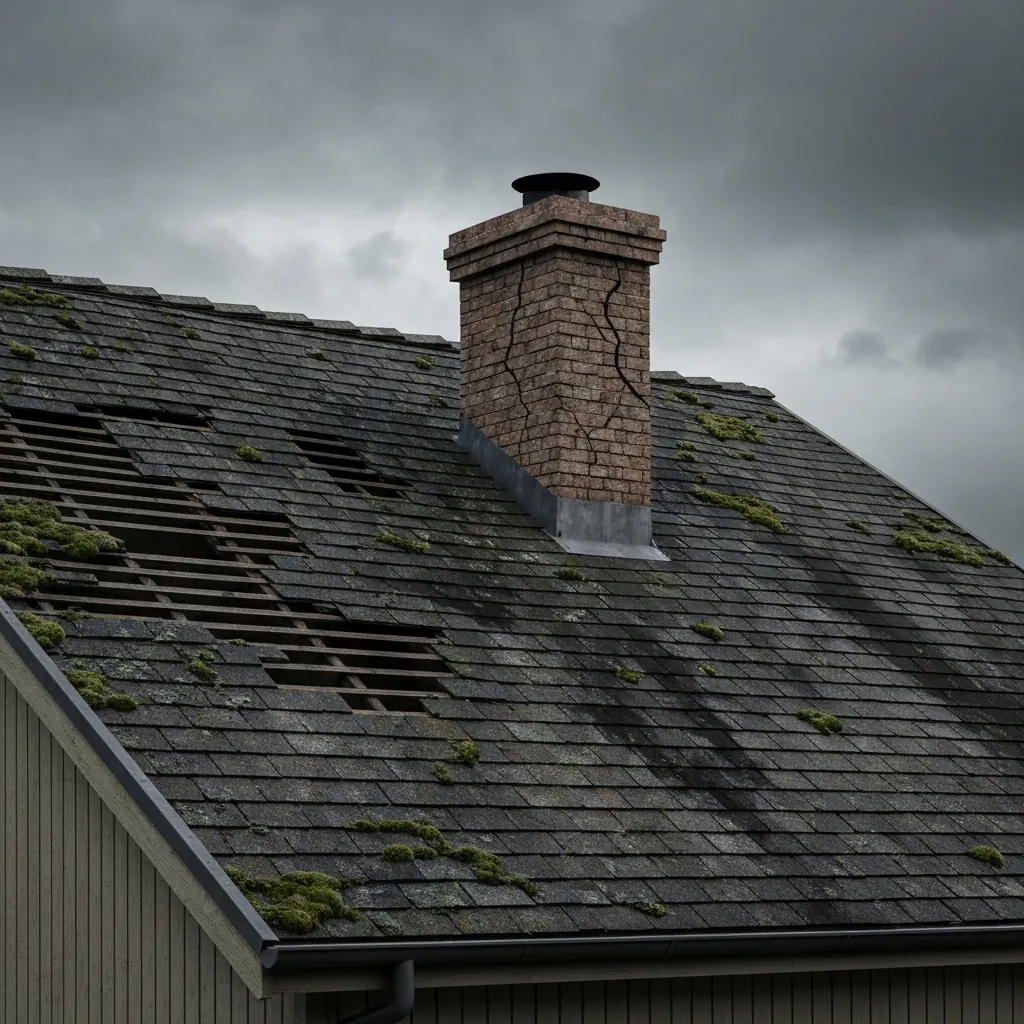
To find a roof leak, start at the ceiling stain, then go into the attic and follow the wet wood uphill, rafter by rafter and sheet by sheet, until you reach the point where water gets through. The source is usually a penetration or a transition, such as a cracked pipe boot, chimney flashing or a valley. The hole is often several feet upslope from the stain.
Finding most leaks takes four steps.
- Inspect the attic on a dry day. Trace stains, wet insulation and rusty nails from the drip point toward the ridge.
- Rule out condensation, ice dams and gutters. Frosted nails, winter-only leaks and overflowing gutters can all look like roof leaks.
- Check the common leak points. Pipe boots, vents, skylights, valleys and wall and chimney flashing cause most leaks.
- Run a hose test if the source is still hidden. Two people work from the bottom of the roof up until water appears inside.
Leaks are rarely right above the stain
Water under the shingles rarely falls straight down. Surface tension holds it to the underside of the plywood, and it travels down a rafter or across a ceiling joist before it drips onto the drywall. Roofers call this tracking, and it is how a stain over a bedroom closet can trace back to a pipe boot halfway up the roof.
Roof slope determines how far water travels. On a steep roof it can travel a long way. On a low-slope or flat roof, water mostly pools and soaks straight down, so the hole is closer to the stain. In either case, work backward from the drip to the hole rather than guessing where the leak should be.
Start in the attic and trace the wet wood uphill
Inspect the attic on a clear day with a bright flashlight. Position yourself over the stain, then move slowly toward the ridge while watching the underside of the sheathing. Look for dark rings, streaks and gray-edged stains on the plywood or OSB. Fresh stains look damp and darker than the surrounding wood, while old ones are dry with a crusty edge.
Check the insulation as you go. Wet fiberglass batts look flat and lumpy, and loose-fill insulation develops small craters where a drip keeps landing. When you find a crater, shine the light straight up to the nearest rafter or sheet of decking and continue uphill from there. A wet streak can disappear for a foot or two and reappear, so check both sides of each rafter before deciding the trail has ended. Take photos along the way to show the roofer.
Condensation on shiners can mimic a leak. Shiners are roofing nails that missed the framing and poke through the deck into the attic. On cold nights, warm, moist air from the house condenses and freezes on them, and when the attic warms the next day, the frost melts and drips. Rusty nail tips or a neat row of drip marks below them point to a ventilation or air sealing problem, not a hole in the roof.
How do you do a hose test for a roof leak?
A hose test takes two people working from the bottom of the roof up, and it often finds a leak the attic inspection missed. One person works on the roof with a garden hose while the other watches from the attic with a flashlight and a phone, and the two stay in contact throughout. Use normal garden hose flow, never a jet nozzle, and test only a roof you can walk safely, with dry shingles and fall protection. If that is not possible, hire a professional.
- Start low. Begin just above the gutter below the suspect area. Spraying high first sends water over every possible leak at once and tells you nothing.
- Soak one section at a time. Run water on a single section for several minutes, longer if needed, while the spotter watches the decking and rafters for the first sign of water.
- Work upward in stages. Move up one feature at a time: open shingles, then the pipe boot, the side of the chimney and the valley.
- Mark the spot. When the spotter sees water, stop and mark that area of the roof with chalk. That is where the repair belongs.
Most leaks start at pipe boots, vents, valleys and flashing
Roofs usually leak where something passes through them, rarely in the open field of shingles. Plumbing vent boots are near the top of the list. The rubber collar around the pipe sits in the sun for ten or fifteen years until it cracks or pulls loose, and water then runs down the outside of the pipe into the house.
Roof vents fail in similar ways. Plastic box vents crack from hail or UV exposure, and the nails through their flanges can back out and lift the shingle above. Ridge vents leak at exposed nail heads once the sealant wears off. Skylights usually leak at the flashing kit, or when clogged condensation channels spill onto the drywall, and caulk around the frame is at best a one-season fix.
Valleys carry more water than any other part of the roof. In an open metal valley, leaves pile up, dam the flow and push water sideways under the shingles. A closed-cut valley can leak where the shingles bridge across the valley instead of lying flat.
Walls and chimneys are the next most common sources. Where a roof meets a sidewall, the code-approved detail is step flashing woven into every shingle course, with a kickout flashing at the bottom. InterNACHI notes that a missing kickout flashing "often results in concentrated areas of water accumulation" and damage to the wall below. Chimneys have counter-flashing set into the mortar joints, so when the mortar deteriorates, water gets behind the metal. The guide to roof flashing covers each detail.
A winter-only leak is probably an ice dam
A leak in January after weeks without rain is probably an ice dam. Heat escaping into the attic melts snow high on the roof, the meltwater runs down to the cold eaves and freezes into a ridge of ice, and later meltwater backs up behind it. Shingles shed moving water well, but standing water works its way up under the laps.
InterNACHI explains that "as water backs up behind the dam, it can leak through the roof" and damage walls, ceilings and insulation. Large icicles along the eaves and stains high on exterior walls are the usual signs. The lasting fix is more attic insulation and better air sealing, followed by an ice barrier at the eaves at the next roof replacement.
Condensation can also look like a winter leak. Damp decking over a wide area, frost on every nail and no single drip line point to an attic that needs more ventilation, not a damaged roof.
Clogged gutters can pass for a roof leak
Sometimes the source of a "roof leak" is the gutters. Clogged gutters back water up under the first course of shingles, especially where the overhang is short. Soft fascia and stains on the soffit directly behind the gutter indicate a drainage problem rather than a roof problem.
Check the drip edge while you are on the ladder. It should lap over the back of the gutter so water falls into the trough. If it was tucked behind the gutter instead, water runs down the fascia and into the soffit, which from inside the house looks like a roof leak at the wall line.
Flat roofs leak at seams, corners and parapets
Flat and low-slope roofs made of EPDM, TPO or modified bitumen fail in different places than shingle roofs: at seams, inside and outside corners and the base of parapet walls. Standing water on these roofs will find even a very small pinhole.
Look for blisters, curling seam edges, punctures and, on older bitumen, an overall cracked "alligator" pattern. Check the coping on parapet walls and the seals around drains and scuppers. On a flat roof, the interior stain is usually close to the entry point, so start directly above it.
How much does a roof leak inspection cost?
A roofer's leak inspection usually costs a few hundred dollars, covering a roof walk, an attic check and photos, and many companies credit the fee if you hire them for the repair. Infrared scans and moisture-meter surveys cost more, but they can map wet insulation and decking without cutting into the ceiling.
| Repair | Typical cost |
|---|---|
| Cracked pipe boot or a few shingles | About $350 to $600 |
| Valley or chimney flashing | About $700 to $1,800 |
| Rotted decking or framing | Can exceed $3,000 |
If an old roof has several leaks, the roofing calculator prices a full replacement by the square, which helps when repeated repairs start to look like poor value.
Ask the roofer whether they will replace the boot or flashing or only cover it with roof cement. Mastic is a temporary fix that looks fine for a season or two, then dries, shrinks and peels away. A proper repair lifts the shingles, installs new metal or a new boot, and comes with a written warranty and before-and-after photos.
Ignored leaks lead to rot, mold and ceiling damage
Small leaks grow. Each soaking weakens the glue in plywood and the strands in OSB, and the deck slowly delaminates and sags. A roof that feels spongy underfoot has usually been wet for a long time.
Inside, wet insulation loses much of its R-value, drywall stains and sags, and mold can grow in damp insulation and framing within a few days. Water near light fixtures and junction boxes also creates an electrical hazard, so if a stain is spreading around a ceiling light, turn off that circuit until it has been inspected. Finding the leak now costs little compared with repairing rot, mold and a ceiling next year.
How to find a roof leak questions
How do I find where my roof is leaking from?
Use the ceiling stain as a starting point, then trace the leak in the attic. On a dry day, take a bright flashlight and follow the dark wood, wet insulation and rusty nails uphill. If that does not find it, run a hose test from the bottom up with someone watching inside.
Can a roof leak be far from the water stain?
Yes, sometimes several feet away. Water runs along the underside of the decking or down a rafter before it drips, so the actual hole can be well uphill. Low-slope roofs are the exception, since there is little slope for water to follow, so look nearly straight above the stain.
What is the most common cause of a roof leak?
Penetrations and transitions cause most roof leaks. Typical culprits are cracked rubber pipe boots, worn step or chimney flashing and valleys clogged with leaves. Missing or wind-lifted shingles come next, usually noticed after a storm.
Why does my roof only leak in heavy rain?
Heavy or wind-driven rain pushes water where light rain never reaches. It forces water under shingle laps, through flashing gaps, past lifted shingles and over the edge of a full valley. Spraying the suspect area from the direction the storm came from can sometimes reproduce the leak.
Can a professional find a roof leak with a thermal camera?
Often, yes. Wet insulation and decking hold heat differently from dry material, and an infrared camera detects that difference without cutting into drywall. It works best on an evening after a sunny day or just after rain, with a moisture meter to confirm.
Prices are 2026 US national averages and building codes vary by town. Materials, warranties and code adoptions change, so confirm prices with local contractors and code rules with your building department before you sign anything.
Estimate Your Roof Cost
Use our free roofing calculator. No sign-up required.