 RoofingCalculator.io
What Is Roof Flashing?
By RoofingCalculator.io. Updated October 14, 2026. Prices, ratings and code references link to their sources.
Pricing your own roof? Get squares, materials and a 2026 cost range in about two minutes. Free, no sign-up.
Roof flashing is the bent metal, usually aluminum, galvanized steel or copper, installed wherever a roof meets a wall, chimney, vent pipe or valley. Shingles shed water well on an open slope but cannot seal those transitions, so flashing laps over and under them to steer water back onto the roof. The International Residential Code sets a minimum thickness of 0.019 inch for metal flashing, the same as No. 26 galvanized sheet.
Four points cover what most homeowners need to know.
- Flashing works by overlap, not caulk. Each upper piece laps over the lower one so water never runs into a seam.
- Different spots need different flashing. Step, counter, valley, drip edge, pipe boot, apron and kick-out flashing each have a specific job.
- The metal sets the lifespan. Galvanized steel lasts 15 to 20 years, aluminum 20 to 30, and copper 70 or more.
- Replace it with every new roof. Reused flashing is one of the most common causes of leaks on a reroof.
How does roof flashing work?
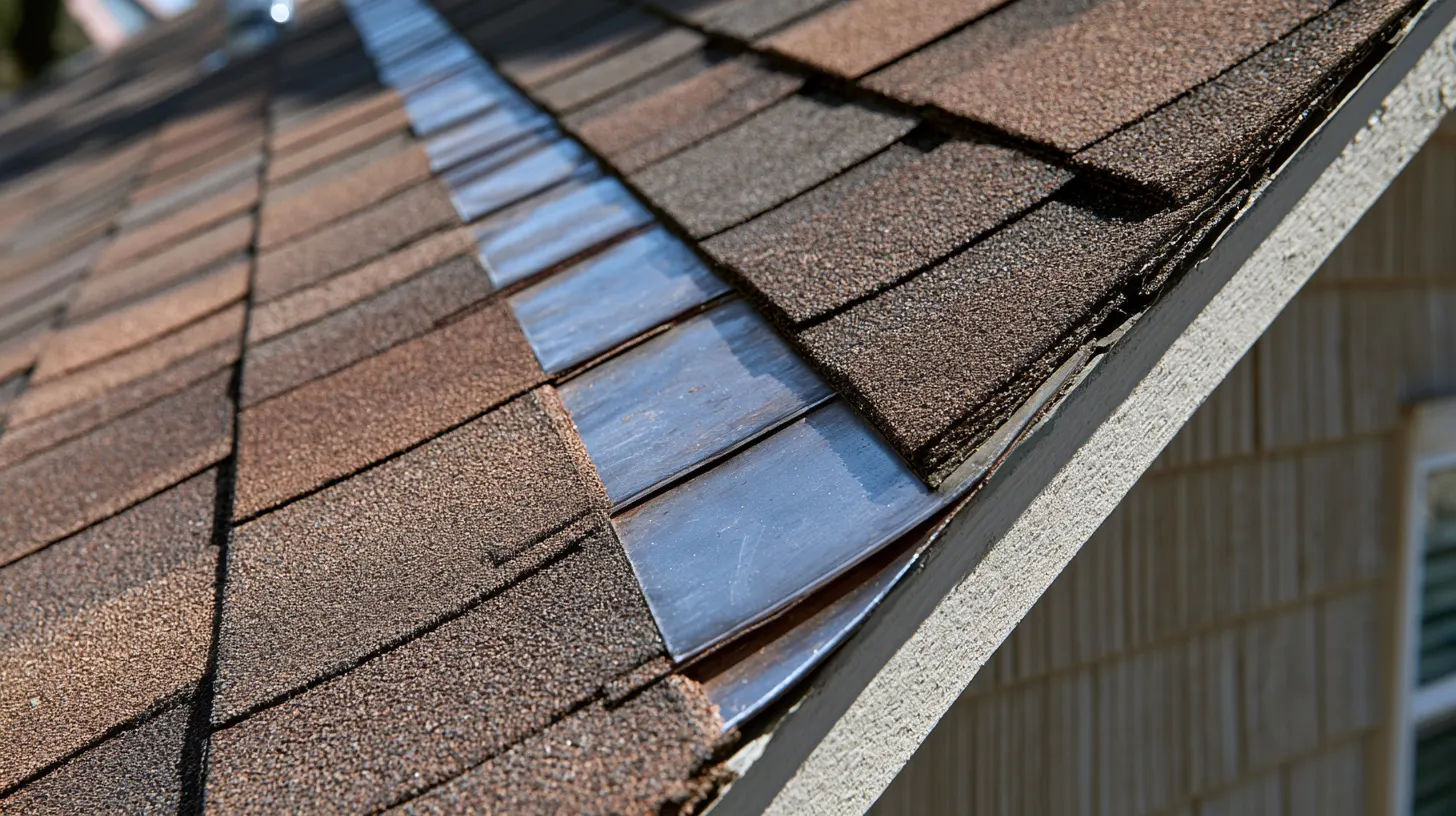
Flashing follows the same rule as shingles: the upper piece always laps over the lower piece, so gravity carries water across the surface and never into a seam. The metal tucks under the shingle course above and lies on top of the course below. If water gets behind a shingle, it hits the metal and is directed back out.
Consider a two-story house with a one-story garage attached to the side. In a hard rain, the water running down the garage roof beside the tall wall wants to enter the joint between shingles and siding. Without flashing, surface tension and wind pull it into that gap, then into the sheathing and wall framing, slowly over years, until a stain appears on a ceiling. That is why leaks start at transitions and rarely in the middle of a shingled slope.
Good flashing stays watertight because of how the pieces overlap. Sealant has a small role at the top edge of a few details, but a joint that depends on caulk alone will leak after the first hot summer.
Types of roof flashing
Step flashing is the most common type. Wherever a sloped roof runs along a wall, such as a dormer or second-story wall, it uses a series of small L-shaped pieces, at least 4 inches by 4 inches under the IRC, with one woven into each shingle course. Because each piece moves independently, step flashing handles seasonal expansion far better than one long strip of L-metal, which tends to buckle and open gaps.
Masonry walls and chimneys get a second layer called counter-flashing. A roofer cuts a groove into a mortar joint (a reglet), inserts the bent top edge of the metal, and lets the bottom hang over the step flashing so water running down the brick flows past the joint. The shortcut, metal caulked flat to the brick face, has to be redone every few years.
Valleys, the inside corners where two roof planes meet, carry more water than any other part of the roof. Open valleys use an exposed W-shaped metal channel at least 24 inches wide, and the raised center keeps water from one slope from running up under the shingles on the other. Closed valleys hide the metal or membrane under woven or cut shingles, which looks tidier but traps more grit and pine needles.
Several other types complete the system:
- Drip edge runs along the eaves and rakes. It keeps water off the fascia and goes under the underlayment at the eaves and over it on the rakes.
- Pipe boots seal plumbing vents. They use either a metal or plastic base with a rubber collar, or a lead sleeve folded over the top of the pipe.
- Apron flashing covers the downhill face of a chimney or wall. It laps over the shingles below.
- Kick-out flashing protects siding. It sits where a roof edge ends against a wall, and is covered in its own section below.
A chimney needs several flashing pieces working together
A chimney needs several pieces working together. The apron wraps the front and laps over the shingles, step flashing runs up each side one course at a time, and counter-flashing set into the mortar covers the steps. A backer or saddle seals the uphill side.
The uphill side takes the most abuse, because a chimney acts like a small dam where rain, snowmelt and leaves collect. The IRC requires a cricket (a small peaked, framed diverter) on the ridge side of any chimney wider than 30 inches, and the roof cricket guide explains how one is framed and flashed. A narrower chimney without a cricket still needs a generous backer flashing that runs well up the slope.
If a chimney leaks, check the counter-flashing first. Cracked mortar, an opened reglet joint and counter-flashing that is only caulked to the brick are the usual causes, and all cost less to fix than the step flashing underneath.
Leaving out kick-out flashing is expensive
Kick-out flashing is often left out, and the omission is expensive. At the bottom of a roof-to-wall joint, where the roof edge meets the gutter, a small piece of metal bent outward should direct the water coming down the step flashing into the gutter instead of down the siding. InterNACHI warns that a missing kick-out often leads to "potentially severe damage to exterior walls."
The damage is hidden. Water soaks the sheathing and framing behind the siding for years before any stain appears inside. The IRC now requires a diverter wherever the eave of a sloped roof meets a sidewall, so on an older house, add one during any roofing or siding job. The part costs a few dollars, while the wall repair can run into the thousands.
Aluminum is the everyday flashing metal
| Metal | Typical life | Notes |
|---|---|---|
| Galvanized steel | 15 to 20 years | Inexpensive and stiff; shorter life near salt water |
| Aluminum | 20 to 30 years | Most common on houses; rust-free and easy to bend |
| Copper | 70 years or more | Soldered joints; standard on slate and tile |
Aluminum is the everyday choice on houses. It does not rust, bends easily on a brake and often comes prepainted to match the trim. It needs a coating or barrier against fresh mortar or pressure-treated lumber, both of which can corrode it. Thicknesses range from 0.019 to 0.032 inch, and 0.024 inch is a sensible minimum.
Galvanized steel costs less and is stiffer, which helps in high wind. Look for G90 coating, meaning 0.90 ounce of zinc per square foot; lighter coatings rust sooner. As the zinc wears off, rust streaks appear, followed by pinholes.
Copper is the premium option. Its green patina protects it, and 70 years or more is routine, which is why it is standard on slate and tile roofs that outlive ordinary flashing. Stainless steel is used on harsh coastal homes, and lead is still common on pipe sleeves because it molds easily over a vent.
Match the fasteners to the metal. Steel nails in copper flashing, or copper runoff dripping onto aluminum, can cause galvanic corrosion that eats through the softer metal in a few years.
Rust, lifted metal and wet valleys signal bad flashing
- Rust streaks. Orange streaks on the shingles below a chimney or wall mean the zinc on galvanized steel is gone and pinholes are coming.
- Lifted or bent metal. Pieces that have lifted, bent or pulled away from a wall let wind-driven rain blow underneath.
- Failed sealant or pipe boots. Look for cracked or missing sealant at the top of counter-flashing. On pipe boots, a split rubber collar pulling away from the pipe causes most bathroom and kitchen ceiling stains on 10- to 15-year-old roofs.
- Wet valleys. Curling shingles, heavy granule loss or soggy leaves in a valley mean the metal has stayed wet too long.
Inside, check room corners, the wall around the fireplace and the drywall under skylights. A leak that appears only in heavy, wind-driven rain is nearly always flashing, because it takes strong gusts to push water sideways into gaps at transitions. In the attic after a storm, you will often find darkened sheathing directly under the failed joint.
Why does roof flashing fail early?
Most flashing fails because it was installed wrong or reused, not because it wore out. Reusing old pieces on a reroof is the classic shortcut. They are already bent, nailed and weathered, and the new shingle courses rarely line up with the old step spacing, while new metal costs very little compared with the rest of the job.
Nailing errors come next. A nail through the exposed face of the metal will eventually leak, and step flashing nailed into the wall instead of the deck cannot move as the house expands and contracts. Each step piece should get one nail, placed high, where the next shingle course covers it.
Roof cement is the third cause. A thick layer over a loose joint holds for a while, then shrinks and cracks after two or three summers. Debris also shortens flashing life, because leaves and needles packed behind a chimney or in a valley hold water against the metal and speed corrosion.
Labor is most of the cost of flashing repair
Most of the cost is labor, because shingles have to be lifted or removed to reach the metal. Approximate 2026 prices:
| Repair | Typical cost |
|---|---|
| Step or wall flashing | About $10 to $30 per linear foot installed |
| Valley flashing | About $15 to $25 per linear foot |
| Pipe boot | $150 to $300 rubber; $250 to $400 lead |
| Chimney reflash with new step and counter-flashing | $500 to $1,500 |
| New chimney cricket | $300 to $600 during a reroof, $800 to $1,500 as a retrofit |
Copper costs two to three times as much as aluminum or steel because of the metal and the soldering skill required. Expect a $300 to $500 minimum for a small repair visit to cover travel, insurance and diagnosis. The guide to roof leak repair cost explains how those calls are priced.
On a full replacement, flashing is usually included in the per-square price. Architectural shingle roofs cost about $450 to $750 per square installed, plus $100 to $150 per square for each layer torn off. Multiplying the squares from the roofing calculator by the per-square rate is a fair way to spot a bid where flashing has been padded or quietly dropped.
Shingle age decides repair or replacement
The age of the shingles decides whether to repair or replace flashing. On a roof under about 12 years old with one problem spot, repair it: a new pipe boot, reset chimney counter-flashing or a few new step pieces woven into shingles that still bend. Done properly, that repair can last as long as the rest of the roof.
After about fifteen years, replacement usually makes more sense. Old shingles crack when lifted, so a simple repair becomes a patch that may not match or seal. If several transitions leak at once, replacing the roof and all its flashing together usually costs less than repeated service calls.
Valleys rarely repair well, because the metal sits under shingles on both sides and cannot be replaced without stripping a wide band of roof. Whoever you hire, ask these questions:
- What gauge metal will you use? It should meet or exceed the 0.019-inch code minimum.
- Will you cut a reglet on masonry? Counter-flashing should be set into the mortar, not caulked to the face.
- Will ice and water shield go under the new metal? It adds a second line of defense at transitions.
- Will all the old flashing come off? Clear answers usually mean a repair that holds; vague ones often mean a callback.
Roof flashing questions
How long does roof flashing last?
It depends on the metal. Galvanized steel lasts about 15 to 20 years, aluminum 20 to 30, and soldered copper 70 or more. Rubber pipe boots usually fail first, often at 10 to 15 years, and most flashing should be replaced along with the roof.
Can roof flashing be replaced without replacing the roof?
Yes. A roofer lifts the surrounding shingles, replaces the metal and weaves the shingles back in, which is routine for chimneys and pipe boots. This only works while the shingles are still flexible; brittle shingles crack when lifted, and the job grows to a larger section or the whole roof.
How much does it cost to replace roof flashing?
Step or wall flashing costs about $10 to $30 per linear foot installed, a pipe boot $150 to $400, and a full chimney reflash $500 to $1,500. Copper costs two to three times more, and most contractors charge a $300 to $500 minimum for a small job.
Should flashing be replaced with a new roof?
Almost always. Old flashing is already nailed, bent and weathered, and new shingle courses will not line up with the old step pieces. New metal is inexpensive compared with the whole roof, and it eliminates the most common source of leaks.
Can you just caulk roof flashing?
Only as a short-term measure on a small gap. Caulk and roof cement dry out and crack after a few summers, so it is not a real repair. Overlapping metal should do the waterproofing, with sealant only as a backup.
Prices are 2026 US national averages and building codes vary by town. Materials, warranties and code adoptions change, so confirm prices with local contractors and code rules with your building department before you sign anything.
Estimate Your Roof Cost
Use our free roofing calculator. No sign-up required.