 RoofingCalculator.io
What Is a Rain Diverter?
By RoofingCalculator.io. Updated October 14, 2026. Prices, ratings and code references link to their sources.
Pricing your own roof? Get squares, materials and a 2026 cost range in about two minutes. Free, no sign-up.
A rain diverter is a short strip of metal, bent into an L or J shape and slipped under a course of shingles at a slight angle, that steers roof water away from a doorway or other spot below. Most are 5 to 10 feet long, and a professionally installed aluminum diverter over a single door usually costs $250 to $500.
A diverter that works depends on four things.
- Placement. It goes two or three shingle courses above the door or fixture you want to protect.
- Slope. About an inch of drop per foot keeps water moving toward the outlet instead of pooling.
- Metal. Aluminum suits most houses; galvanized steel and copper fit specific situations, and plastic should be avoided.
- Installation. The flange must tuck well under the shingles above, with every nail hidden and sealed.
A rain diverter moves runoff sideways across the roof
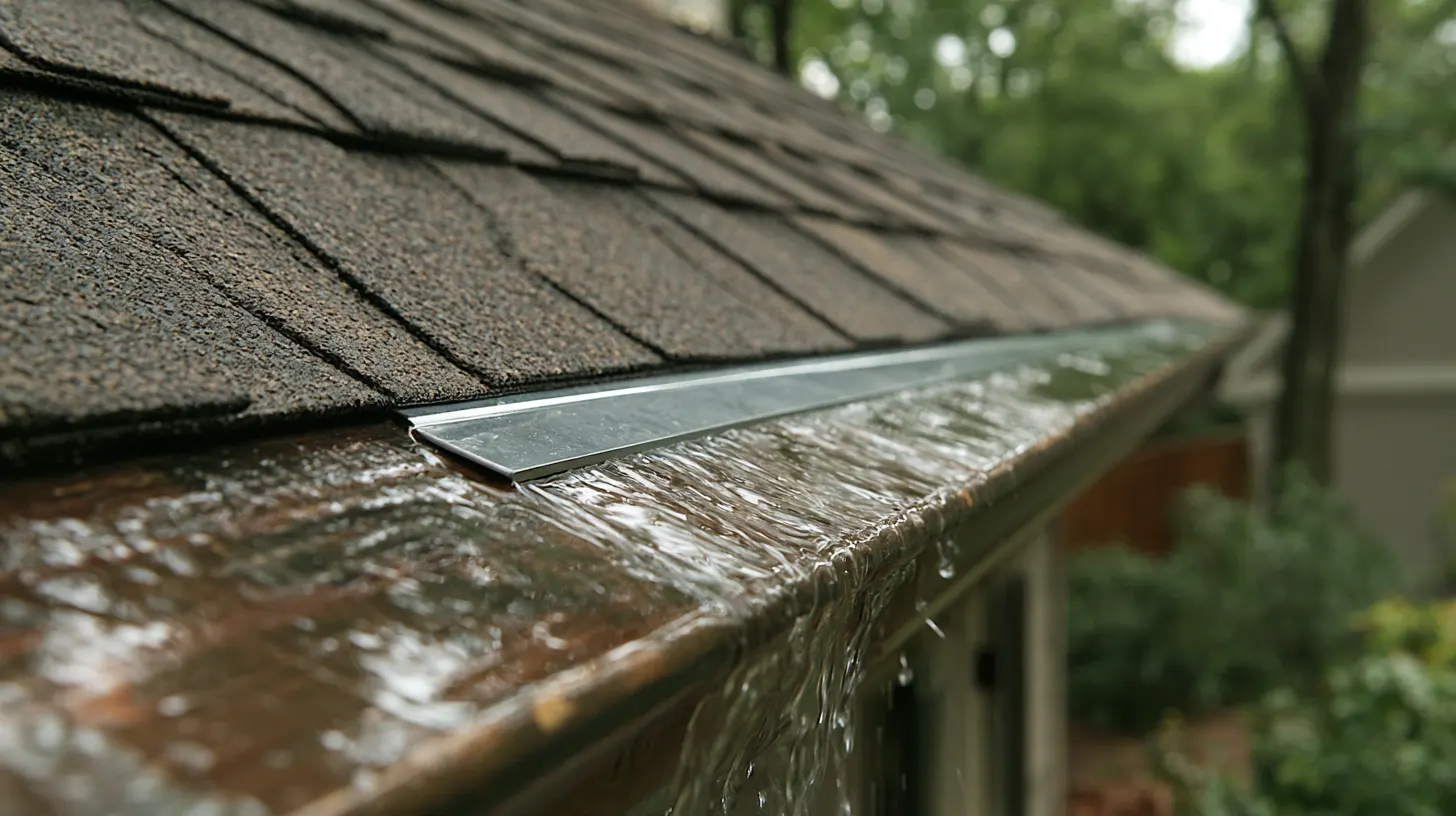
A rain diverter is a specialized piece of roof flashing that moves runoff sideways across the roof instead of letting it run straight down the slope. It tucks under the shingles above a doorway, porch or vulnerable section of wall. A gutter catches water at the eave and carries it to a downspout, while a diverter intercepts water partway down the roof and releases it into a gutter or onto a lower roof.
The shape is simple: a flat flange that slides up under a shingle course and a raised lip that catches water and guides it along the metal. Diverters matter most on steep roofs, where water moves fast, and below long valleys, which can turn a doorway into a waterfall in a heavy storm. Without one, the door frame wears out, the threshold rots and the soil by the foundation stays wet.
Most are called door diverters because that is where they are usually installed. They also go over outdoor light fixtures, garage doors and places where a lower roof meets a wall with no gutter. Placement is the hard part. Too shallow an angle lets water pool and leak over the back of the flange, and too steep an angle sends it fast enough to splash over the side or erode the ground where it lands.
A rain diverter only works at a slight tilt
A rain diverter only works at a slight tilt, because water runs straight down the roof's fall line and a level diverter simply dams it. A level diverter collects water and debris, and the standing water creeps under the shingles by capillary action or backs up over the top edge of the flange.
The standard slope is about an inch of drop per foot of run. Gravity keeps the water moving toward the outlet, and the lip keeps it from continuing down the roof. Most premade diverters are five to ten feet long, and longer runs use pieces lapped in the direction of flow so water cannot seep through the joints.
The outlet end needs attention too. Water tends to cling to and curl around the end of the metal, so a diverter that simply stops can still drip onto something sensitive. Good installers add a small kick-out or flare at the outlet so the stream clears the roof edge or lands in the middle of the gutter. That keeps water off the fascia and siding, which rot first.
Most houses get an aluminum rain diverter
Rain diverters are made from aluminum, galvanized steel or copper, and most houses get aluminum.
- Aluminum is the standard choice. It is light, does not rust, and cuts and bends easily on the roof. It comes in .019-inch and .027-inch thicknesses, and the thicker one is better where wind or heavy snow could bend thin metal. It can be painted to match, but constant water and sun eventually chip or fade the paint.
- Galvanized steel is stronger and stiffer. It handles falling branches better, which makes it a good choice under large trees. If the zinc coating is scratched or wears off, it rusts, the rust spreads to the nails and the diverter loosens.
- Copper is the premium option. It lasts fifty years or more and develops a green patina. It does not rust and is naturally antimicrobial, so moss and algae tend to stay off nearby shingles. It costs much more and takes skill to install, since joints are usually soldered rather than lapped and sealed.
- Plastic or vinyl should be avoided. A few years of UV makes it brittle, and in cold climates it can snap when ice builds up behind the lip. A permanent diverter should be metal.
Rain diverters cost $1.50 to $5 a linear foot
Aluminum diverters cost about $1.50 to $5 a linear foot, so a standard 10-foot piece might be $15 to $30 at a store. Galvanized steel runs a little more, roughly $3 to $7 a foot. Copper costs $15 to $35 a foot, depending on metal prices and the copper's weight.
| Item | Typical cost |
|---|---|
| Aluminum | $1.50 to $5 per linear foot |
| Galvanized steel | $3 to $7 per linear foot |
| Copper | $15 to $35 per linear foot |
| Roofer's small-job minimum | $150 to $300 |
| Added during a larger roofing job | About $50 to $100 per diverter |
| Aluminum diverter over one door, installed | $250 to $500 |
Labor is usually the larger cost. Most roofers have a small-job minimum, often $150 to $300, covering travel, ladders and the work itself. Adding a diverter during a larger roofing job is much cheaper.
Difficult locations cost more. A steep roof of 8:12 or more, or a diverter on the second or third story, adds risk and requires roof jacks or harnesses. Removing a damaged old diverter or repairing shingles from a previous installation also adds to the price. For a professional to install a good aluminum diverter over one door, expect $250 to $500 in total.
How do you install a rain diverter?
You install a rain diverter by working the metal into the shingle pattern so water never gets behind the flange.
- Lay out the diverter. The installer locates the spot to protect, such as the front door, moves up two or three courses above it and marks the diverter's angle.
- Release the shingles. A flat bar slides under the shingles in that course to break the sealant strip loose without tearing the asphalt mat.
- Clear old nails. Nails in the flange's path are pulled or driven flush, depending on their position.
- Slide in the flange. The metal goes under the shingles until the top edge of the flange is at least two inches past the bottom edge of the course above. That overlap keeps water from backing up under the metal.
- Fasten and seal. Galvanized or stainless 1.25-inch roofing nails go through the flange high enough that the course above hides every head, with a dab of roofing cement or polyurethane sealant over each one.
- Reseal the shingles. The old sealant strip is usually no longer sticky, so fresh roofing sealant goes under the tabs to hold them flat in wind. The installer then confirms the outlet is clear and aimed at a safe spot.
Leaf clogs are the most common diverter failure
Clogging with leaves is the most common failure. A diverter is a small dam, so it catches leaves, pine needles and twigs. As debris builds, water backs up and either soaks the shingles or spills over the flange. Under trees, clean it as often as the gutters, because a clogged diverter concentrates water in one spot and can be worse than none.
Incorrect pitch is the second cause. A level diverter holds water in its channel, which freezes into a small ice dam in winter, lifts the shingles and lets meltwater inside. The slope must be steady all the way to the outlet.
Poor nailing is the third. Nails through the exposed metal or uncovered nail heads under the shingles eventually leak, and a flange tucked too shallowly lets wind-driven rain push over it.
Thermal movement is the fourth. Metal expands in heat and contracts in cold, so a 20-foot diverter nailed tight with no room to move can buckle and open gaps between metal and shingle. Professionals use shorter, properly lapped sections to prevent this.
A rain diverter rarely replaces gutters
A rain diverter rarely replaces gutters. Gutters remove all the water from the roof and carry it away from the foundation, while a diverter is a spot fix for places where a gutter will not fit or cannot keep up.
The two usually work together. When a door is set back from the eave, or a valley sends water hard enough to overshoot the gutter, a diverter moves that water sideways into the main gutter run.
A diverter's advantage is simplicity: no moving parts and no downspout on the front of the house. It cannot handle anything close to the volume of a 5-inch or 6-inch K-style gutter, though, and in a cloudburst water will jump the lip.
On a small porch roof, a diverter alone may be enough. On the main roof, use gutters to protect the foundation. A diverter in place of a gutter drops the whole stream in one spot, which washes out soil and leaves the basement damp.
Inspect a rain diverter once or twice a year
Inspect a diverter at least once a year, and preferably twice: in late fall after the leaves drop and again in spring. Clear debris from behind the lip and check for rust on steel or corrosion on aluminum. Wire-brush any rust and coat it with rust-inhibiting primer and paint.
Check the sealant at the same time. Roofing cement and polyurethane dry out and crack over ten to fifteen years, so reseal any shingles lifting over the flange before wind gets under them. In cold climates, look for ice damage after a hard winter and carefully reshape bent metal so the channel still drains.
Check the nails too. As the wood deck swells and shrinks, nails can back out. Drive them back down and reseal them, because a loose diverter rattles in the wind and eventually stops catching water.
Hiring a contractor for a rain diverter
A few questions show whether a contractor will install a diverter that lasts:
- What gauge metal will you use? Thin, store-grade aluminum in a high-wind area suggests durability is not a priority.
- What sealant will you use? Many installers prefer a good polyurethane to plain asphalt roofing cement for this job.
- How will you handle the shingles? A good installer can explain how they break the seal without tearing anything and how they get enough overlap to stop capillary action. Avoid anyone who suggests nailing the diverter on top of the shingles and caulking the edge, because top-mounting does not hold up.
- Where will the water go? There should be a clear plan so the discharge does not cause problems elsewhere on the roof or at the foundation. Many professionals add kick-out flashing at the end.
- Is there a labor warranty? Most reputable roofers offer at least a year on workmanship, long enough to cover all four seasons.
Steep and shallow roofs need different diverters
Roof pitch is the rise over a 12-inch horizontal run, the same figure the roofing calculator uses with your roof's length and width to work out squares. A 4:12 roof is fairly shallow, and a 12:12 roof is 45 degrees.
On a low-slope roof, water moves slowly. A diverter on a 3:12 or 4:12 roof needs a wider flange so water does not back up, and because the water has little momentum, it pools at the smallest bump. The slope along the diverter has to be perfectly even.
On a steep roof, water moves fast. A standard 2- or 3-inch lip may not stop it, and heavy rain on a 10:12 roof can jump a small diverter. Steep roofs may need a custom diverter with a profile of 4 inches or more.
That speed also affects the outlet. Water leaving a steep diverter has real force, so it can splash out the far side of a gutter or wear granules off a lower roof early where it lands. Installers often add a splash block or a reinforced patch of roofing at that spot.
J-diverters and custom shapes
The L shape is standard. A J-diverter adds a small return lip at the top of the vertical leg, which contains splash and keeps wind or heavy flow from pushing water over. It is useful where hard, driving rain is common.
Custom diverters are bent on site with a sheet metal brake to match the exact roof angle and the door below. A custom shape is also needed when the diverter has to work around a chimney or dormer and still cover the door.
On high-end roofs, the diversion can be built into the valley flashing by crimping or folding the valley metal into a channel. This is far more durable than a standard diverter but requires an expert tinsmith or specialist roofer.
Kick-out flashing is often used at the end of a diverter where a roof meets a side wall. InterNACHI describes kickout flashing, also known as diverter flashing, as a piece that sends rainwater away from the cladding and into the gutter, and it warns that a missing kickout often causes concentrated water damage to exterior walls. The International Residential Code also requires flashing that diverts water away from the point where the eave of a sloped roof meets a vertical sidewall. A diverter combined with kick-out flashing gives the exterior of a house strong protection.
Which rain diverter is best for a shingle roof?
For a typical asphalt-shingle house, a .027-inch aluminum diverter is the right choice, with a good balance of price and corrosion resistance.
Size it to the door. A 5-foot diverter over a standard 36-inch exterior door leaves 12 inches of overlap on each side, usually enough to keep splash off the threshold. If a long valley above drains a large area, you may need a 10-foot diverter.
Climate narrows the choice. Near the coast, avoid galvanized steel, since salt air speeds up rust; aluminum or copper are better options. In heavy snow areas, use thicker metal so sliding snow and ice do not flatten it.
Installation still matters more than the metal. Even a copper diverter leaks if it is not tucked under the shingles correctly or lacks the slope to drain. Watch it through the first few heavy rains to confirm it is in the right spot or needs adjusting.
Rain diverter questions
Do rain diverters work?
Yes, for small, specific problems such as water pouring onto a doorway or stoop. They work when installed with a steady slope, tucked under the course above and kept free of leaves. They are not a replacement for gutters on the main roof.
Where should a rain diverter be installed?
Usually two or three shingle courses above whatever you want to protect, such as a door, a light fixture or a spot where a valley empties. Angle it toward a gutter or a safe discharge point at about an inch of drop per foot.
Is a rain diverter better than a gutter?
No. A gutter catches water along the whole eave and carries it to a downspout, while a diverter only moves water sideways for a few feet. A diverter is useful on a small porch or where a gutter will not fit, and it often empties into a gutter anyway.
How much does a rain diverter cost?
Aluminum costs about $1.50 to $5 a linear foot and copper about $15 to $35. With labor and the roofer's minimum charge, most people pay around $250 to $500 for one aluminum diverter over a door.
What is the difference between a rain diverter and kickout flashing?
The difference is mainly location. A rain diverter sits on the open roof and moves water across the slope. Kickout flashing, sometimes also called diverter flashing, sits at the bottom of a roof-to-wall joint and directs water off the siding into the gutter.
Prices are 2026 US national averages and building codes vary by town. Materials, warranties and code adoptions change, so confirm prices with local contractors and code rules with your building department before you sign anything.
Estimate Your Roof Cost
Use our free roofing calculator. No sign-up required.