 RoofingCalculator.io
What Is a Drip Edge?
By RoofingCalculator.io. Updated October 14, 2026. Prices, ratings and code references link to their sources.
Pricing your own roof? Get squares, materials and a 2026 cost range in about two minutes. Free, no sign-up.
A drip edge is an L-shaped or T-shaped strip of metal flashing nailed along a roof's eaves and rakes so water drips clear of the fascia instead of curling back into it. Most drip edge is aluminum or galvanized steel, sold in 10-foot lengths, and it costs roughly $1.50 to $3.00 per foot installed. You can usually feel it as a thin lip of bent metal under the bottom edge of the roof.
Four points cover what most homeowners need to know.
- Code requires it on shingle roofs. The International Residential Code has required drip edge at eaves and rakes since its 2012 edition.
- Install order differs by edge. Drip edge goes under the underlayment at the eaves and over it on the rakes.
- Type D is the usual choice. Its T-shaped profile throws water farther from the fascia than the older L-style.
- It costs little and prevents rot. A typical house pays $240 to $480, far less than repairing a rotted deck edge and fascia.
Drip edge keeps water off the fascia
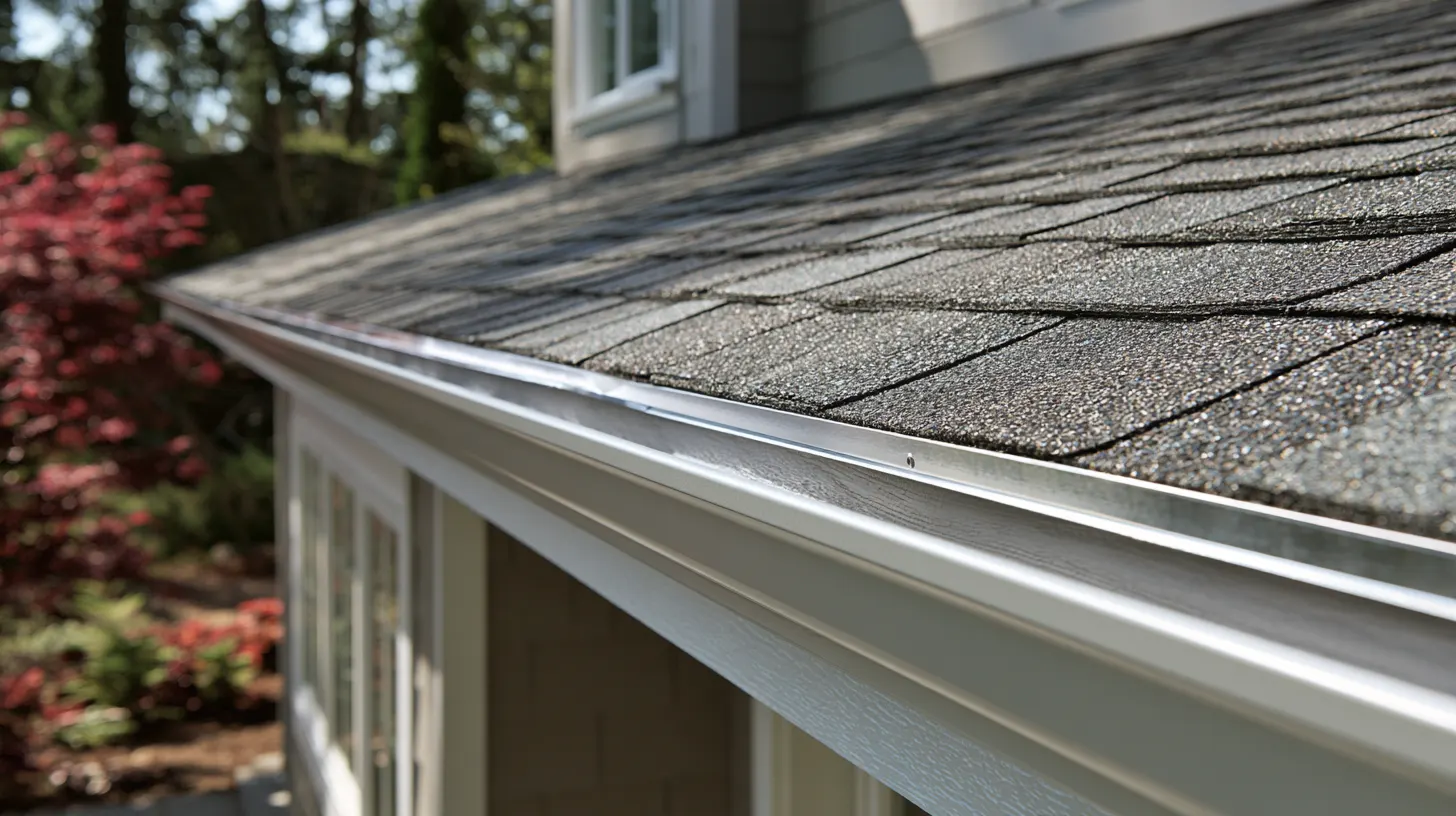
Drip edge is a type of roof flashing: corrosion-resistant metal run around the edges of the deck to bridge the roofing and the gutter or fascia. Its job is to move water off the roof and away from the house. Without it, surface tension and capillary action let water cling to the shingle edge, curl back underneath and run down the face of the fascia. The wood absorbs it, and over a few years that leads to rot, mold and structural damage.
Most modern drip edge is L-shaped or T-shaped. The top leg tucks under the first course of shingles, the face hangs over the edge, and the bottom usually has a small outward bend called a hem or kick-out. That bend breaks the surface tension so water drops into the gutter instead of running back toward the deck. Drip edge looks like trim, but it is a functional part of any shingle roof meant to reach its rated life.
Code has required drip edge since 2012
Drip edge became a code requirement in the 2012 International Residential Code (IRC), after years as a recommended practice, and the 2015, 2018 and 2021 editions kept it. Section R905.2.8.5 of the 2021 International Residential Code requires drip edge at the eaves and rake edges of shingle roofs.
The same section sets the dimensions:
- Overlap of at least 2 inches. This applies where adjacent pieces meet.
- At least 1/4 inch below the sheathing. The metal must hang below the deck edge.
- At least 2 inches back onto the deck. The top leg must extend onto the roof surface.
- Fasteners no more than 12 inches apart. The metal must be mechanically fastened along its length.
The IRC's general flashing rules call for corrosion-resistant metal, with 0.019-inch (26-gauge) galvanized steel as the benchmark thickness throughout Chapter 9. Where these rules are adopted, skipping drip edge on a reroof is a code violation and can fail inspection.
Type C, Type D and Type F
Drip edge comes in three main shapes, and the right one depends on the pitch and whether the edge has a gutter.
- Type C is the old L-style. It has a plain 90-degree bend with no extended top flange. Wind-driven rain can still push under the shingles, and it is mostly found on older houses and inexpensive sheds.
- Type D (T-style or D-style) is the most common. Its T-shaped profile has a wide top flange and a projecting bottom lip that throws water farther from the fascia than an L-shape. It also keeps insects out better and supports the shingle edge so it does not sag with age.
- Type F, the gutter apron, is for eaves only. Its long, angled face reaches deep into the gutter, so even in a downpour water cannot splash into the gap between gutter and fascia. It is common on steep roofs, where water comes off fast.
Most drip edge is aluminum
Most drip edge is aluminum. It does not rust, comes in many factory-painted colors to match trim, and residential stock is usually sold in 10-foot lengths. The minimum thickness for standard work is 0.019 inch, and better jobs use stiffer 0.024-inch or 0.032-inch stock.
Galvanized steel is common in heavy snow country because it is stronger than aluminum and resists bending under ice dams. If the galvanizing is scratched or cut through, though, the steel underneath can rust. In coastal salt air, use G90 galvanized or stainless steel.
Copper is the premium option, used mostly on historic restorations and high-end custom homes, often alongside slate, tile or cedar shake. It needs no paint, turns green with age and lasts longest, often 50 to 100 years, at a much higher price.
Water clings to an edge without a drip
Water molecules cling to each other and to the surfaces they touch. On a roof without drip edge, water reaches the shingle edge and, instead of falling, follows the curve of the shingle back toward the deck, slips underneath and soaks into the edge of the plywood or OSB (oriented strand board) sheathing.
The wet sheathing begins to delaminate. The deck edge softens and nails lose their grip, then the fascia rots and the gutters screwed to it start to sag or pull away. Drip edge breaks that path: its sharp bend and kick-out overcome surface tension, so gravity takes over and the water drops clear.
Eaves first, rakes second
The most important installation detail is which layer goes on top, and the answer differs at the eaves (the bottom edges, where gutters hang) and the rakes (the sloped side edges).
At the eaves, the metal goes directly on the deck, under the underlayment or felt. Any water that gets under a shingle then runs down the underlayment, onto the metal and into the gutter. If the metal goes over the felt instead, water gets trapped between them and rots the deck.
On the rakes, the order reverses: underlayment first, then metal on top. Rakes take wind-driven rain, and metal over the felt keeps the wind from lifting the felt's edge and blowing water underneath. In both cases every lap sheds water over a seam rather than into one, which roofers call "shingle fashion." The IRC writes the same order into code: underlayment goes over the drip edge along eaves and under it along rake edges.
Nail drip edge about every 12 inches
Drip edge should be nailed about every 12 inches with fasteners of the same metal as the flashing, such as aluminum or stainless nails on aluminum drip edge, to avoid galvanic corrosion. Metal expands and contracts with temperature, and poor fastening makes it buckle.
Where two pieces meet, overlap them by 2 inches. At corners where an eave meets a rake, cut and fold the metal around the corner so the deck corner is not left open. Do not caulk the joints, because sealant can trap moisture; the overlap alone handles the water.
Drip edge costs $1.50 to $3 per foot installed
Most homeowners pay $1.50 to $3.00 per foot for professionally installed aluminum or galvanized steel drip edge, a small cost compared with the rest of a reroof.
Drip edge is priced by the foot rather than the square, so add up the eave and rake lengths; if you have already measured the house for the roofing calculator, those edge lengths are in your notes. A typical 2,000-square-foot house has about 160 feet of roof edge, which works out to $240 to $480 for parts and labor. Copper often costs $15.00 to $25.00 per foot, which puts the same house at $2,400 or more.
For DIY work, a 10-foot length of standard aluminum D-style usually costs $8.00 to $12.00 at large home stores, and a little less in contractor bulk. The metal is inexpensive; a professional's fee mainly covers the ladder work and fitting the drip edge neatly with the shingles and gutters.
Three mistakes cause most drip edge failures
Three installation mistakes cause most drip edge failures.
- Metal over the felt at the eaves. This opens a path for water straight to the deck. Five to ten years later the roof edge is soft, and nobody notices until the next reroof or until a gutter falls off.
- The wrong gap at the fascia. Some crews leave too much space between drip edge and fascia, and others press it tight against the wood. About 1/8 to 1/4 inch keeps water from being drawn up behind the metal while letting the wood breathe.
- The wrong size. If the roof already has a second layer of shingles from an earlier recover, standard drip edge may not reach over the thicker edge and can leave the deck exposed. A wide-flange drip edge or custom-bent flashing is needed.
Does drip edge prevent ice dams?
Drip edge does not prevent ice dams, which form when snow melts higher on the roof and refreezes at the cold eave, backing water up under the shingles. It does protect the edge that water reaches first.
Paired with self-adhering ice and water shield, drip edge gives the membrane a solid surface to bond to. Run the membrane over the top of the drip edge flange to seal the edge, so water pooling behind an ice dam cannot seep into the fascia or soffit.
Gutters depend on drip edge
Gutters depend on drip edge. When it is missing or installed poorly, water misses the gutter and runs behind it, rotting the fascia and rafter tails until the spikes or brackets let go.
The metal should reach far enough to drop water near the middle of the trough. That also prevents "tiger striping," the dark streaks of roof grime that form down the front of a gutter. Most importantly, it ensures the thousands of gallons a roof sheds in a storm are caught and carried away from the foundation.
What to ask a roofer
A bid that promises a "complete roofing system" says nothing about flashing details, so ask specific questions.
- What gauge will you use? A cheap bid may use 0.015-inch "utility grade" aluminum, which bends easily and is thinner than the 0.019-inch benchmark. Ask for 0.019 or 0.024.
- How do you handle eaves versus rakes? The answer should come immediately: under the felt at the eaves, over it on the rakes. One method all the way around skips best practice.
- How much overlap, and how do you do corners? Anything under 2 inches risks leaks at the joints, and a good contractor will explain whether they use pre-cut corner pieces or fold metal on site to keep the seal continuous.
How do you know if your roof has drip edge?
You can check for drip edge from the yard. At the eaves, you should see a metal flange running down and slightly away from the fascia. Shingles that hang more than an inch past the edge with nothing under them will eventually crack and break off, and they usually mean drip edge is missing or too small.
Other signs include stains on the fascia, bird or wasp nests in the gap between deck and fascia, and gutters pulling away from the house. Check the attic too. Water stains or mold on the underside of the sheathing near the edges almost always mean the drip edge was installed in the wrong order or left out.
Shingle warranties require code-compliant edges
Major shingle makers, including GAF, CertainTeed and Owens Corning, set edge requirements in their warranty documents. They do not always require their own brand of drip edge, but they do require the roof to meet local code and industry standards such as those of the National Roofing Contractors Association.
If a leak appears at the edge and an inspection finds no drip edge, or one installed in violation of the IRC, the manufacturer may void the warranty for that part of the roof. Edges are among the most common failure points on asphalt roofs, so proper metal there is effectively a warranty requirement.
Most homeowners match drip edge to the trim
Most homeowners now match drip edge to the gutters or trim, in white, brown, black, tan or gray, though mill-finish (bare) aluminum used to be standard. The finish is usually baked-on polyester or Kynar paint, made to resist peeling and fading in the sun.
Matching the trim gives a clean transition from roof to walls. On a complex house with many gables and dormers, that thin metal line keeps the roof's shape looking crisp.
Drip edge keeps shingle edges from sagging
Shingles soften in summer heat, and without support under the overhang, the edge sags. It then cracks along the line of the plywood, leaving the deck edge open to weather.
T-style drip edge gives the shingles a stiff support, keeping them flat and preventing the slumped edge seen on worn roofs. A supported first course lasts as long as the rest of the roof.
Starter shingles are no substitute for metal
Some installers use starter shingles in place of metal. Starter strips matter for wind resistance, but they do not shed water the same way or protect the deck edge, so they do not replace drip edge.
Vinyl drip edge is generally a poor choice on houses. Sun makes it brittle, freeze-thaw cycles crack it, and it is too flexible to support shingles or ice. Corrosion-resistant metal remains the standard on shingle roofs.
Home inspectors check for drip edge
Home inspectors check for drip edge and whether it is installed correctly. If it is missing, expect it to be flagged as a defect, especially where the IRC is adopted.
A flagged defect becomes a negotiating point, and buyers may ask for a credit. Adding drip edge properly after the fact can mean removing the bottom two courses of shingles and the gutters, while installing it during a reroof costs a fraction of that, at a couple of dollars per foot.
Drip edge questions
Is drip edge required on a new roof?
Yes, on shingle roofs in any area that has adopted the International Residential Code. Section R905.2.8.5 requires it at both the eaves and the rakes. Leaving it off during a replacement can fail inspection.
Does drip edge go over or under the underlayment?
It goes under the underlayment at the eaves and over it on the rakes. At the eave, the metal goes down first so water running down the underlayment lands on the metal and drops into the gutter. On the rakes, the metal goes on top so wind-driven rain cannot get under the felt.
Can drip edge be added to an existing roof?
Yes, with care. A roofer has to break the seal on the first course of shingles, slide the metal underneath and nail everything back down without tearing the shingles. Installing it during a full replacement is usually cheaper and cleaner.
What is the difference between drip edge and a gutter apron?
A gutter apron, often called Type F, is a drip edge with a longer, angled face that reaches into the gutter. It goes on eaves where gutters hang. Plain L-style or T-style drip edge is what you usually see on the rakes.
How much does drip edge cost?
Aluminum or galvanized steel drip edge costs about $1.50 to $3.00 per foot installed. A house with around 160 feet of roof edge usually pays $240 to $480. Copper costs more, at about $15 to $25 per foot.
Prices are 2026 US national averages and building codes vary by town. Materials, warranties and code adoptions change, so confirm prices with local contractors and code rules with your building department before you sign anything.
Estimate Your Roof Cost
Use our free roofing calculator. No sign-up required.