 RoofingCalculator.io
A roof cricket, also called a saddle, is a small two-sided peak built on the uphill side of a chimney or other wide roof penetration. It splits water around the obstruction so it cannot pool behind it. The International Residential Code requires one on the ridge side of any chimney or penetration more than 30 inches wide, measured perpendicular to the slope.
A damp spot on the attic wood just uphill of the chimney after a hard rain is the classic sign that you need one. The essentials:
- Code requires a cricket above 30 inches of width. Many roofers build one on every chimney to prevent leaks.
- It should match or exceed the roof pitch. A flatter cricket lets debris and snow collect.
- It is cheapest during a reroof. Expect $300 to $600 then, versus $800 to $1,500 as a retrofit.
- Flashing decides whether it works. Its two valleys and the joint with the brick are where leaks start.
A cricket diverts water around a chimney
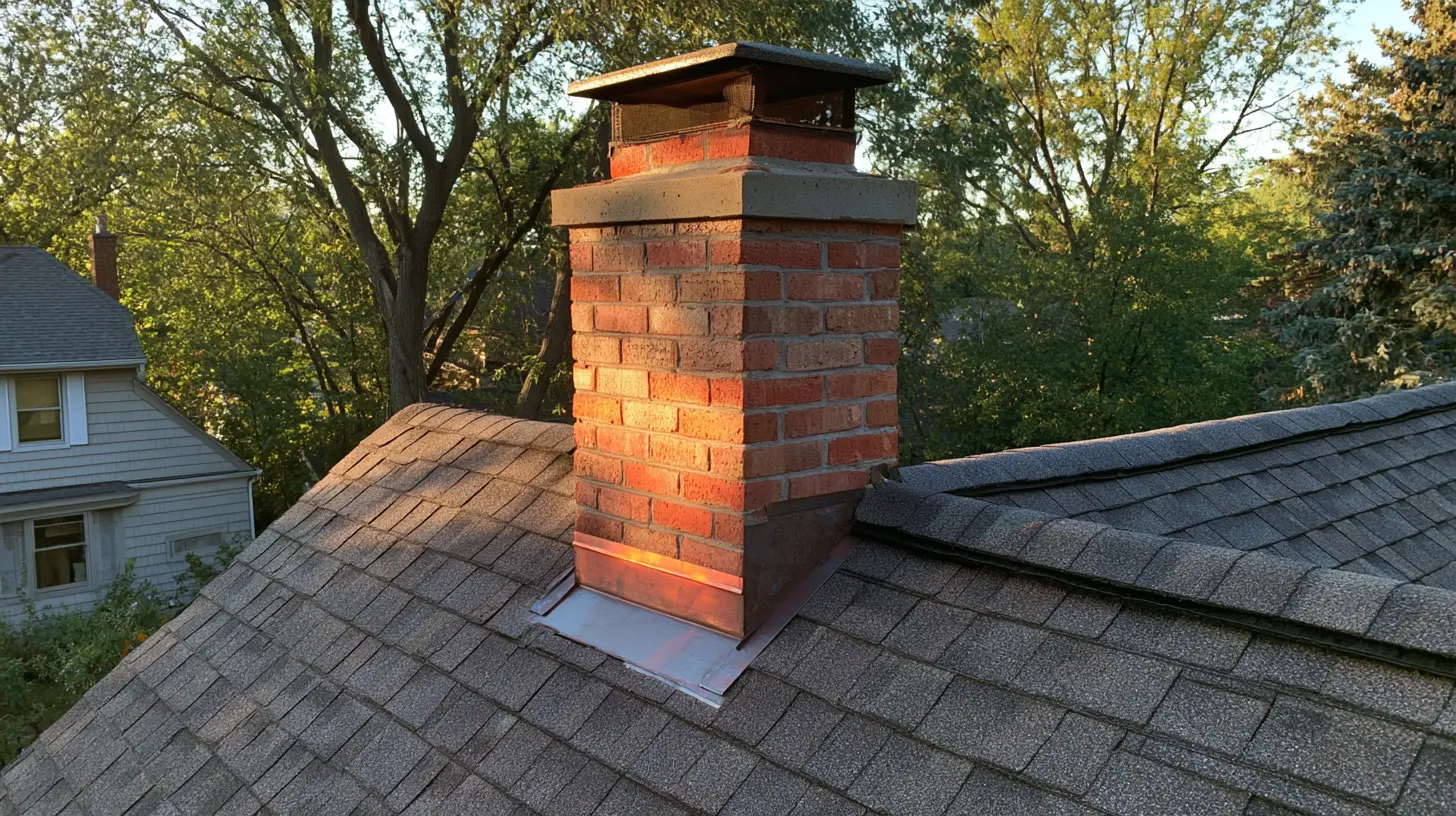
A cricket diverts water before it stalls against the back of a chimney. Without one, rain running down the roof hits the brick and pools in a spot roofers call a dead valley, a common source of leaks and rot.
The cricket has two sloped planes that meet at a ridge. The ridge starts at the middle of the chimney's back face and runs uphill to the main deck, like a small tent. Water hitting the peak splits left and right and runs past the chimney, instead of pressing against the brick and flashing for the whole storm. That steady pressure, called hydrostatic pressure, is very good at finding gaps.
Most crickets are framed with wood, sheathed and covered with the same material as the rest of the roof. Some custom homes have crickets built entirely of heavy copper or lead-coated copper, which are more durable and attractive but require a skilled metalworker who can solder. On a standard asphalt roof, framed wood is the norm.
Code requires a cricket on chimneys over 30 inches wide
IRC Section R903.2.2 requires a cricket or saddle on the ridge side of any chimney or penetration wider than 30 inches, measured perpendicular to the slope. The same section says cricket coverings must be sheet metal or the same material as the roof covering. A 32-inch chimney needs a cricket to pass inspection; a 28-inch chimney does not, though most professionals recommend one anyway.
The 30-inch threshold exists because a wide obstruction catches more water and debris. On a steep roof, water gains speed, hits the brick, and with nowhere to go it climbs up under the shingles or around the step flashing. Many contractors add a cricket to every chimney, whatever the width, to reduce warranty calls.
The cricket's slope should match or exceed the main roof, so a 6:12 roof needs at least a 6:12 cricket. Slow-moving water drops silt, needles and leaves, which build a small dam that forces water into the roof.
How do you size a roof cricket?
Cricket height depends on chimney width and roof pitch: multiply half the chimney width by the slope. A 36-inch chimney on a 6:12 roof gets a ridge that runs 18 inches back and peaks about 9 inches high.
The base usually starts with a flat board, called a sleeper, laid on the deck for the cricket rafters to nail into. Each rafter gets a birdsmouth cut so it sits tight on the slope. CDX plywood or OSB goes over the framing, flush with the main deck, so underlayment and shingles run across smoothly.
Some builders make a cricket flatter than the roof to save lumber or keep the peak low. In snow country, that is a mistake: snow drifts behind the chimney, melts, gets trapped behind ice, and forms an ice dam. A cricket steeper than the surrounding roof sheds snow and ice better.
A cricket costs far less to add during a reroof
| Type | Typical cost |
|---|---|
| Wood and shingle, built during a reroof | $300 to $600 |
| Wood and shingle, retrofit | $800 to $1,500 |
| Custom copper | $2,000 to $4,500 |
Timing drives cost. During a full reroof, a plain cricket on a normal chimney is a small add covering lumber, sheathing, extra ice and water shield, and labor. It barely changes the shingle order, and you can estimate the rest of the reroof with the roofing calculator.
A retrofit costs more because several courses of shingles around the chimney come off, the old flashing is removed, the cricket is framed, and new shingles are woven back in to match. Very wide chimneys and steep roofs that require extra safety equipment cost more again.
A custom copper cricket on a luxury home costs more because copper is sold by weight and a master coppersmith has to form and solder it. It can last 75 years or more, outliving several asphalt roofs.
Roof cricket materials
- Framing is kiln-dried 2x4 or 2x6 lumber. Plain spruce-pine-fir works well under good underlayment; pressure-treated lumber is usually avoided because it warps as it dries and can pull the flashing away from the chimney.
- Sheathing is often 1/2-inch CDX plywood. Plywood tolerates small leaks better than OSB (oriented strand board), and cricket valleys get wet often.
- Self-adhering ice and water protector covers the whole cricket. In the valleys, it is the most important layer.
- Flashing is corrosion-resistant metal. The IRC requires metal flashing at least 0.019 inch thick (No. 26 galvanized sheet), so asphalt roofs typically use 26-gauge galvanized steel or 0.019-inch aluminum.
The flashing ties into the masonry with a reglet joint or counterflashing, so water running down the brick lands on the cricket rather than the deck. Silicone or polyurethane sealant along the top edge completes the seal.
Crickets mostly fail because of poor flashing
Crickets mostly fail because of poor roof flashing. Many installers lay one flat piece of metal at the base and stop. A cricket creates two new valleys where it meets the roof, and each needs flashing done as carefully as any other valley. If the valley metal is not lapped correctly with the chimney flashing, water eventually finds the gap.
An undersized cricket is the second cause. A short cricket with a low peak below a large area of roof can be overrun in a heavy downpour, with water washing over the ridge and pooling behind it anyway. Size it for the roof area above.
Neglect is the third. The V shape catches leaves and twigs, and if nobody clears them, the debris stays wet against shingles and brick. Granules wash off, mortar joints crumble, and moss grows, because cricket valleys stay shady and damp longer than the rest of the roof.
Crickets are prone to ice dams in cold climates
In cold climates, crickets are prone to ice dams. Heat escaping around the chimney melts snow on the cricket, the water runs into the valleys away from the warm brick, and it refreezes. The next round of meltwater hits that ice and backs up under the shingles.
The fix is high-temperature ice and water shield over the entire cricket and well up the main roof around it. It seals around each nail like a gasket, so backed-up water cannot reach the attic. Some homeowners also run electric heat cable in the cricket valleys to keep a channel open through the winter.
Ventilation helps. A well-vented attic keeps the deck colder, so less snow melts in the first place. The small pocket under the cricket itself, which sits on top of the old deck, cannot really be vented, which is why the membrane matters so much.
How do you inspect a roof cricket?
You can check a cricket with binoculars from the yard or from a ladder. Look for these signs:
- The ridge should be centered on the chimney. An off-center ridge sends most of the water to one side, which can overwhelm the gutter or flashing there.
- The valleys should be clear. Debris that keeps piling up may mean the pitch is too shallow or the cricket needs more frequent cleaning.
- The shingles should lie flat. A lumpy, uneven surface, called shingle wave, signals swollen plywood and usually rotting framing underneath.
- The metal should be tucked into the mortar. Flashing held on with caulk, or metal pulling away from the brick, will leak. The sealant should be intact and flexible; if it is cracked or missing, water runs behind the cricket into the ceiling.
Budget and pitch decide metal vs shingle crickets
Budget and pitch decide between metal and shingle. Shingled crickets are standard, inexpensive and match the roof. They work well at 4:12 or steeper, where asphalt holds up and is easy to replace.
Use metal on low slopes. At 2:12 or 3:12, water moves too slowly across shingles for a cricket to do its job. Standing seam or flat-locked soldered copper creates one continuous waterproof surface, and metal sheds snow much faster, which matters in northern climates.
Appearance also plays a part. Historic homes and large feature chimneys often get metal crickets, and well-made copper weathers to a patina many owners like. It requires a contractor with real soldering equipment; seams built by a general crew without it can fail within a few seasons.
What to ask your roofer
- What gauge flashing will you use? Aluminum should be at least 0.019 inch, and galvanized steel is normally 26-gauge. Thin coil stock crinkles and fails early.
- What goes under the shingles? The right answer is self-adhering membrane in the cricket valleys, not plain felt.
- How will you flash the chimney sides? On shingle roofs, step flashing is correct, because the roof and chimney move independently and the seal has to allow for that.
- How does the cricket ridge end at the brick? The solid answer is a reglet cut in the masonry with the metal tucked in. Caulking the edge will not last; only a mechanical tie into the brick stays sealed.
More roof above a chimney means more water
The more roof above a chimney, the more water reaches it. A chimney near the eaves sees a trickle, while one at the bottom of a long 40-foot slope can have thousands of gallons run past it in a heavy storm.
That volume can overwhelm a standard cricket. Some engineers recommend building wider and steeper than the 30-inch code minimum, to push water farther from the chimney corners, the weakest points on the roof, and reduce splash-back, where water hits the brick and sprays up under the shingles.
Gutters feel the effect too. A large cricket concentrates water at two points on the eave, and poorly placed downspouts will let the gutters overflow. If you are building a wide cricket, check whether the gutters can handle the flow or whether you need a 6-inch system.
Framing a roof cricket
Ridge board length depends on the cricket's pitch relative to the roof's. When the pitches match, the ridge runs back a horizontal distance equal to half the chimney width. A cricket flatter than the main roof needs a longer ridge to meet the deck.
Valley rafters, where the cricket meets the roof, are calculated with the Pythagorean theorem. Poorly cut valley rafters are often the first part to fail: a gap underneath lets the sheathing flex when someone steps on it, cracking shingles or breaking the flashing seal.
Many professionals use the sleeper method, nailing the cricket rafters into a flat 2x4 on the deck rather than down through the shingles into the main rafters. This spreads the load, gives the valley flashing a firm base, and lets the cricket stay in place at the next reroof while the shingles around it are replaced.
A good cricket lasts 20 to 30 years
A well-built cricket lasts as long as the surrounding shingles, usually 20 to 30 years. Flashing and sealant need attention sooner: polyurethane sealant at the top of the counterflashing typically lasts 5 to 10 years before it dries out and cracks. Replacing it is a small job, and skipping it can lead to a large repair.
Check the chimney at the same time. Spalling brick or crumbling mortar lets water into the chimney itself, bypassing the cricket, and the roof is often blamed for those leaks. Keep the masonry sound so the cricket can do its job.
A cricket is a few boards and some metal at the point on the roof where water most wants to stop. Sized to the chimney and pitch, with the valleys and brick properly flashed and the valleys kept clear, it will last as long as the roof around it.