 RoofingCalculator.io
Hail Damage Roof Guide
By RoofingCalculator.io. Updated October 14, 2026. Prices, ratings and code references link to their sources.
Pricing your own roof? Get squares, materials and a 2026 cost range in about two minutes. Free, no sign-up.
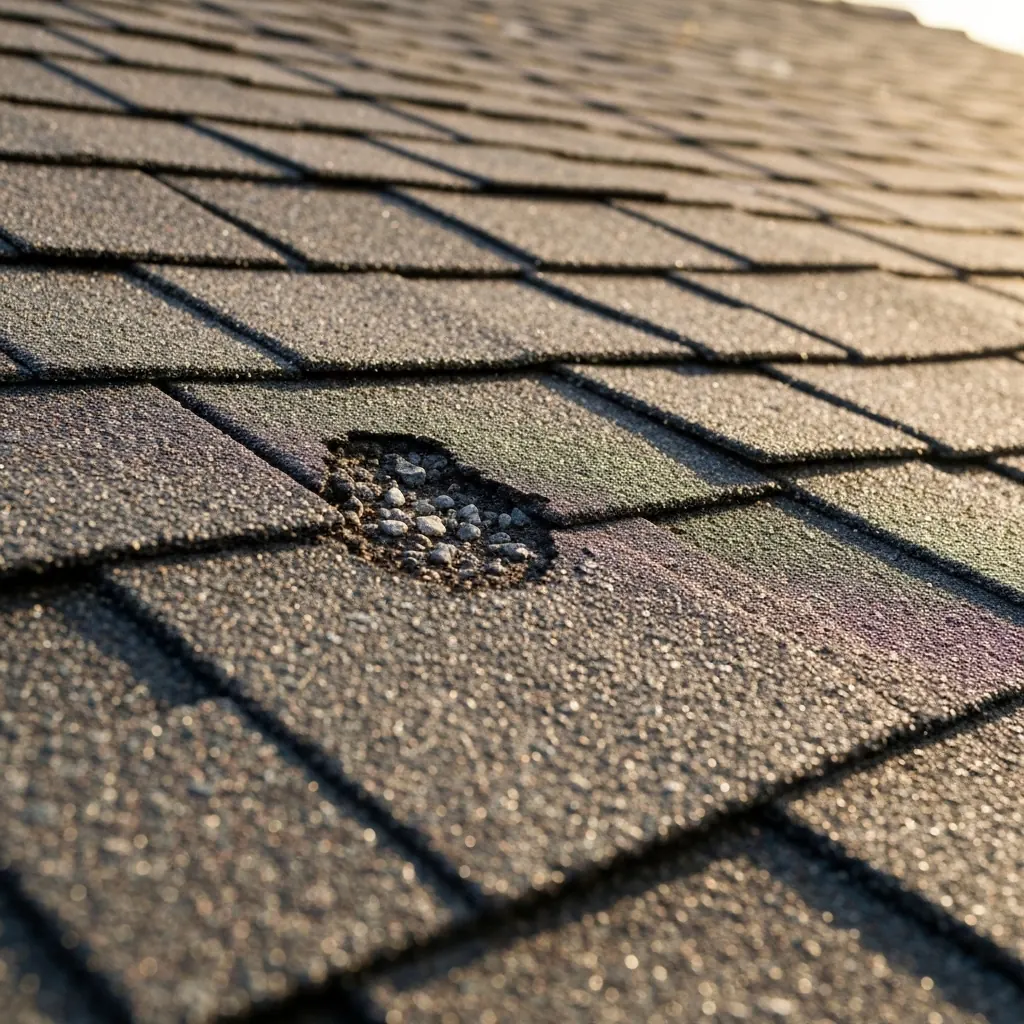
Hail damage on a roof shows up as dark, bruise-like spots where granules were knocked off, along with dents in gutters, vents and other soft metal. Asphalt shingles usually start taking real damage from stones about 1 inch across (roughly the size of a quarter). Most of that damage cannot be seen from the ground, and a roof with no leak can still be badly hurt.
After a hailstorm, four steps protect both the roof and the claim.
- Check from the ground first. Dented gutters, vents, screens and AC fins tell you whether the hail was big enough to hurt the roof.
- Note the date of loss and photograph the evidence. Put a ruler or coin beside each dent so the size is clear.
- File the claim well inside your policy's deadline. Many policies allow one to two years, and some allow less.
- Hire a local, licensed roofer to meet the adjuster. A good contractor points out missed damage and handles code upgrades and supplements.
Hail damage is a bruise in the shingle
Hail damage is a bruise in the shingle: granules knocked loose and, quite often, a crack in the fiberglass mat underneath. Water finds those cracks and works down to the wood deck. Size matters. In IBHS research on hail-damaged shingles, small dents caused "negligible water leakage," while larger dents and tears let in far more.
Granules protect the asphalt from the sun. Once they are gone, UV light bakes the bitumen brittle, it cracks with each hot and cold cycle, and leaks often follow two to five years later. Stones under an inch are mostly cosmetic, while larger ones open real holes in the roof's defenses right away.
Soft metal is the best clue. Dented aluminum attic vents, chimney flashing or gutters almost always mean the shingles were hit too. Storm direction also matters: a storm moving west to east pounds the western, windward slopes and may barely touch the east side. Inspectors look for round or teardrop-shaped bald spots that feel soft when pressed. A hard spot, or missing granules with no dent, is more likely normal weathering.
How much does hail damage repair cost?
A small hail repair of ten to twenty shingles usually costs $500 to $1,500, depending on the damage and the roof's age. When damage is spread out, most insurers will not approve spot repairs, and once more than 25 percent of a slope is hit, full replacement is the normal call.
On a typical 20- to 25-square roof, architectural shingles cost about $450 to $750 a square installed, plus $100 to $150 a square for tear-off. That comes to roughly $11,000 to $22,000, including removal, disposal and new underlayment. The roofing calculator gives you a square count to compare against the adjuster's scope.
| Material | Installed cost per square | Hail notes |
|---|---|---|
| Architectural asphalt | $450 to $750, plus $100 to $150 tear-off | $11,000 to $22,000 for 20 to 25 squares |
| Standing seam metal | $1,000 to $1,600 | About $20,000 to $40,000; dents easily, rarely punctures |
| Concrete tile | $900 to $1,600 | Expensive to repair after hail |
| Natural slate | More than concrete tile | Highest repair cost, mostly specialized labor |
Many policies carry cosmetic waivers on metal, which means no payout unless hail actually punctures the panels, so check yours before upgrading. Your deductible also matters. Many newer policies have replaced a flat $500 or $1,000 deductible with a percentage, so a two percent deductible on a $400,000 house means $8,000 comes out of the payout. A contractor who offers to waive it is committing insurance fraud in most states, and that can sink the claim.
How do you check for hail damage from the ground?
Stay off the roof. After bad weather, the National Roofing Contractors Association says homeowners "should only perform a roof system inspection from ground level." Take a strong flashlight, even in daylight, and walk around the house.
- Gutters and downspouts show dents first. They are the quickest sign that the hail was large.
- Window screens tear or dent. Hail big enough to damage screens is big enough to damage a roof.
- AC condenser fins flatten easily. Crushed fins choke airflow and can ruin the condenser.
- Garage doors and metal siding show round, shiny marks. If you see them low on the house, the roof almost certainly took hits.
Leave the close inspection to a professional. A roofer starts at the ridge caps, which take hail head-on and show cracked mats most clearly, then checks the valleys for bald patches and the soft metal such as turtle vents and pipe jacks. A half-inch dent in a vent means at least some stones were that large. Photograph each dent with a ruler or coin beside it, since those photos are your main evidence.
Most policies give you one to two years to file
Many policies require a hail claim within one to two years of the storm, and some allow less, so check yours for the exact window. The longer you wait, the easier it is for the insurer to blame wear and tear or a later storm. The date of loss is the most important detail, and local weather records or a hail tracking app that maps strikes by ZIP code will confirm it.
The claim starts with a call to the claims line, and the guide on how to get insurance to pay for a roof replacement covers each step. You receive a claim number and an adjuster, who inspects the roof and sets the scope of loss, usually within seven to ten days. Have a roofer you trust there to point out anything the adjuster misses.
After the visit, the insurer sends an estimate and a first check, usually for Actual Cash Value (ACV): the roof's current value after depreciation. On a 10-year-old roof with a 20-year life, the insurer might hold back 50 percent. On a Replacement Cost Value (RCV) policy, you receive that held-back money once the work is done and you send in the final invoice. The mortgage company is usually named on the check and has to sign it too.
ACV policies pay much less than RCV
An ACV policy costs less per year than RCV and pays much less when you claim. If the roof is near the end of its life, the payout may not cover half of a new one, and you pay the rest plus the deductible. A $15,000 roof can end up costing you $10,000.
Most homeowners carry RCV, which pays to replace the roof at today's prices regardless of its age. Depreciation is held back at first and released once the contractor shows the job is finished, so in the end you pay only the deductible. Check your declarations page: if it says "Actual Cash Value" for roof surfacing, a hailstorm will cost you far more.
Two other policy terms reduce payouts:
- Roof payment schedules lower coverage every year. The amount drops as the roof ages, whatever its condition.
- Cosmetic damage exclusions skip dents that do not leak. Hail that dents a standing seam roof without making it leak may pay nothing.
Find out which terms you have before a storm, while you can still change the policy.
Storm chasers leave when the season ends
Large hailstorms draw "storm chasers" from across the country. They set up temporary offices, knock on every door, push hard and promise to "cover your deductible." When the season ends they move to the next state, and you have no local company to call about a leak or a warranty.
Hire a local contractor with a real office and a long track record.
- Verify the license. Check it with the state licensing board, and confirm workers' comp and general liability are active.
- Get a detailed written estimate. Labor, materials and permits should be broken out.
- Keep the deposit reasonable. Thirty percent down, or payment when materials arrive, is standard.
- Expect a full system. A good roofer replaces underlayment, drip edge and flashing along with the shingles. Synthetic underlayment resists tearing and UV better than old felt paper.
- Ask about manufacturer certifications. Contractors rated "Certified" or "Master Elite" by GAF or Owens Corning can offer longer warranties that cover labor.
Hail can crack the mat even when you can't see it
Hail breaks a shingle through mass and speed. A one-inch stone falling from 10,000 feet reaches terminal velocity on the way down, and on impact it crushes the asphalt layer into the fiberglass mat. That is a "functional hit." A cracked mat compromises the shingle even when the crack cannot be seen from above; it shows when the shingle is pulled and turned over.
Granules also wash into the gutters after hail, and that "sand" is the roof's protective layer leaving through the downspout. Insurers pay even without a leak because they are paying for the years of life the roof just lost.
Some people fake hail damage with a heavy thumb or a small tool. Trained adjusters can tell the difference: real hail leaves random, jagged hits, while fakes look neat and uniform. Real hail also causes "collateral damage" around the property. A shredded roof next to an undamaged plastic mailbox and thin aluminum gutters usually leads to a denial on suspicion of fraud.
Many homeowners switch to Class 4 shingles after a claim
Many homeowners switch to Class 4 shingles after a hail claim. These are tested under UL 2218, which drops a two-inch steel ball from 20 feet. Per the IBHS Roof 101 guide, after two hits in the same spot the product "passes if no crack is visible on the back of the shingle." Class 4 shingles cost 10 to 20 percent more than standard architectural shingles and can greatly reduce future damage.
Many insurers in hail-prone states discount premiums for them, though the amount varies widely by state and carrier. Class 4 products also differ in real performance. IBHS's FORTIFIED program reports that "many IR shingles do not perform as expected in real-world storms." Some makers reach the rating with rubberized asphalt (SBS modified bitumen), which flexes under hits that would shatter a standard shingle.
Metal is the other option in hail country. Stone-coated steel looks like shingles or tile and is rated for very large hail without functional failure, though dents remain its weak point and "dimpling" may not be covered. If function matters more to you than appearance, thick-gauge standing seam is among the toughest choices.
The first insurance estimate is rarely final
The first insurance estimate is rarely the final number. Adjusters price jobs in software such as Xactimate, which often misses local code requirements or features of your roof. A "supplement" is an additional charge sent to the insurer for necessary work the original estimate left out.
Common supplements include:
- Permit fees. City permits are often left off the first estimate.
- Rotten decking. Damage is often found only after the old roof is torn off.
- Code upgrades. Many towns require ice and water shield in valleys or specific ventilation, which the adjuster may have skipped.
A professional contractor documents each supplement with photos and code references, the insurer reviews it, and an extra payment follows. If the insurer approves the supplements, your cost is still only the deductible, and the roof is brought up to current code at the insurer's expense. Poor supplement paperwork causes delays or unpaid invoices, so hire a contractor who has done it before.
Ignored hail damage turns into leaks
Ignored hail damage turns into leaks over time, even if the roof works in the short term. Water in the attic soaks the insulation, which loses R-value and raises energy bills, and lingering moisture grows mold and mildew on the underside of the deck and rafters. By the time a ceiling stain appears, the damage is already deep.
Old hail damage also causes trouble at sale time. A home inspector spots it, your claim window has closed, and you pay for a whole roof to satisfy the buyer's lender. That kind of deferred maintenance can stall a sale or force an expensive credit at closing.
Wind is the other risk. Hail-damaged shingles slowly lose their seal strips, so they are the first to blow off in the next storm. If the real cause was old hail damage you never addressed, the insurer can deny the wind claim for negligence, because most policies require you to keep the roof in good repair.
Questions to ask a hail repair contractor
- Can I see jobs that are at least three years old? References on older work show whether it held up.
- How do you price hidden damage? The contractor should quote a set price per sheet of plywood or OSB before work starts.
- How will you protect my yard? Expect tarps over landscaping and a magnetic sweep of the driveway and lawn for nails.
- Who runs the crew on site? A dedicated project manager keeps the install to the manufacturer's specs and safety rules.
- What warranties do I get? There are two: the manufacturer's warranty on materials and the contractor's workmanship warranty, which usually runs two to five years and sometimes ten or more at high-end firms.
Get both warranties in writing, since a verbal promise is worthless if the company closes or changes its name. Ask for the insurance certificate directly from the contractor's agent so you know it is active.
A hail-damaged roof must meet today's code
A hail-damaged roof must be replaced to today's code, not the code in force when the house was built. Older homes often lack drip edge or enough attic ventilation, and newer codes may require specific underlayments and tighter nailing in high-wind zones. Those changes can add several thousand dollars.
"Law and Ordinance" coverage pays the extra cost of meeting current code during a covered loss. Without it, you may owe the difference between replacing what was there and replacing what the law now requires. A good contractor checks with the local building department before starting so the new roof passes inspection.
Ventilation is often overlooked. A roof without enough intake and exhaust traps heat, and the shingles fail early. During a hail replacement, the contractor should calculate the "net free vent area" and add soffit vents or a ridge vent if needed, which extends shingle life and can lower summer cooling bills.
Send the final invoice to release held-back depreciation
Send the contractor's final invoice to the insurer to release the held-back depreciation on an RCV policy. The final check may need the mortgage company's signature, like the first one.
Ask for a lien waiver, which proves the contractor paid its suppliers and subcontractors. Without one, a supplier could place a lien on your house if the contractor never paid for the shingles, even though you paid in full.
Register the manufacturer's warranty, since most shingle companies require registration within 30 to 60 days of installation for full coverage. Keep the contract, claim summary, final invoice, lien waiver and warranty certificates in one folder for the next storm or the next sale.
Hail damage roof questions
What does hail damage look like on a roof?
Hail damage looks like dark, round or slightly lopsided spots where granules were knocked off. Pressed, the spot often feels soft, like a bruise on an apple. Dents in nearby gutters, vents, pipe jacks and AC fins are the best supporting evidence.
What size hail damages a roof?
Hail about 1 inch across (roughly the size of a quarter) is where asphalt shingles usually start taking real damage. Older, brittle shingles can be hurt by smaller stones. Wind-driven hail also hits harder, so size is not the only factor.
How long do you have to file a hail damage claim?
It depends on your policy and your state, but many policies allow about one to two years from the storm. File sooner rather than later. The longer you wait, the easier it is for the insurer to blame wear and tear or a later storm.
Will homeowners insurance replace a roof with hail damage?
Usually, yes, if the damage is functional and the storm is a covered peril, minus your deductible. Actual cash value policies, roof payment schedules and cosmetic damage exclusions can all reduce the payout, so read the fine print.
Are impact-resistant shingles worth it?
Often, yes, in hail country, especially if your insurer offers a discount for them. IBHS testing shows large differences between products, though. Look for strong independent hail ratings, not only a Class 4 label on the wrapper.
Prices are 2026 US national averages and building codes vary by town. Materials, warranties and code adoptions change, so confirm prices with local contractors and code rules with your building department before you sign anything.
Estimate Your Roof Cost
Use our free roofing calculator. No sign-up required.