 RoofingCalculator.io
Gutter Guards
By RoofingCalculator.io. Updated October 14, 2026. Prices, ratings and code references link to their sources.
Pricing your own roof? Get squares, materials and a 2026 cost range in about two minutes. Free, no sign-up.
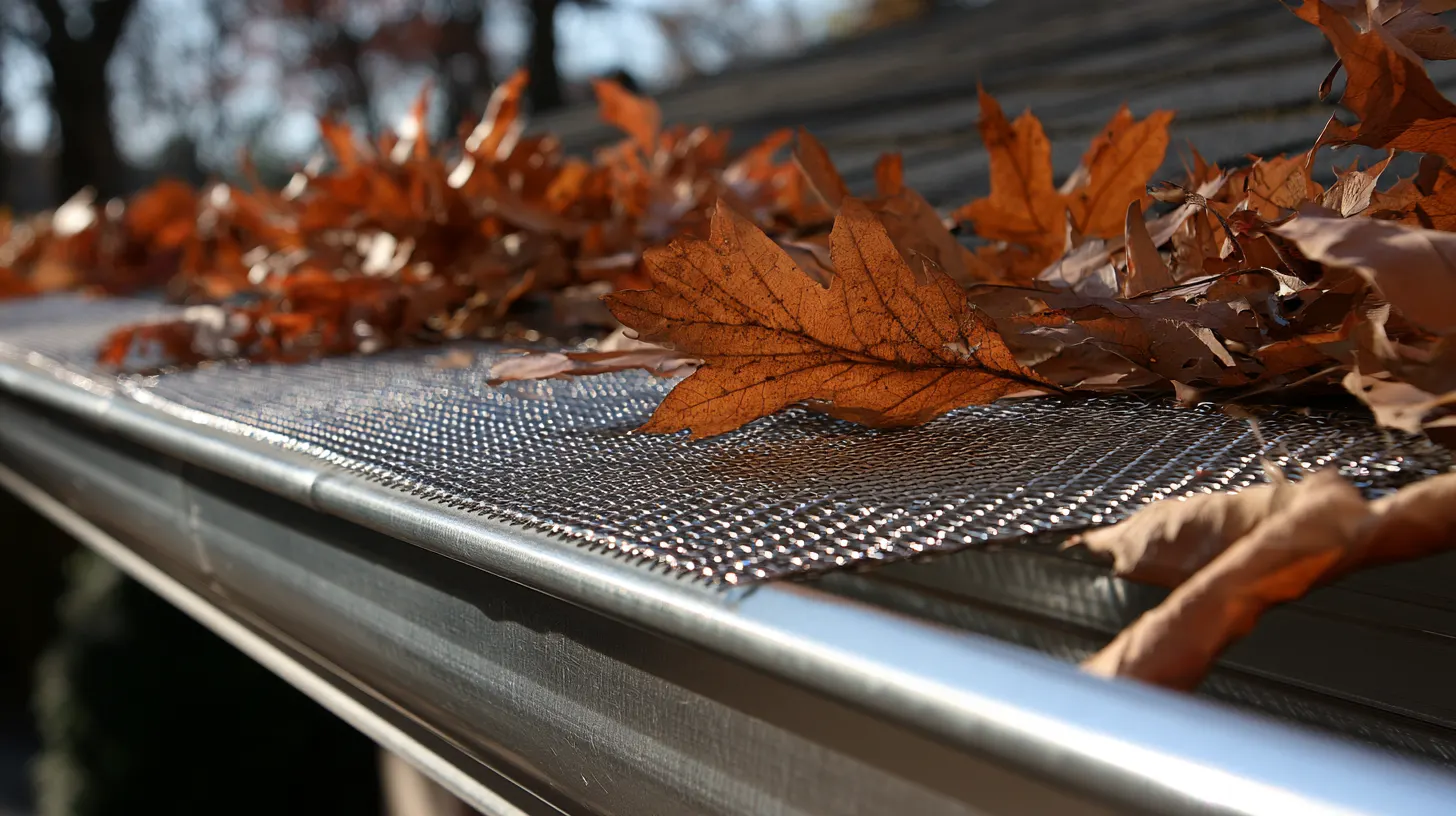
Gutter guards reduce how often you clean your gutters, but they don't eliminate cleaning. Stainless micro-mesh blocks the most debris, including pine needles and shingle grit, while cheap screens and foam or brush inserts stop large leaves and let fine material through. Prices range from about 50 cents a foot for DIY plastic to $15 to $35 a foot for a professionally installed system.
Choosing a guard comes down to four questions.
- What trees are near the house? Broad leaves suit most guards; pine needles need fine micro-mesh.
- Are the gutters sound? A guard can't fix gutters that are too small, sagging or badly pitched.
- How does the guard attach? Guards that slide under shingles can affect the roof warranty; fascia-mount guards don't touch the roof.
- What does it cost against cleaning? Compare the installed price with $150 to $300 per professional cleaning.
Are gutter guards maintenance-free?
No gutter guard is maintenance-free. Every guard needs cleaning eventually, and homeowners who expected otherwise are often the least satisfied. A good guard keeps oak leaves and maple seeds out of the trough, but many screens let silt, pollen and shingle grit through. That fine material settles on the bottom and forms a sludge that can grow weeds or moss inside a supposedly protected gutter.
The right guard depends on your yard. Many guards work well under large broad-leaf trees, but the same guard can fail under pines, because thin needles fall through large openings and a flat screen becomes a wet mat. Roof pitch also matters: a steep roof sends water off fast, and if the guard can't absorb it quickly enough, the rain overshoots the gutter and lands near the foundation.
What you are really paying for is fewer ladder trips. Reducing cleanings from four a year to one every two years is considered a good result. The larger benefit is avoiding a clog during a major storm, when water backs up into the fascia or spills over the flower beds. You still need to inspect gutters with guards: FEMA advises homeowners to "maintain gutters and downspouts using routine inspections" so debris is removed and loose connections are tightened.
Clearing a clogged gutter
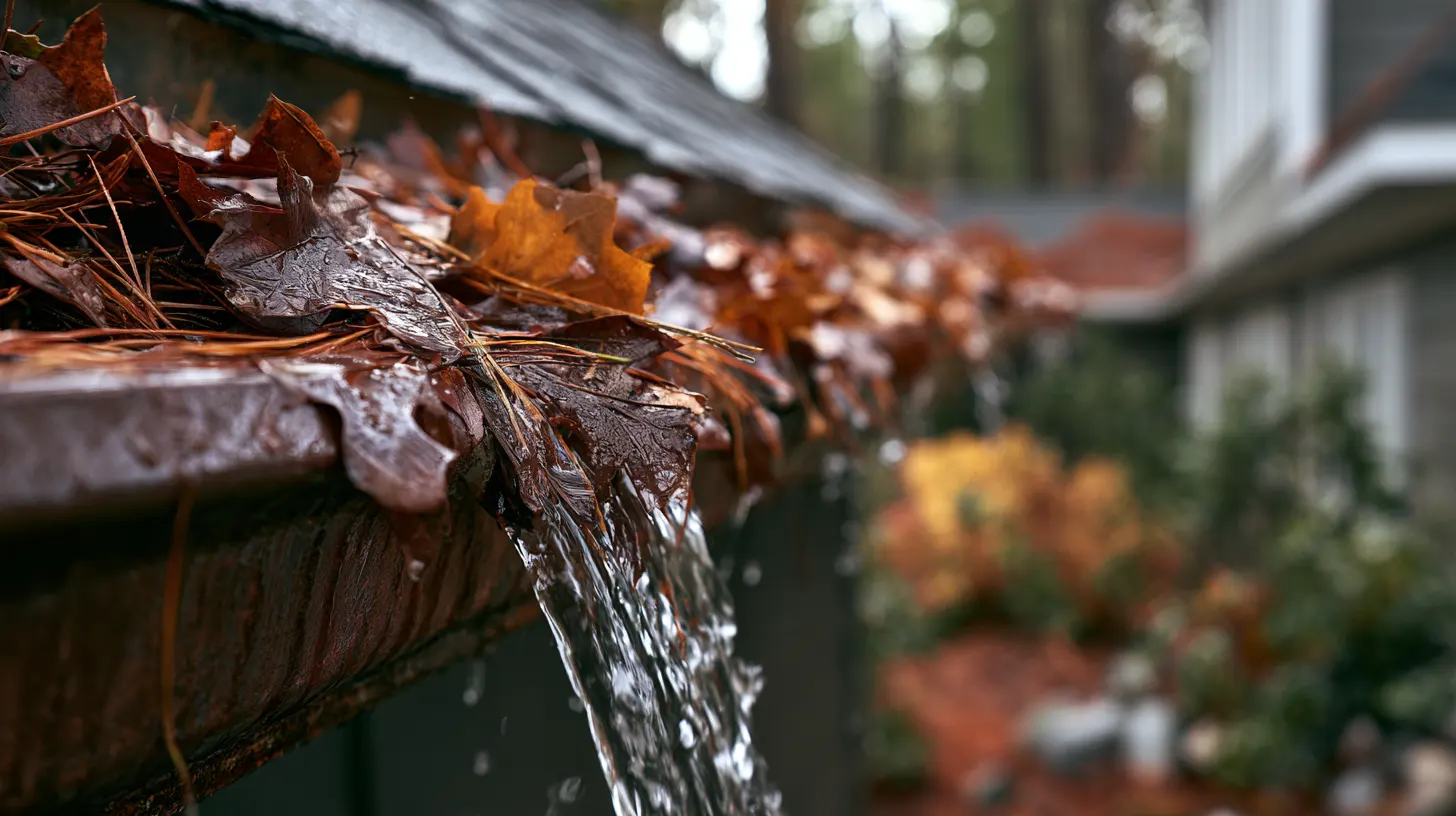
A gutter is clogged if heavy rain spills over the front edge. Other signs include dark vertical streaks on the siding (often called tiger striping), peeling paint on the fascia, a trench worn into the mulch below the drip line and a damp basement. InterNACHI's roof drainage guide states it plainly: "Clogged downspouts will cause runoff to overflow the gutter." That overflow lands against the foundation instead of five to ten feet away, where it should be discharged.
Clogs usually don't start with leaves. Shingle granules are heavy, so they sink and form a gritty layer that slows the water. Seeds, buds and maple helicopters add to it in spring, leaves in fall and needles year-round under pines. If that material stays damp, seeds sprout, their roots trap more debris and the downspout opening seals shut. A single bird's nest in an elbow can block it even faster.
Cleaning a gutter takes three steps.
- Scoop out the debris. Use a plastic gutter scoop and a bucket on a hook; a metal trowel scratches the coating and invites rust. Wear gloves, since gutters have sharp edges and screws.
- Flush the trough. Run a hose from the far end toward the downspout to wash the remaining silt along.
- Clear the downspout. If it is still backed up, feed the hose straight down it, and use a plumber's snake if that doesn't work.
Set up the ladder safely first. Stay off the top three rungs and attach a stabilizer, a U-shaped stand-off bar that rests the ladder against the roof or siding instead of the gutter. Ladder falls are one of the leading causes of injury in home projects. A one-story house on level ground is a reasonable DIY job, but for two-story gutters most people are better off hiring a professional.
How much do gutter guards cost?
Gutter guards cost about $0.50 to $2.50 a foot for DIY products and $7 to $35 a foot installed, and those prices make the most sense compared with the cost of cleaning.
| Service or product | Typical cost |
|---|---|
| Professional cleaning, ranch house (150 to 200 ft of gutter) | $150 to $250 |
| Professional cleaning, 2,500 sq ft two-story | $250 to $450 |
| Professional cleaning, three stories or steep lot | Over $600 |
| DIY plastic or thin aluminum guards | $0.50 to $2.50 a foot ($100 to $500 for 200 ft) |
| Perforated aluminum installed by a local roofer | $7 to $12 a foot ($1,400 to $2,400 for 200 ft) |
| Professional micro-mesh system installed | $15 to $35 a foot ($3,000 to $7,000 for 200 ft) |
Professional cleaning prices include hauling debris away and flushing downspouts. Heavily neglected gutters packed with saplings, sludge or hardened grit often carry an extra $50 to $100 debris charge, while many companies discount each visit by 15% to 20% if you sign up for two cleanings a year.
Skipping cleaning costs more. Water pooling at the base of a wall saturates the soil until the pressure cracks or bows the foundation, and foundation wall repairs start around $5,000, with severe cases exceeding $20,000. Rotted fascia is the more common expense: new boards cost $6 to $12 a foot, but the gutters must be removed and rehung, so one side of a house can cost $1,500 to $3,000.
DIY guards from big-box stores, mostly plastic or thin aluminum mesh, are inexpensive for the roughly 200 feet of gutter on an average house, but they are flimsy. They warp in the sun and collapse under snow, so expect to replace them.
Professional systems from specialty companies use surgical-grade stainless micro-mesh on a heavy aluminum frame, and the price usually includes cleaning the existing gutters, minor pitch corrections and a performance warranty.
Compared with professional cleaning at $150 to $300 a visit, a high-end system takes 15 to 20 years to pay for itself, and a mid-range system about 5 to 7 years.
A guard won't fix an undersized gutter
If a gutter still overflows after cleaning, it may be too small or installed incorrectly, and a guard won't help. In moderate rain of about an inch an hour, a 5-inch K-style gutter handles roughly 5,500 square feet of roof and a 6-inch gutter close to 8,000. Moving up one size adds about 40 to 50 percent more capacity, which matters below large valleys and along long runs.
Sagging is another problem. A heavy clog bends the gutter into a low spot that often stays bent after cleaning, so water keeps collecting there and breeds mosquitoes. Older spike-and-ferrule hangers make sagging worse because the spikes gradually work loose from the wood, while hidden hangers with heavy screws hold far more weight. Older sectional gutters also catch debris at every seam, which is one reason seamless aluminum became the standard.
Check where the water goes after the downspout. Discharging within two feet of the foundation does little good; an extension or splash block should carry water at least five feet away. Buried drain lines create their own problem, since debris settles inside where it can't be reached, and clearing it usually requires hydro-jetting. A strainer at the top of the downspout prevents this but catches everything, so it needs frequent clearing.
Types of gutter guards
Six main designs are sold, and each fails in its own way.
- Foam inserts. Triangular blocks of porous polyether or polyurethane foam sit in the trough, letting water soak through while leaves stay on top. Because foam acts as a filter, fine debris builds up into something like potting soil, where seedlings and mold grow. UV light also breaks the foam down within two to five years.
- Brush guards. These look like large pipe cleaners lying in the gutter. Leaves rest on the bristles while water drips past, but pine needles and small seeds tangle in them, and a packed brush must be pulled out and shaken clean, which means a lot of ladder work.
- Screen guards. The most common DIY choice, these plastic or metal screens have large openings that keep out big leaves but let grit in. They are also weak: heavy snow or a falling branch can knock them loose, and unscrewed screens can blow out in strong wind.
- Perforated metal. A sheet of aluminum punched with holes, sturdier than a screen, usually screwed to the gutter's front lip and either slid under the shingles or fastened to the fascia. It handles heavy rain well, but wet leaves stick to the flat top and, if they don't dry and blow away, cover the holes so water runs off the edge.
- Micro-mesh. Fine stainless mesh stretched over a rigid aluminum or plastic frame stops even sand and pollen. Better brands angle it to match the roof pitch so debris slides off. Its weakness is film: oily residue or algae can coat the mesh until water runs off instead of through, so it needs occasional brushing with mild soap.
- Reverse curve guards. Also called surface tension guards, these solid metal covers have a rounded nose. Water follows the curve into the gutter while leaves fall off the edge. They are very durable but must be installed at exactly the right pitch or water skips past the curve, and the dark, dry space underneath attracts bees and wasps.
Under-shingle guards can break the shingle seal
How a guard is mounted matters nearly as much as its design. There are two styles: under-the-shingle and fascia-mount. Many guards require the back edge to slide under the first or second course of shingles, which means prying up shingles that have already sealed. That breaks the bond and gives wind an edge to lift. If a metal plate is forced under the shingles so they lift or drainage is blocked, the shingle manufacturer may void the warranty.
Fascia-mount guards attach only to the gutter and the fascia board and don't touch the roof, so they are usually the safer choice for the warranty. The fascia must be solid, though; soft, rotting wood carrying the weight of the gutter and guard can let the whole run pull away from the house.
The mounting angle also matters. A flat guard collects debris like a shelf. A steep guard sheds leaves well but lets more water overshoot in a downpour. A good installer chooses an angle in between, based on local rainfall and the roof's pitch.
Climate changes which guard works
In cold climates a guard can make ice problems worse. During freeze-thaw periods it adds another cold surface where snow melts and refreezes, so mesh openings freeze shut, meltwater runs over the top and forms icicles, and the added weight pulls on the gutters. Heat escaping from the house remains the root cause. InterNACHI states that "ice dams are caused by inadequate attic insulation." Air-sealing and insulating the attic does more good than any guard or heat cable.
Near the ocean, salt air corrodes metal. Plain aluminum and low-grade stainless break down quickly there, which is why 316-grade stainless, which resists salt pitting, is the coastal standard. In hot, sunny regions such as the Southwest, avoid plastic guards, which turn brittle and crack within a few seasons.
Where storms bring intense rainfall, flow rate matters most. Micro-mesh is usually rated in inches of rain per hour, and manufacturers often advertise figures well above any normal storm. Those ratings assume a clean surface; with leaves or film covering half the guard, actual capacity drops sharply.
Even micro-mesh needs some attention
Even the best micro-mesh needs some attention. The most common task is brushing the nose: using a brush on a long pole to sweep off debris hanging over the front edge. Left in place, that strip of debris wicks water back toward the fascia.
Film is the other recurring task. Oily residue from nearby roads or trees coats the mesh so rain beads up and runs off instead of passing through. A soft brush and soapy water once or twice a year usually removes it. Near a construction site, or under an older asphalt roof that sheds grit, rinse the mesh whenever buildup appears.
With screen and perforated guards, the trough still needs flushing every three to five years, because the fine debris that passes through accumulates and can block the downspouts. Most professionals install a cleanout port or removable section near each downspout so the system doesn't have to be taken apart to reach it.
Your trees decide which guard works best
The trees around your house largely decide which guard works best. Under oak, maple or hickory, almost any guard works, because large leaves tend to dry and blow away. The exception in that group is the maple helicopter, which can lodge upright in a perforated hole and sprout.
Pines are the most difficult. Their thin, heavy, flexible needles slide into screen and perforated openings, wedge there and catch more needles until they form a thick mat. Only the finest micro-mesh keeps them out reliably.
Cedar and cypress shed tiny scale-like leaves and small cones that clog even some mid-range mesh. Oaks also drop catkins each spring, long sticky tassels that can coat a guard until water can't pass. Under these trees, clean the guards at least twice a year, once after the spring bud drop and once after the fall leaves come down.
Questions for the installer
Ask about more than price.
- How will the guard affect my roof warranty? If it tucks under the shingles, ask whether they use a starter strip and whether a fascia-mount version is available.
- How thick is the frame? Thin aluminum bends under wet leaves or snow; good systems are .024 inches or thicker.
- Is the mesh 304 or 316 stainless? 316 lasts longer.
- Will you check and correct the gutter pitch first? Gutters should slope toward the downspouts about a sixteenth of an inch per foot. A guard on a sagging or badly pitched gutter fixes nothing, since water and debris still collect.
- Are my downspouts large enough? A good guard can move water faster, and a narrow 2x3-inch downspout may back up in a heavy storm, so 3x4-inch downspouts are often recommended with premium guards.
Some guards are visible from the yard
Appearance matters to many homeowners. Some systems are visible from the yard, especially reverse curve guards, whose thick nose extends past the gutter lip. On a low roofline or a house with a distinctive architectural style, that can be distracting.
Many manufacturers offer colors to match the gutter or roof, and a guard matched to the gutter is barely noticeable. Some micro-mesh systems sit low enough to be nearly invisible from the street, although the mesh itself is usually plain silver or dark gray.
Copper gutters need copper guards. Aluminum in contact with copper causes galvanic corrosion, a reaction between two different metals in the presence of rainwater, which eats through the gutter quickly. Repairing that damage costs far more than the guards.
Valleys overwhelm most gutter guards
Valleys, where two roof slopes meet, channel large volumes of water that come off with real force in a storm, and most guards can't handle it. Professionals often install splash guards or diverters, tall upright shields that slow the water and direct it into the gutter.
Dormers create the same problem on a smaller scale. A dormer downspout discharging onto a guarded section below can dislodge debris or flood the mesh, so it is better to run the upper downspout directly into the lower gutter, bypassing the guard.
Steep roofs, such as those on Victorian and Tudor houses, need guards that absorb water quickly. Water runs off a 12/12 pitch much faster than off a typical 4/12, and the roofing calculator can confirm your roof's pitch and area. On a steep roof, water can skim across a smooth guard, so choose a textured surface or micro-mesh with a high pore count that breaks the surface tension and draws water into the trough.
Guards cut mosquito habitat but can invite other pests
Wet leaves in a clogged gutter hold standing water where mosquitoes breed, and keeping leaves out reduces both the water and the debris they need. A poor installation, however, can attract other pests.
Open ends give animals easy access. Without end caps, birds nest in the gap between guard and gutter, and wasps build under reverse curve guards. Look for end caps and a tight fit at the brackets.
Mice and rats sometimes use gutters as a route to the roof and into the attic. A solid, securely fastened guard blocks that route, which costs far less than professional pest removal.
Guard materials and lifespan
Each part of a guard affects how long it lasts.
- Plastic (PVC). It expands and contracts with heat, and a single hot day can loosen fasteners or warp the guard, opening gaps that let debris in.
- Aluminum. It is the standard on mid- to high-end systems because it doesn't rust and expands at about the same rate as the gutters. Thin coil stock can crush under a ladder or heavy ice, while much thicker extruded aluminum forms the frames of the best guards.
- Stainless mesh. It provides strength and corrosion resistance. Grade 304 is common and works well in most places. Grade 316 contains added molybdenum, which resists chlorides and salt far better, so it is the right choice near the ocean for decades of service without pitting.
- Fasteners. Zinc-plated steel screws on an aluminum guard rust within a few years, streak the gutters and then fail. Fasteners should match the guard, usually stainless or aluminum, so all the parts age together.
Gutter guards questions
Are gutter guards worth the money?
Usually yes, if you have many trees or gutters two stories up. On a one-story house with few trees nearby, paying $150 to $300 for a cleaning once or twice a year can cost less over time.
What type of gutter guard works best?
Stainless micro-mesh, for most houses. It blocks nearly everything, including pine needles and shingle grit. Reverse curve guards handle large leaves well only if they are installed at exactly the right angle, and foam and brush inserts perform worst.
How do you unclog a downspout?
Clear the debris from the top opening, then run a garden hose down the pipe at full pressure. If it is still blocked, a plumber's snake can break up a packed clog, and a stubborn elbow can be removed and cleaned by hand.
Do gutter guards void a roof warranty?
They can. A guard slipped under the shingles that breaks their seal or makes them lift can lead the shingle manufacturer to deny warranty coverage. Fascia-mount guards don't touch the roof, so ask how a guard attaches before you sign.
How often should gutters be cleaned?
At least twice a year without guards, in late spring and again after the leaves fall. With pines or large oaks over the house, plan on three or four cleanings, or install a good guard that reduces the job to an occasional rinse.
How long do gutter guards last?
It depends on the material. Plastic guards last a few years, sometimes less in strong sun, before they warp or crack. Stainless mesh on an aluminum frame commonly lasts 20 years or more with occasional cleaning.
Prices are 2026 US national averages and building codes vary by town. Materials, warranties and code adoptions change, so confirm prices with local contractors and code rules with your building department before you sign anything.
Estimate Your Roof Cost
Use our free roofing calculator. No sign-up required.