 RoofingCalculator.io
What Is Roof Underlayment?
By RoofingCalculator.io. Updated October 14, 2026. Prices, ratings and code references link to their sources.
Pricing your own roof? Get squares, materials and a 2026 cost range in about two minutes. Free, no sign-up.
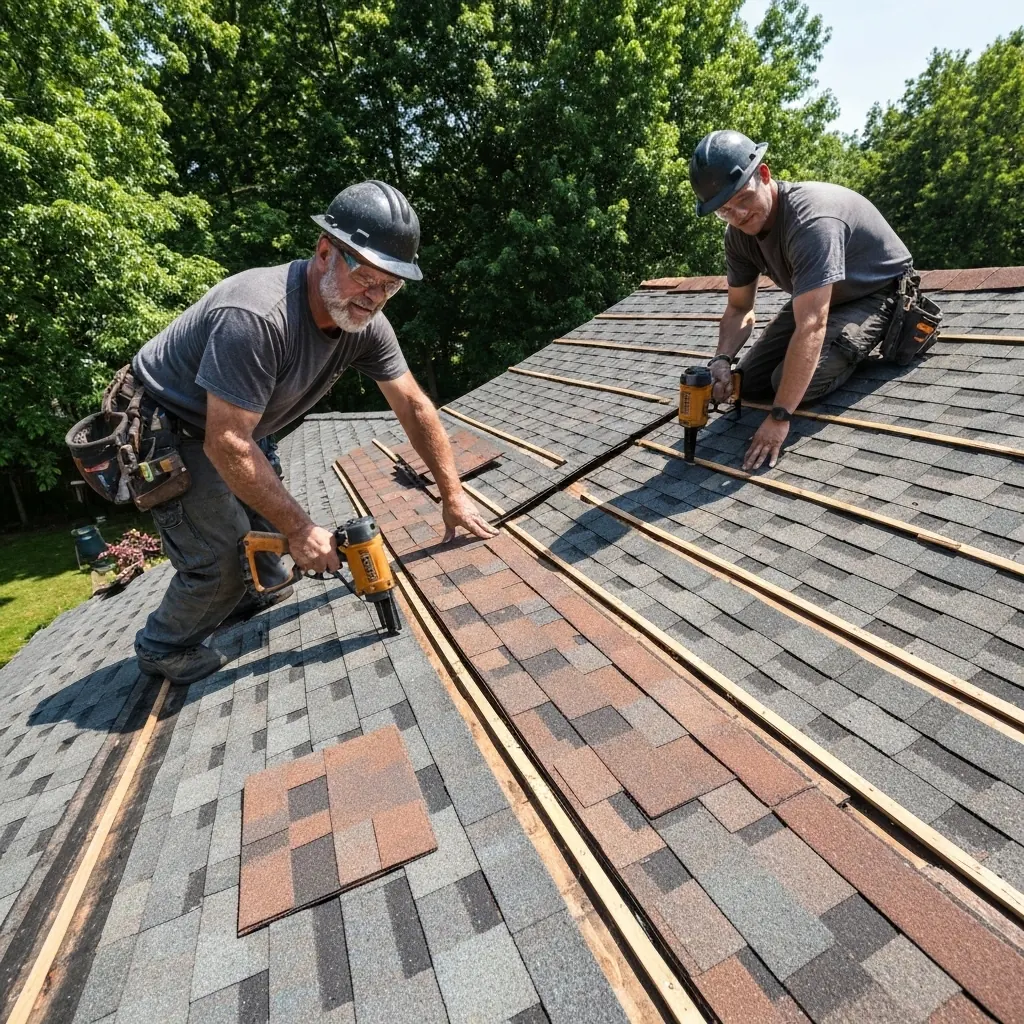
Roof underlayment is a water-resistant or waterproof layer installed directly on the roof deck under shingles, metal or tile. It catches water that gets past the roof covering, such as wind-driven rain or meltwater backing up behind an ice dam. The material costs about $5 to $100 per square, depending on the type.
There are three main types of underlayment.
- Asphalt-saturated felt is the low-cost standard. No. 15 and No. 30 felt meet code but tear easily and must be covered quickly.
- Synthetic underlayment is the modern default. It is lighter, much stronger and tolerates weeks of sun exposure.
- Self-adhered ice and water shield is fully waterproof. It goes at the eaves, in valleys and around penetrations, where water collects or backs up.
Shingles need underlayment because they are not waterproof
Underlayment is needed because shingles are not waterproof. They shed water by overlapping, which works most of the time, but sideways rain, wind-torn shingles and ice dams all let water get underneath. Without underlayment, that water soaks into the wood and causes rot, mold and ceiling stains.
It also protects the house during the job. Once the old roof is off and the deck is covered with underlayment, the house can get through an afternoon shower before any shingles are nailed down.
Underlayment has a few other roles. It evens out small bumps and dips in the deck so shingles lie flat, and it separates asphalt shingles from resins in the wood. Some underlayments are part of a roof's tested fire rating, and many synthetics have a textured top surface that gives roofers better footing.
Felt underlayment is inexpensive and meets code
Felt underlayment, also called tar paper, is a fiberglass or organic mat soaked in asphalt and sold as No. 15 or No. 30. The numbers come from an old weight per square, and today's No. 15 is lighter than the name suggests. No. 30 weighs about twice as much and resists tearing much better.
Felt is inexpensive and meets code. The International Residential Code lists felt meeting ASTM D226 among the accepted underlayments for asphalt shingles, and it calls for strips of at least No. 30 felt between each course of wood shakes. Some roofers prefer felt because it breathes, letting a little moisture vapor escape from the deck.
Its drawbacks are significant. It rips from a misstep or a gust of wind, and if it gets rained on before the shingles go down, it wrinkles in ways that show through thin shingles. Over the years the asphalt oils dry out and it turns brittle, and it breaks down quickly in direct sun, so it should be covered the same day or within a few days.
Synthetic underlayment has largely replaced felt
Synthetic underlayment has largely replaced felt on professional jobs. It is woven or spun-bonded polypropylene or polyethylene, so it does not absorb water, rot or grow mold. It is also much lighter, and one roll often covers as much as several rolls of No. 30 felt, which means fewer trips up the ladder and fewer seams.
Its main advantage is strength. A good synthetic is nearly impossible to tear by hand, it stays in place in winds that would shred felt, and if a storm strips off a few shingles, well-fastened synthetic often keeps the house dry until repairs are made.
It also tolerates sun. GAF says its FeltBuster synthetic "Resists UV degradation for up to 90 days," and other products vary, so check the exposure rating. That helps on large, complex roofs that take time, or when weather delays the shingle delivery.
Vapor is the one thing to watch. Many synthetics let very little vapor through, which is good against rain but can trap moisture against the underside of the deck over a poorly ventilated attic. Breathable synthetics exist for that reason, and adequate attic ventilation solves most of the problem.
Ice and water shield is peel-and-stick underlayment
Ice and water shield is a peel-and-stick underlayment made of rubbery, polymer-modified asphalt with an adhesive back. Felt and most synthetics only resist water; ice and water shield is waterproof.
When a roofing nail goes through it, the asphalt seals around the shank like a gasket, so water cannot follow the nail into the wood. That makes it the right material anywhere water collects or backs up.
Cold climates must use it at the eaves. Where ice has a history of forming, the IRC requires an ice barrier extending to "a point not less than 24 inches" inside the exterior wall line. In practice, that often means two or three feet of membrane up from the edge, and more on low slopes or deep overhangs. The guide to ice dam prevention explains why that strip matters.
Roofers also install it in valleys, around chimneys and skylights, and along roof-to-wall joints. It rarely covers the whole roof, because it is expensive and acts as a vapor barrier; full coverage is mostly for very low slopes, some metal roofs and houses in extreme climates.
Underlayment is a small part of roof cost
Underlayment is a small part of the total roof cost. Approximate material prices:
| Underlayment | Material cost per square |
|---|---|
| No. 15 felt | About $5 to $10 |
| No. 30 felt | About $10 to $18 |
| Standard synthetic | About $15 to $25 |
| Premium heavy synthetic | About $30 to $40 |
| Ice and water shield | About $50 to $100 |
On a typical 25-square roof, upgrading from felt to a good synthetic costs a few hundred dollars, while the whole roof with architectural shingles runs $11,000 or more. Labor on synthetic is often slightly lower because the wide rolls go down quickly.
Underlayment rarely appears as its own line on a bid; it is included in the per-square price, though ice and water shield is sometimes listed separately by the linear foot or square. It is bought by the square like shingles, so the square count from the roofing calculator is roughly the amount you need before overlaps.
How do you install roof underlayment?
Underlayment goes on in horizontal rows, starting at the eave and working up to the ridge, with each row lapped over the one below, the same as shingles. Water running down the roof should always land on top of the next sheet, never slip under it. End laps, where two rolls meet, are wider, with exact widths set by code tables and product instructions.
Low pitches have stricter rules. Under the IRC, asphalt shingle roofs between 2/12 and 4/12 need double underlayment, which usually means each row overlaps the previous one by half its width. Clay and concrete tile have a similar double-layer rule from 2 1/2/12 to 4/12. A single layer of felt on a 3/12 roof violates code and will eventually leak.
The IRC also allows a sealed-deck option. Every seam in the deck is taped with a 4-inch strip of self-adhered membrane, and regular underlayment goes over everything. If a hurricane strips the shingles and underlayment, the taped seams still keep water out.
Fasteners matter more than most people realize. Plain staples have small heads that can tear through the sheet in wind. Plastic cap nails, with a wide washer under the head, hold synthetic much better, and many manufacturers require them.
Underlayment laps over drip edge at eaves, under at rakes
Underlayment and drip edge go on in a set order that crews sometimes reverse. The IRC states that underlayment goes "over the drip edge along eaves" and under the drip edge along the rakes.
At the eave, the metal goes down first and the underlayment laps over it, so water running down the sheet drops onto the drip edge and into the gutter. On the rakes, the order flips: underlayment first, then drip edge over it, so wind cannot drive rain under the edge of the sheet. The drip edge article covers the full detail.
Valleys usually get a strip of underlayment or ice and water shield running down the valley first, with the horizontal rows lapped over it. That puts two layers where the roof gets wettest.
Common underlayment mistakes
- Installing over a damp deck. Moisture trapped under a nearly waterproof sheet causes mold and swelling, often unnoticed for years until someone finds a soft spot.
- Using the wrong product for the pitch. A single layer of standard underlayment cannot handle the slow drainage and backups on low slopes.
- Ignoring heat under metal. Metal roofs get hot enough to soften plain felt and some cheap synthetics, so metal manufacturers usually require a high-temperature underlayment.
- Poor deck preparation. Raised nails, cracked sheathing and soft spots poke through or bridge the new sheet. Every rotten board should be replaced before the first roll goes down, because underlayment cannot compensate for a weak deck.
Which underlayment is best for your climate?
In cold, snowy climates, ice and water shield is the priority at the eaves, in valleys and around chimneys, because that is where ice dams and slow melt do their damage.
On windy coasts and in hurricane regions, tear strength and fastening matter most. Heavy synthetic with cap nails, or a taped and sealed deck, keeps the house dry if the shingles blow off. In hot, humid climates, pay attention to vapor permeability and attic ventilation so moisture does not get trapped against the deck.
The roof covering also matters:
- Asphalt shingles. They work with nearly any code-approved underlayment.
- Tile. Tile lasts for decades and lets some water run underneath, so it needs a heavy, long-lived underlayment rated for that use.
- Metal panels. They expand and contract with heat and get very hot, so they need a high-temperature, smooth-surfaced underlayment or a slip sheet; otherwise the panels slowly wear holes in the layer below.
Labels, warranties and questions to ask
Check the label for the ASTM standard. The IRC requires underlayments that must meet ASTM D226, D1970, D4869 or D6757 to carry a label saying so. D226 and D4869 cover asphalt felts, and D1970 covers self-adhered membranes such as ice and water shield. Synthetics usually rely on an ICC-ES evaluation report instead, which a contractor can show you.
Shingle manufacturers' upgraded system warranties usually require the brand's own underlayment, starter strips and ridge caps, so mixing brands can reduce the coverage you expect.
When you interview roofers, ask these questions:
- Which underlayment will you use? Get the brand and product name.
- How will it be fastened? Cap nails are better than staples.
- Where will the ice and water shield go? Eaves, valleys and penetrations at a minimum in cold climates.
- How will it layer with the drip edge? Over the drip edge at the eaves and under it on the rakes.
- What is the exposure limit if the job is delayed? A roofer who answers clearly is usually just as careful with the parts you can see.
Roof underlayment questions
Is roof underlayment necessary?
Yes. The International Residential Code requires it under asphalt shingles, tile, slate, wood, metal shingles and metal panels, and shingle manufacturers will not honor a warranty without it. Shingles shed most water, but wind-driven rain and ice dams push some underneath, and underlayment keeps it off the wood.
Which is better, felt or synthetic underlayment?
Synthetic, on most new roofs. It is lighter, much harder to tear, lies flatter and tolerates sun exposure far longer. Felt is cheaper and still meets code, and some installers still prefer No. 30 felt under wood shakes or because it breathes.
How long can underlayment be exposed before shingles go on?
Felt should be covered within a few days, because sun and rain degrade it quickly. Synthetics last much longer; GAF, for example, rates its FeltBuster synthetic to resist UV degradation for up to 90 days. Each product's exposure limit is on its data sheet.
How much does roof underlayment cost?
Roughly $5 to $18 per square for No. 15 or No. 30 felt, about $15 to $40 for synthetic, and about $50 to $100 for self-adhered ice and water shield. It usually is not a separate line on a bid, because it is included in the roof's installed price.
Do you need ice and water shield on the whole roof?
Usually not. Code requires it along the eaves where ice dams have a history, and roofers add it in valleys and around chimneys and skylights. Full coverage is mainly for very low slopes, some metal roofs, and high-wind or extreme climates.
Prices are 2026 US national averages and building codes vary by town. Materials, warranties and code adoptions change, so confirm prices with local contractors and code rules with your building department before you sign anything.
Estimate Your Roof Cost
Use our free roofing calculator. No sign-up required.