 RoofingCalculator.io
Can You Shingle Over Shingles?
By RoofingCalculator.io. Updated October 14, 2026. Prices, ratings and code references link to their sources.
Pricing your own roof? Get squares, materials and a 2026 cost range in about two minutes. Free, no sign-up.
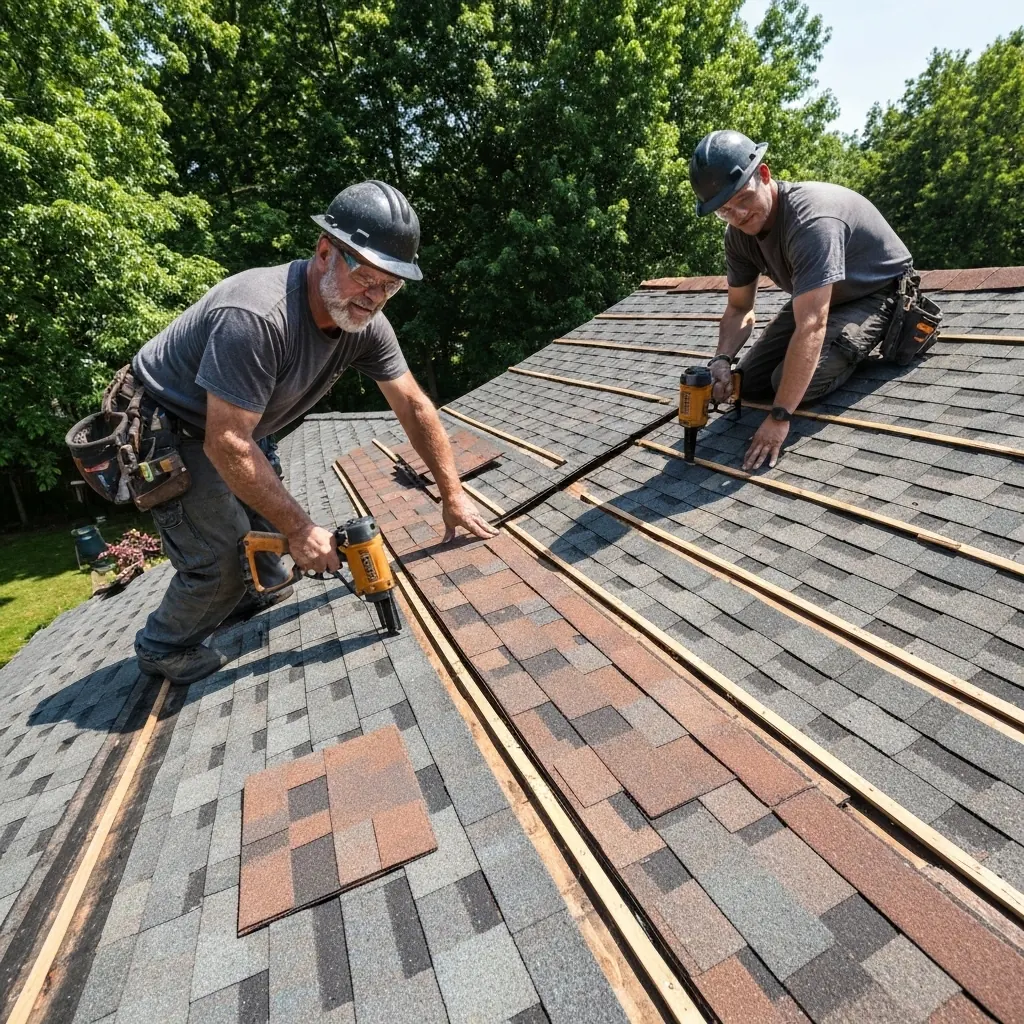
Yes, once. In most of the US you can install one new layer of asphalt shingles over a single existing layer, because the International Residential Code (Section R908.3.1.1) limits a roof to two layers. Skipping the tear-off saves about $100 to $150 a square, but only if the old shingles lie flat and the deck underneath is sound.
Before agreeing to an overlay, confirm four things.
- There is only one existing layer. If the roof already has two, everything comes off.
- The old shingles lie flat. Curled or buckled shingles show through the new layer.
- The deck is solid. Soft or rotted decking won't hold nails, and an overlay hides it.
- The framing can carry the weight. A second layer roughly doubles the shingle load on the rafters.
Can you put shingles over shingles?
Yes, an overlay is allowed when the existing roof has one flat layer of asphalt shingles over a sound deck and framing that can carry the extra weight. The main reason homeowners choose it is cost: about $2,000 to $3,000 saved on a standard 2,000-square-foot roof, because no one strips the old shingles or hauls several tons of debris to the landfill.
The Asphalt Roofing Manufacturers Association accepts the practice, saying shingles "can often be applied directly over existing roofs," but warns against uneven surfaces and roof decks with warped, rotted or unsound support. If any of the conditions above isn't met, the roof needs a tear-off.
An overlay saves a few thousand dollars up front
On a 20-square roof (2,000 square feet) with architectural shingles, an overlay costs about $9,000 to $15,000, against $11,000 to $18,000 for a tear-off and new roof. Architectural shingles run about $450 to $750 a square installed, and tear-off adds $100 to $150 a square per layer. An overlay also skips demolition day and most dumpster fees, which run $300 to $600 each.
| 20-square roof, architectural shingles | Typical cost |
|---|---|
| Overlay (no tear-off) | $9,000 to $15,000 |
| Tear-off and new roof | $11,000 to $18,000 |
| Extra for a future double tear-off | $2,000 to $3,000 |
Once the roofing calculator gives you your number of squares, you can price the tear-off yourself: squares times $100 to $150.
The savings look smaller over the life of the roof. The InterNACHI life expectancy chart gives about 20 years for 3-tab and 30 for architectural shingles on a properly installed roof. A second layer over an old one runs hotter and often fails several years early, which raises the cost per year.
The final replacement also costs more. Two layers are thicker, heavier and harder to remove than one, and they double the weight going into the dumpster, so a future double tear-off can add $2,000 to $3,000 to a 20-square estimate. That cost falls on you or on the next owner.
A second layer doubles the dead load
One square of asphalt shingles weighs 230 to 430 pounds, depending on thickness and quality. On a 2,500-square-foot roof, a single layer puts roughly 5,750 to 10,750 pounds of dead load on the house, and a second layer doubles it.
Most newer houses can carry that load. Older houses with 2x4 rafters or spaced board sheathing may not. The rafters gradually bow, a low spot forms, water collects there and eventually gets in. In snow country two layers of shingles plus two feet of wet snow can exceed what the trusses were designed for. Before any overlay, someone should inspect the attic for cracked rafters and signs of stress.
A second layer traps heat
A second layer traps heat. On a normal roof, heat passes through one layer of shingles into the deck and is carried away by attic ventilation. With two layers, the bottom layer acts as insulation and the top layer can't cool off.
A dark asphalt roof can reach 160 degrees Fahrenheit on a summer afternoon, and a double layer gets hotter. The heat drives oils out of the asphalt and causes early aging: cracking, granules washing into the gutters and curled edges. This is predictable enough that some manufacturers limit warranty coverage on overlays for that reason.
An overlay hides deck damage
Hidden deck damage is the biggest risk of an overlay, because none of the roof decking can be seen. The plywood or OSB deck is what everything else is nailed to, and if the old roof was leaking, the wood underneath may be soft, delaminated or rotting.
Nails don't hold in decayed wood. Without solid fibers to grip, the new shingles are vulnerable to wind, and a moderate storm can tear off whole sections. Skipping the tear-off buries the problem, and fixing it later costs far more than replacing a few sheets of plywood during a normal reroof.
Lumps in the old layer show through the new one
New shingles take the shape of the layer underneath. Shingles are flexible, and within a summer they settle onto whatever they rest on, so curled, buckled or wavy old shingles show through the new ones. Roofers call this telegraphing or telescoping. The roof can look fine when the crew leaves and lumpy a year later.
Thicker architectural shingles hide some of the unevenness, while 3-tab hides almost none. Curb appeal suffers, and so can resale, since buyers and home inspectors tend to see a double layer as deferred maintenance or cut corners.
Reusing old flashing is risky
Flashing is the metal that seals vulnerable spots such as chimneys, walls and joints between roof planes. A tear-off removes all of it and installs new metal. An overlay often reuses the old flashing or places new pieces over it.
Reusing flashing is risky. Old metal fatigues, and a pinhole or rusted edge is easy to miss. The extra thickness of two shingle layers also means step flashing along a sidewall may not reach far enough up behind the siding, and walls and chimneys are already the weakest points on a roof.
Overlays need longer nails
An overlay needs 1.75-inch or 2-inch roofing nails. A single-layer job usually uses 1.25-inch nails, which is enough to pass through one shingle and a 1/2-inch or 5/8-inch deck. On an overlay, each nail must go through the new shingle, the old shingle and then the wood.
Short nails barely grip the deck. As the deck swells and shrinks with the seasons, the nails back out (nail pops) and lift the shingle above into a small "fish-mouth" gap that lets in wind-driven rain.
Most manufacturers allow one overlay, with conditions
GAF, Owens Corning and CertainTeed all set rules for their limited lifetime warranties, and most allow one new layer over an existing one under conditions. The old shingles must lie flat, for example, and they must be asphalt.
If a leak develops, the manufacturer may blame the original layer or poor ventilation caused by the double thickness. The labor portion of the warranty is often void on an overlay, which means defective shingles may be replaced free but no one pays the crew to strip two layers and reinstall. Read the warranty for the specific brand going on your house so you know what coverage you give up.
Nesting and bridging
Installers lay new shingles over old ones in one of two ways.
- Nesting is the better method over 3-tab. The installer butts the top of each new shingle against the bottom edge of an old tab in the course above, so the new shingle tucks into the old one and the result is thinner and flatter.
- Bridging ignores the old courses. The new shingles are laid as if the surface were flat, which is common with architectural over 3-tab. It leaves air pockets between the layers, and shingles over those pockets can crack and leak when someone walks on them.
A good roofer chooses the method that suits both shingle profiles.
A second layer can choke the ridge vent
Code requires attic ventilation, and shingles last longer with balanced intake at the soffits and exhaust at the ridge. A second layer adds roughly half an inch to an inch of thickness at the ridge.
If the old ridge vent is shingled over and a new one is set on top, airflow can drop sharply. Moisture then stays in the attic, mold grows on the underside of the deck and the wood rots faster. Any overlay quote should include an assessment of the existing vents and whether they can handle the extra heat.
Some roofs can't take an overlay
Some roofs can't take an overlay at all.
- Wood shake, slate or clay tile roofs. These surfaces are too uneven for asphalt shingles.
- Roofs that already have two layers. The IRC, which most US jurisdictions adopt, prohibits a third.
- Sagging decks or structural problems. The roof must be torn off so the wood can be repaired.
- Widespread leaks or interior water damage. The old shingles must come off to find the source and repair the decking.
- Badly curled or cupped shingles. They don't provide a flat enough surface for a second layer.
Two layers can cost you when you sell
Home inspectors identify two layers quickly and note it in the report, and buyers then ask for a price reduction or a new roof. Since the buyer would inherit the cost of a double tear-off, the request is reasonable.
In a competitive market a two-layer roof can discourage buyers, and sellers often give back the money they saved on the overlay during negotiations.
How can you tell if a roof has two layers?
Check the roof edge at the gables or eaves, next to the drip edge. Two distinct layers of shingles stacked together mean the roof has already been re-covered once.
There are other signs. A double roof can feel firmer or spongier underfoot, depending on the condition of the materials. From the ground, it looks thick at the edges and slightly rounded at the ridge caps, and architectural shingles that look unusually bulky are often covering an older layer of 3-tab.
Questions for the roofer
- Did you inspect the attic? A roofer who recommends an overlay without going into the attic may be missing structural problems.
- What nail length will you use? 1.25 inches is the wrong answer for a double layer.
- How will you handle the chimney and valley flashing? A good contractor will want new valley metal and chimney flashing whether or not the job is an overlay.
- Is the warranty still valid on two layers? Ask for a written statement from the shingle manufacturer.
If the answers are vague, choose a tear-off.
Climate changes which overlay risk matters most
Climate changes which risk matters most. In hot, humid regions such as the Southeast, heat is the main problem: the shingles bake from the sun above and the trapped heat below, which shortens their life considerably.
In cold, snowy regions, the concern is weight. In windy regions it is blow-off, since nails may not grip as well through two layers as through one. Overlays tend to perform best in moderate climates without extremes.
A tear-off resets the whole roof
A tear-off costs more up front but resets the whole roof. With the old shingles gone, modern synthetic underlayment can go down, and on most older roofs it is a far better backup water barrier than the original felt paper.
Ice and water shield can also be installed at the valleys and eaves. This rubberized membrane bonds directly to the wood deck and stops ice dams and wind-driven rain, and it can't be applied properly over old shingles. Stripping to the deck means the wood, underlayment, flashing and shingles are all new and work together.
A tear-off usually costs less per year
Per year of service, a tear-off usually costs less. A $14,000 tear-off that lasts 25 years works out to $560 a year, while an $11,000 overlay that lasts 15 years is about $733 a year. Adding the $2,500 surcharge for the future double tear-off widens the gap.
An overlay makes sense mainly when you plan to move within a few years and need a working, leak-free roof for the lowest possible cost, and even then, disclosing the double layer at sale may cancel the savings. If you plan to stay, tear it off. A roof works as a system, and a clean, inspected deck remains the best foundation for it.
Shingling over shingles questions
How many layers of shingles are allowed on a roof?
Two at most under the International Residential Code, which most US towns adopt. If a roof already has two layers, both must come off before new shingles go on. Some local codes are stricter, so check with your building department.
Is it cheaper to put a new roof over old shingles?
Yes, up front. Skipping the tear-off saves roughly $100 to $150 a square, or about $2,000 to $3,000 on a 20-square roof. Those savings shrink once you account for the shorter lifespan and the more expensive double tear-off later.
Does shingling over shingles void the warranty?
Not automatically. Many manufacturers allow an overlay on one flat layer of asphalt shingles, but with conditions, and some coverage may be reduced. Get the warranty terms in writing before you agree to it.
Can you put architectural shingles over 3-tab shingles?
Yes. It is the most common overlay combination, provided the 3-tab is flat and the deck is solid. The nails must be longer, usually 1.75 to 2 inches, so they pass through both layers and into the wood.
What are the disadvantages of a roof overlay?
No one can inspect the deck, and bumps in the old layer show through. The roof runs hotter and heavier, ice and water shield can't be applied directly to the wood, and the next replacement means removing two layers instead of one.
Prices are 2026 US national averages and building codes vary by town. Materials, warranties and code adoptions change, so confirm prices with local contractors and code rules with your building department before you sign anything.
Estimate Your Roof Cost
Use our free roofing calculator. No sign-up required.