 RoofingCalculator.io
3-Tab vs Architectural Shingles
By RoofingCalculator.io. Updated October 14, 2026. Prices, ratings and code references link to their sources.
Pricing your own roof? Get squares, materials and a 2026 cost range in about two minutes. Free, no sign-up.
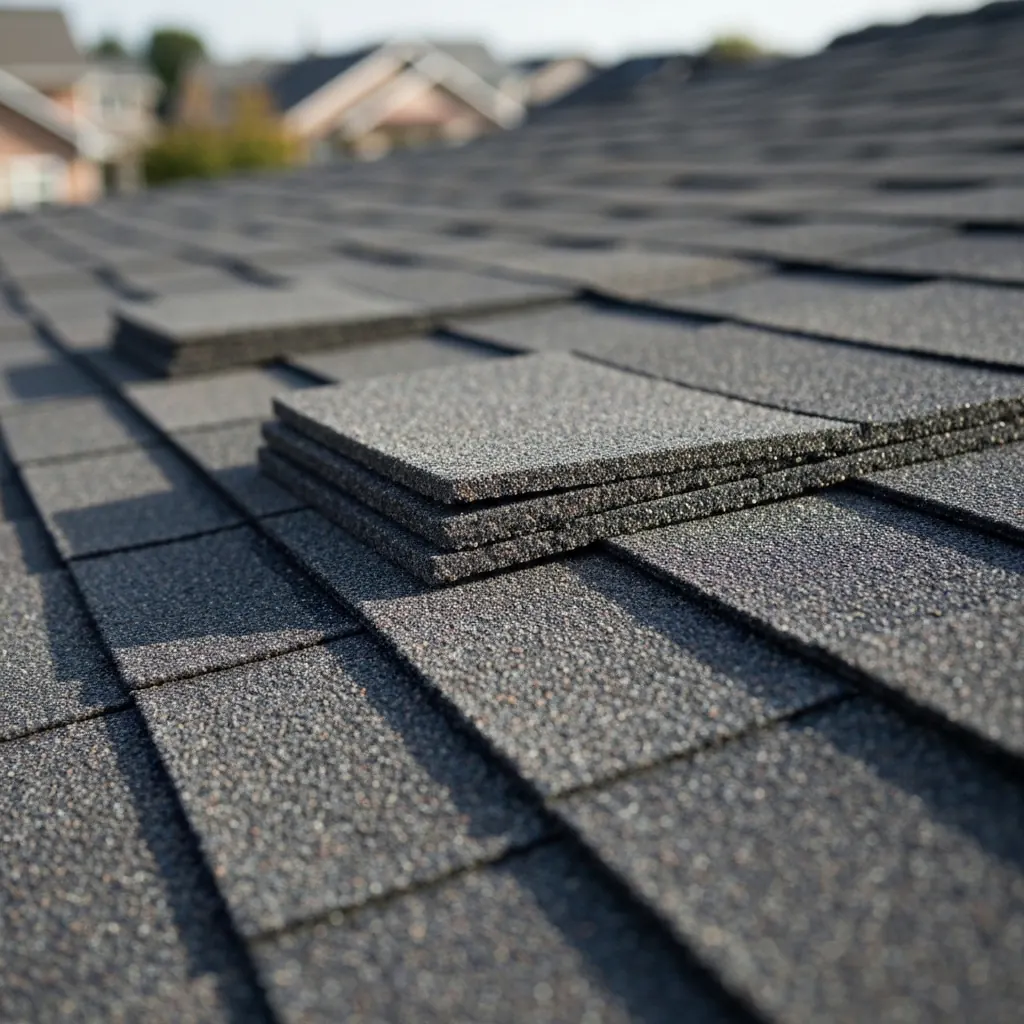
Architectural shingles cost more than 3-tab, about $450 to $750 a square installed against $380 to $550, but they usually last about ten years longer and resist far more wind. The IBHS Roof 101 guide explains the wind gap: the basic ASTM D3161 Class A rating is tested to 60 mph, while Class F, which most architectural shingles carry, is tested to 110 mph.
For most homes the choice comes down to four points.
- Architectural costs more up front. Expect roughly $70 to $200 more per square installed.
- Architectural lasts longer. Plan on about 25 to 30 years, against about 15 to 20 for 3-tab.
- Architectural handles wind and hail better. It is heavier, thicker and has no separate tabs for wind to lift.
- 3-tab still fits a few jobs. Sheds, outbuildings, low-value rentals and short-term fixes before a sale are the main ones.
What is the difference between 3-tab and architectural shingles?
A 3-tab shingle is a single flat, thin sheet with two notches cut into the bottom edge, so it looks like three separate tabs side by side. Architectural shingles, also called dimensional or laminated shingles, are two or more layers of asphalt-coated fiberglass bonded together. The layering gives them a textured, shadowed look somewhere between wood shake and slate.
Architectural shingles add a second bonded layer
Both types start the same way. A fiberglass mat is soaked in hot liquid asphalt, which is the layer that keeps water out, and ceramic-coated mineral granules are pressed into the top. The granules shield the asphalt from sunlight; without them it bakes, turns brittle and cracks within a few years.
The difference is the number of layers. A 3-tab is one sheet of even thickness, which makes it light and low in asphalt. A square of it (100 square feet) weighs about 200 to 240 pounds.
Architectural shingles add a second piece on top of the base, which roofers call the dragon tooth, bonded with a permanent adhesive. The result is stiffer and heavier, typically 250 to 450 pounds a square. That weight keeps the shingle flat when wind pulls at it and helps it absorb hail without folding.
How much do architectural shingles cost vs 3-tab?
Material alone runs about $90 to $120 a square for 3-tab and $125 to $170 for architectural. Premium or high-profile architectural lines can pass $250 a square. Roofers price by the square, meaning 100 square feet of roof.
With labor, underlayment, starter strip, ridge cap and overhead included, installed prices come to about $380 to $550 a square for 3-tab and $450 to $750 for architectural. Tear-off is extra, roughly $100 to $150 a square for each layer removed. Some crews find 3-tab slower to install because every cutout has to line up down the roof, but that rarely changes the labor price much.
| 25-square roof (2,500 sq ft) | Installed, before tear-off | Typical lifespan |
|---|---|---|
| 3-tab | $9,500 to $13,750 | 15 to 20 years |
| Architectural | $11,250 to $18,750 | 25 to 30 years |
To price your own house, get your square count from the roofing calculator and multiply it by both ranges. Compare the gap against the lifespans: 3-tab often needs replacing or serious repair at around 15 to 20 years.
Architectural shingles add depth that 3-tab lacks
A 3-tab roof looks flat and uniform, with straight horizontal rows and evenly spaced vertical notches. Most people associate it with older houses, rentals and budget builds, and it adds little depth to a house.
Architectural shingles change the look of the whole roof. The uneven layers cast shadows, and the texture hides small dips and bumps in the deck underneath. Many homeowners say the house looks more expensive afterward.
The difference also shows at resale. Real estate agents often say architectural shingles return more at sale time, and buyers can usually tell them apart from the curb. An aging 3-tab roof signals a coming expense, while a newer architectural roof signals one already taken care of. In some neighborhoods a 3-tab roof can pull a house's value below its neighbors.
Wind is the main weakness of 3-tab
Wind is the main weakness of 3-tab. The tabs are thin and light, so a strong gust can get under one, and if the sealant strip has weakened with age or cold, the tab flips back or tears off. That exposes the shingles next to it, and the damage spreads across the roof.
Architectural shingles are much harder to lift. They are heavy and have no separate tabs for wind to catch. Most are rated to 110 mph as standard, and with a high-wind nailing pattern (six nails instead of four) many brands warranty them to 130 mph.
Hail favors architectural shingles for the same reason. Two layers of fiberglass and asphalt absorb more impact, while a hailstone that hits a 3-tab bruises its single layer, knocks granules loose and can start a leak. Some premium architectural shingles carry a UL 2218 Class 4 impact rating, and in storm-prone states some insurers offer a premium discount for them. The label is not a guarantee, though. IBHS's FORTIFIED program warns that "many IR shingles do not perform as expected in real-world storms."
Architectural shingles last about ten years longer
The InterNACHI life expectancy chart puts 3-tab asphalt at about 20 years and architectural at about 30. A 3-tab package usually carries a 20-year or 25-year limited warranty. In hot, stormy climates, plan on closer to 15 years for 3-tab, because the thin sheet suffers from thermal shock: it expands and contracts with fast temperature swings until it cracks and sheds granules.
Architectural shingles often carry a "Lifetime" limited warranty, which in practice means about 25 to 30 years of service. The extra asphalt keeps them flexible longer, so they dry out and crack less than 3-tab.
Read the warranty terms in full. Most asphalt shingle warranties cover materials only, not the labor to replace them, and they are usually prorated after year ten. They also apply only if the roof was installed exactly to the manufacturer's specifications, including the right number of nails and the right underlayment.
3-tab and architectural shingles fail in different ways
3-tab shingles have three common failure modes.
- Curling. As the asphalt ages and dries, the tab edges turn up or down (roofers call it cupping or clawing). A curled shingle no longer sheds water properly, and wind can catch the lifted edge and tear it off.
- Thermal splitting. A single layer has less to hold it together through large temperature swings, so cracks open, usually vertically along the tab lines. Water then reaches the underlayment and eventually the wood deck.
- Faster granule loss. The thinner shingle flexes in wind and stretches in sun, and each movement loosens granules. Once they are gone, sunlight breaks down the bare asphalt and the bald patch soon leaks.
Architectural shingles fail less often, and usually because of the installation rather than the product.
- Delamination. The adhesive between the two layers lets go and the top piece slides off. This is rare on modern shingles but can happen in extreme heat or with a factory defect.
- Bad nailing. Each shingle has a nail line where the two layers overlap. Nails placed above it hold only the top layer, and within a few years the heavy shingle can slip and leave a gap.
- Deck overload. If the deck is already sagging, or the plywood or OSB (oriented strand board) is thin or damaged, a heavy laminated shingle makes it worse. Have the deck checked before you choose the shingle.
Longer-lasting architectural shingles are the greener choice
Architectural shingles are generally the greener choice because they last longer. A roof that lasts 30 years sends half as much material to the landfill as one replaced every 15.
Shingle recycling is more common than it used to be, and old shingles can be ground up and mixed into road paving. Availability depends on whether a plant operates near you, so ask your contractor whether the tear-off goes to a recycler or a landfill.
Both types come in "cool roof" versions with reflective granules that keep the attic cooler and lower air conditioning costs. Those granules are far more common in architectural lines, so in a hot climate a reflective shingle will most likely be an architectural one.
3-tab still suits sheds and tight budgets
3-tab is the cheapest way to get a working roof quickly, which makes it reasonable when the budget is tight and water is already coming through the ceiling. It also suits detached garages, sheds and outbuildings that don't need to match the house.
Landlords use 3-tab on lower-value rentals to limit capital spending. If you plan to sell within two or three years and the roof is failing, 3-tab gives you a functional roof for the listing without paying architectural prices.
Hurricane-prone areas are the exception. There, 3-tab usually costs more over time, because repairing blown-off shingles after each storm quickly uses up the savings. Coastal building departments generally require shingles rated for the local design wind speed, and many 3-tab products don't carry a high enough rating.
Choose architectural if you'll stay more than five years
If you plan to stay more than five years, choose architectural. Its longer life, higher wind ratings and better appearance are why it became the industry standard, and it needs less attention after storms and between them.
Steep roofs show off the texture more, so they get more of the visual benefit. Complex rooflines with many valleys and dormers are also easier to shingle, since architectural shingles don't require the precise tab alignment that 3-tab does.
Where insurance premiums are high, the upgrade can pay for itself through discounts, especially with an impact-rated shingle. Call your agent before choosing and ask which shingles qualify for a lower rate.
What to ask a contractor
Five details on the quote make a real difference to how an architectural roof performs.
- Ask for the exact brand and product line. "Architectural shingles" is not specific enough, because some lines have higher wind ratings or better algae resistance than others.
- Ask what starter strip they use. A common shortcut is an upside-down 3-tab as the starter on an architectural roof. Most manufacturers prefer their own starter, which seals better at the eaves and rakes and often raises the wind warranty.
- Ask about the ridge cap. Plain 3-tab pieces folded over the ridge look flat next to thick architectural shingles. A high-profile ridge cap that matches the thickness and texture costs a little more and looks much better.
- Ask whether they nail with four nails or six. In windy areas, six nails is often what qualifies the roof for the manufacturer's maximum wind warranty.
- Ask what underlayment goes under the shingles. Synthetic underlayment tears less easily than #15 felt and gives shingles a flatter base, which is why it is the standard pairing on modern architectural roofs.
Both shingle types need regular upkeep
Both shingle types need some maintenance to reach the end of their warranty. On 3-tab, check periodically for lifted tabs or cracked edges and repair them before wind can get under them.
Keep both kinds clear of debris. Leaves and pine needles packed into valleys or behind a chimney hold moisture against the shingles, which rots the wooden parts of the roof and feeds algae. Most architectural shingles include copper granules to resist Gloeocapsa magma, the algae behind black roof streaks, but that protection wears off over time.
Clean gutters matter too. Clogged gutters let water back up under the bottom row of shingles, and in cold climates that leads to ice dams. Thicker shingles don't stop ice damage; good attic insulation and ventilation do, by keeping the roof surface at an even temperature.
Overlays work best over flat 3-tab
An overlay, meaning a new layer of shingles nailed over the old one, works best over a single flat layer of 3-tab. Thick, uneven architectural shingles make a poor nailing surface, so most contractors won't overlay them.
Putting architectural shingles over old 3-tab adds serious weight, since a two-layer roof can reach 500 to 600 pounds a square. Confirm that the framing can carry it. Most codes allow no more than two layers in total.
A full tear-off is almost always the better job. The crew can inspect the deck, replace rotted boards and install fresh ice and water shield, which is essential waterproofing that can't be installed properly during an overlay. Labor costs more, but the new shingles perform as designed.
The market is moving away from 3-tab
The market is moving away from 3-tab. Manufacturers offer far more colors in their architectural and premium lines, and most new product development happens there, as the wider range of types of shingles now on the market shows. The price gap keeps narrowing, and 3-tab may eventually become a specialty item.
The newest category is "performance" architectural shingles made with SBS (styrene-butadiene-styrene) modified bitumen, a rubberized asphalt. It bends instead of cracking, so it handles large hail and extreme temperature swings. It costs more than standard architectural and is likely where residential roofing goes next.
For most homeowners, moving from 3-tab to architectural is the best value upgrade available on a roof. It costs modestly more in materials and returns that through better durability, wind resistance, appearance, lower upkeep and resale value for decades.
3-tab vs architectural shingles questions
Is it worth upgrading from 3-tab to architectural shingles?
For most homeowners, yes. You pay roughly $70 to $200 more per square and usually get about ten more years of service plus a much higher wind rating. Spread over the life of the roof, the yearly cost often comes out lower than 3-tab.
How long do 3-tab shingles last compared to architectural shingles?
About 20 years for 3-tab and about 30 for architectural, according to InterNACHI's life expectancy chart. Those are averages, not guarantees. Heat, storms, poor attic ventilation or a careless install can shorten either one.
Are 3-tab shingles still being made?
Yes, but the selection is shrinking. Manufacturers now put most of their colors and marketing into architectural lines, so 3-tab choices are fewer and matching an existing 3-tab roof for a repair can be difficult.
Can you mix 3-tab and architectural shingles on the same roof?
Yes. On one continuous slope it usually looks wrong, because the thickness and shadow lines don't match. On a separate section, such as a porch or garage roof, the difference is rarely noticeable.
Which shingle is better in high winds?
Architectural, by a wide margin. Typical 3-tab is tested to the 60 mph class and most architectural shingles to 110 mph or more. Many architectural lines carry 130 mph wind warranties when the roofer uses the manufacturer's high-wind nailing pattern.
Prices are 2026 US national averages and building codes vary by town. Materials, warranties and code adoptions change, so confirm prices with local contractors and code rules with your building department before you sign anything.
Estimate Your Roof Cost
Use our free roofing calculator. No sign-up required.