 RoofingCalculator.io
What Is an Asphalt Shingle Roof?
By RoofingCalculator.io. Updated October 14, 2026. Prices, ratings and code references link to their sources.
Pricing your own roof? Get squares, materials and a 2026 cost range in about two minutes. Free, no sign-up.
An asphalt shingle roof is made of overlapping rows of shingles nailed to a sloped roof, each one a fiberglass mat coated in asphalt and topped with ceramic-coated mineral granules. It is the most common roof in the country: the Asphalt Roofing Manufacturers Association says asphalt shingles sit "atop more than 80 percent of American homes." In 2026, an architectural shingle roof usually costs $450 to $750 a square installed.
Comparing asphalt shingle roofs comes down to four questions.
- Which grade are you buying? 3-tab, architectural and luxury shingles differ in thickness, wind rating, lifespan and price.
- What does the bid include? Tear-off, decking, pitch and roof complexity can move the price as much as the shingle itself.
- Who covers what under the warranty? The manufacturer covers shingle defects, and the contractor covers installation mistakes.
- Are the hidden parts done right? Underlayment, flashing, nailing and attic ventilation decide whether the roof reaches its rated life.
Composition roofing is another name for asphalt shingles
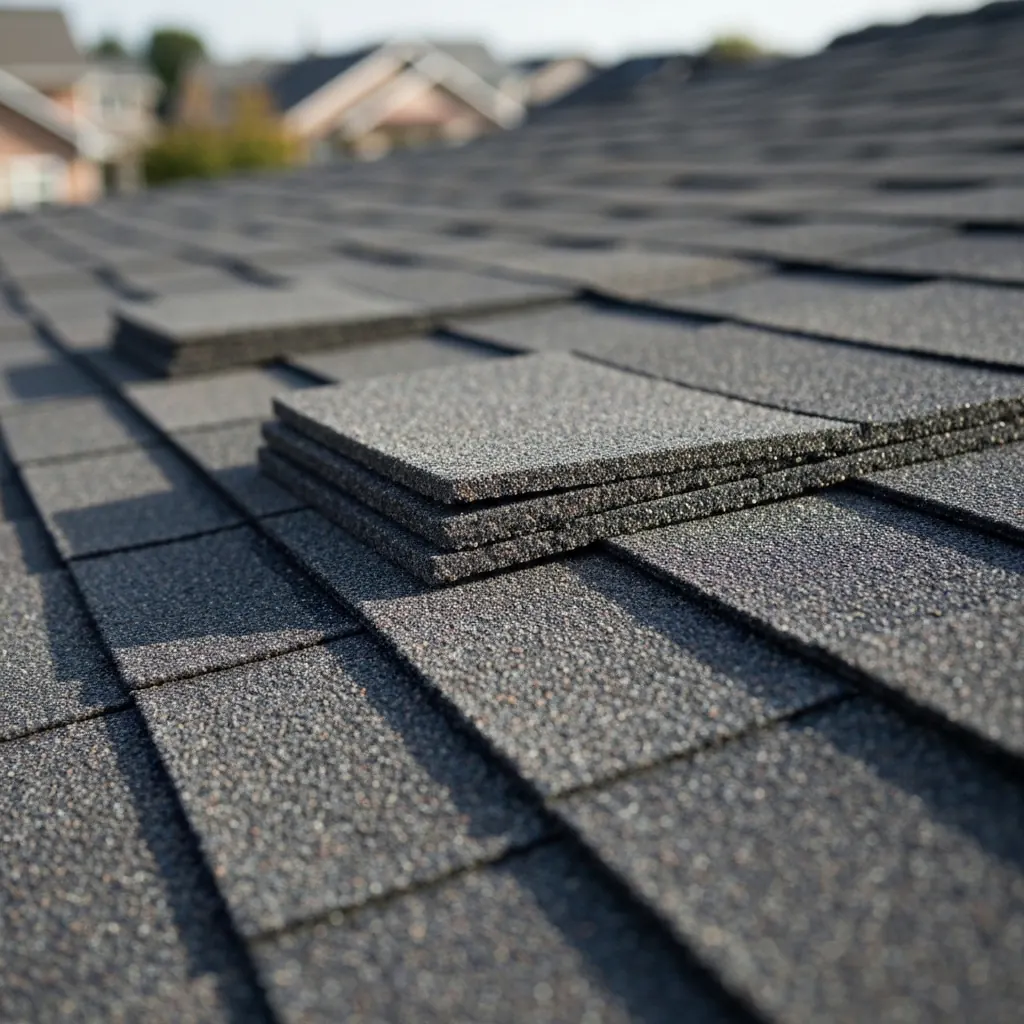
Composition roof and comp shingles are other names for asphalt shingles. The term comes from the shingle's makeup, a composite of reinforcing mat, waterproof asphalt and mineral granules, as opposed to a single natural material like cedar or slate.
The term is more common on the West Coast and in real estate and insurance paperwork. Some roofers use it to distinguish shingles from built-up or torch-down flat roofs, which also use asphalt but in rolls or mopped layers. Composite shingles are different: that term usually means synthetic slate or shake made from plastic and rubber, a separate product at a different price.
If three quotes say composition, comp and fiberglass shingles, they are describing the same family of products. Compare the grade instead, because that is where most of the difference in price and lifespan lies.
An asphalt shingle has three layers
An asphalt shingle has three layers. The core is a thin fiberglass mat, glass fibers bound with resin, which is strong and does not rot. Older shingles used organic felt or paper mats, and fiberglass replaced them because it performs better in fire and does not curl with age.
Asphalt coats both sides of the mat, often blended with a mineral filler such as ground limestone, and it is the layer that keeps water out. Ceramic-coated granules on top shield the asphalt from UV, add fire resistance and give the roof its color. Many brands blend in copper-coated granules to slow the algae that causes black streaks on north-facing roofs in humid areas.
On the back of each shingle is a sealant strip, a heat-activated asphalt adhesive. A few warm, sunny days after installation soften it, and each shingle bonds to the one below, turning separate pieces into a wind-resistant surface. Shingles installed in cold weather may not seal until spring, so winter crews sometimes hand-seal them.
3-tab, architectural and luxury shingles
The three grades differ mainly in thickness, weight and appearance.
| Grade | Weight per square | Wind rating | Installed cost per square |
|---|---|---|---|
| 3-tab | 200 to 240 lb | Often about 60 mph (standard nailing) | $380 to $550 |
| Architectural | 240 to 340 lb | Often 110 to 130 mph (high-wind nailing) | $450 to $750 |
| Luxury or designer | 400 lb or more | Varies by product | Often well over $750 |
3-tab shingles are mostly for rentals and sheds now
A 3-tab shingle is a single flat layer with two slots cut into the bottom edge, creating three equal tabs. From the street it looks flat and uniform. It weighs about 200 to 240 pounds a square, and many carry only about a 60 mile-per-hour wind warranty with standard nailing. Today 3-tab is mostly used on rentals, sheds and repairs that need to match an older roof.
Are architectural shingles worth it?
For most roofs, yes. Architectural shingles, also called dimensional or laminated shingles, have two or more layers bonded together. The top layer is cut in irregular shapes so the darker layer shows through, creating shadow lines that resemble wood shakes. They typically weigh 240 to 340 pounds a square, and many lines are rated for 110 to 130 mile-per-hour winds when nailed to the manufacturer's high-wind pattern.
Architectural shingles are now the standard for new roofs and replacements, because the price gap with 3-tab has narrowed while the lifespan gap has not. The 3-tab vs architectural shingles comparison goes into more detail.
Luxury shingles imitate slate and cedar shakes
Luxury shingles are the thickest and heaviest asphalt shingles, sometimes 400 pounds or more a square, cut and layered to imitate natural slate or thick cedar shakes. Many carry a Class 4 impact rating under the UL 2218 hail test. They cost noticeably more than architectural shingles, often well over $750 a square installed, but far less than real slate, which is also much heavier.
Most shingle roofs cost $380 to $750 a square
In 2026, expect about $380 to $550 a square installed for 3-tab and $450 to $750 for architectural shingles. A square is 100 square feet of roof, and those prices include materials, labor and cleanup for a standard one-layer replacement.
For a common 20-square roof (2,000 square feet of roof surface), that works out to about $7,600 to $11,000 in 3-tab and $9,000 to $15,000 in architectural. Your roof is larger than the house footprint once pitch and overhangs are counted, and crews add 10 to 15 percent for waste. The roofing calculator converts your house dimensions into a bundle count you can compare with the line item on a bid.
Several factors raise a bid:
- Tear-off. Each old layer removed adds about $100 to $150 a square. A second layer must come off anyway, because the International Residential Code forbids a recover "Where the existing roof has two or more applications" of roofing.
- Rotten decking. Damaged sheets are usually replaced at $80 to $150 each.
- Steep pitch. Roofs steeper than about 8/12 take longer and need more safety equipment.
- Complexity. Valleys, dormers, chimneys and skylights all add labor.
Labor is usually the largest share. A simple gable on a ranch house goes quickly, while a roof with hips, valleys and three levels can take twice as long for the same number of squares. Two houses with identical square counts can receive very different bids without anyone padding the price.
3-tab lasts about 20 years, architectural about 30
Asphalt shingles last about 20 years for 3-tab and 30 for architectural. Those figures come from the InterNACHI life expectancy chart, which lists "Asphalt (architectural): 30" for dimensional shingles. Luxury shingles can last longer because they have more material to wear away.
Many roofs fall short. Heat is the main cause: the asphalt slowly loses its oils and turns brittle, and south and west slopes fail before shaded ones. The same architectural shingle might wear out in its early 20s in Phoenix or Houston and last past 30 under mild northern summers. Hail, wind that breaks the seal strips and poor attic ventilation also shorten a roof's life.
Warranties are often misunderstood. A lifetime or 50-year manufacturer warranty covers defects in the shingles and is usually prorated after an initial period, so the payout shrinks as the roof ages. Installation mistakes fall under the contractor's workmanship warranty, typically 2 to 10 years. A manufacturer can also deny a claim if the roof was nailed incorrectly, the attic was not vented to its specifications or off-brand starter and ridge pieces were used.
A shingle roof depends on the layers beneath it
A shingle roof depends on the layers beneath the shingles. Underlayment goes down first, either asphalt-saturated felt or, on most jobs now, a synthetic sheet that resists tearing and wrinkling. In cold climates, an ice barrier, a self-adhering rubberized membrane, runs from the eaves to at least 24 inches inside the exterior wall so ice dams cannot push water back in.
Metal drip edge belongs at the eaves and rakes to direct water into the gutter instead of down the fascia. Starter strips with their own sealant go on first along those edges, and every chimney, wall and valley needs flashing. Slope limits also apply: code allows asphalt shingles only at 2:12 or steeper, requires a double layer of underlayment between 2:12 and 4:12, and requires a membrane roof on anything flatter.
Wind failures usually start with the nails. Each shingle has a marked nail line, and nailing above it can miss the layer underneath, leaving the shingle with only part of its holding power. Most brands call for four nails per shingle on a standard job and six in high-wind areas, driven straight and flush. Overdriven nails cut the mat, and underdriven nails gradually push up through the course above.
Attic ventilation completes the system. Intake at the soffits and exhaust near the ridge keep the attic close to outdoor temperature, which slows heat aging in summer and moisture buildup in winter. Baffles keep insulation off the soffit vents. Without good ventilation, even a well-installed roof deteriorates from below, and manufacturers often point to the attic when denying claims.
What are the signs a shingle roof is failing?
Granule loss is often the first sign. A little grit in the gutters after a new installation is normal, but heavy piles at the downspouts of an older roof mean the asphalt is losing its UV protection. Bald patches with dark asphalt showing come later.
Watch for these other warning signs:
- Cupping. Shingle edges turn upward, a sign of dried-out asphalt.
- Clawing. The middle of the shingle bows up while the corners stay flat, another sign of aging asphalt.
- Cracked or creased tabs. Often caused by wind, these mean the mat is broken and the shingle can no longer keep water out.
- Hail bruises. Dark, soft spots where hail knocked off the granules.
- Moss. It holds water against the shingle and can lift the edges.
- Attic stains. Stained sheathing, rusty nail tips or damp insulation mean a leak, more often at flashing or a pipe boot than in the open field of shingles.
One cracked pipe boot is a repair. Curling and bald spots across a 20-year-old roof usually mean it is time to replace it. To tell which you have, check the roof with binoculars from the yard and inspect the attic with a flashlight after a heavy rain, which covers most of what a roofer would look at.
Asphalt shingles win on upfront price
Asphalt shingles win on upfront price and familiarity. Almost every roofer installs them, repairs are quick and inexpensive, and color options are extensive. They lose on lifespan, since a metal or tile roof can outlast two shingle roofs.
| Material | Installed cost per square | Notes |
|---|---|---|
| Architectural shingles | $450 to $750 | About 30 years |
| Corrugated metal | $600 to $1,000 | Often 40+ years; sheds snow |
| Standing seam metal | $1,000 to $1,600 | Often 40+ years; sheds snow |
| Concrete tile | $900 to $1,600 | Lasts decades, fire resistant, may need framing reinforcement |
| Wood shakes | $900 to $1,400 | Needs more maintenance |
Composition shakes copy the look of wood with a Class A fire rating. If you plan to stay 10 to 20 years, architectural shingles usually make the most sense. In hail country, price Class 4 impact-rated shingles too, since many insurers offer a small premium discount for them. In hurricane zones, check the wind rating and make sure the crew uses the six-nail pattern the high-wind warranty requires.
Asphalt shingle roof questions
Is composition roofing the same as asphalt shingles?
Yes. Composition, or comp, roofing is another name for asphalt shingles. The name comes from the layered materials in each shingle (fiberglass mat, asphalt and mineral granules), and it covers 3-tab, architectural and luxury shingles.
How long does an asphalt shingle roof last?
About 20 years for 3-tab and about 30 for architectural, according to InterNACHI's life expectancy chart. Heat, poor attic ventilation and sloppy installation shorten that, and many architectural roofs in the South wear out in their low 20s.
How much does an asphalt shingle roof cost?
In 2026, roughly $380 to $550 a square installed for 3-tab and $450 to $750 for architectural. A 20-square roof comes to about $7,600 to $15,000. Each extra old layer torn off adds $100 to $150 a square, not including decking repairs.
Can you put new shingles over old shingles?
Sometimes, but only once. The International Residential Code does not allow a recover over two or more existing layers, or over a roof that is water-soaked or deteriorated. A tear-off also lets the crew inspect the deck, which is valuable on its own.
Is a composition roof better than metal?
It is cheaper and easier to repair, but it does not last as long. Metal can last 40 years or more and sheds snow well, but standing seam costs about $1,000 to $1,600 a square installed, roughly double architectural shingles. If you expect to sell within 15 years, shingles are usually the better value.
Prices are 2026 US national averages and building codes vary by town. Materials, warranties and code adoptions change, so confirm prices with local contractors and code rules with your building department before you sign anything.
Estimate Your Roof Cost
Use our free roofing calculator. No sign-up required.