 RoofingCalculator.io
What Is TPO Roofing?
By RoofingCalculator.io. Updated October 14, 2026. Prices, ratings and code references link to their sources.
Pricing your own roof? Get squares, materials and a 2026 cost range in about two minutes. Free, no sign-up.
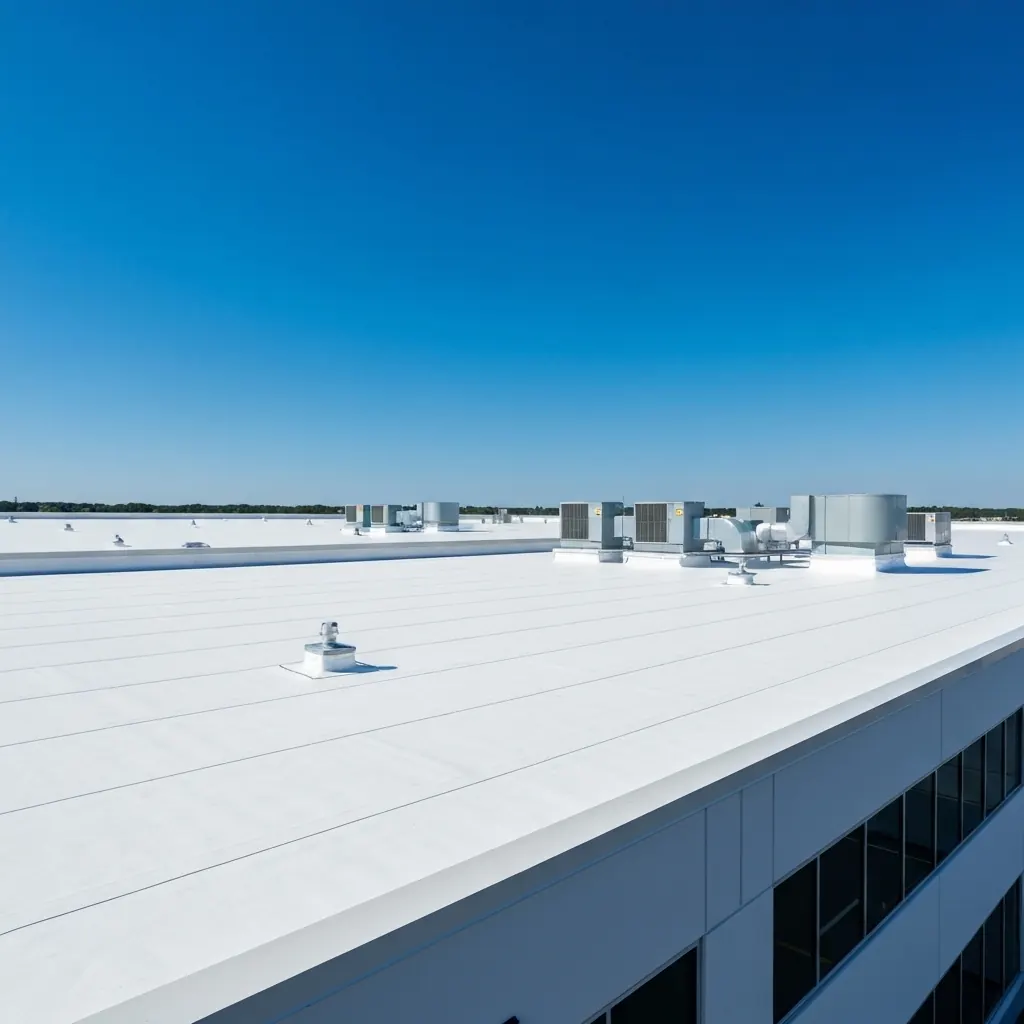
TPO (thermoplastic polyolefin) roofing is a white single-ply membrane made of polypropylene blended with ethylene-propylene rubber, installed in wide rolls that a crew welds together with hot air into one continuous surface. Installed, it costs about $650 to $1,100 per square (100 square feet) in 2026, or $6.50 to $11 per square foot. The International Residential Code allows it on roofs with "a design slope of not less than 1/4 unit vertical in 12," so it is used on porches, additions, garages and flat-roofed modern houses as well as commercial buildings.
Four decisions shape a TPO roof.
- Choose 60 mil for most homes. It costs a little more than 45 mil in material and about the same in labor, and lasts noticeably longer.
- Pick the attachment method for your wind exposure. Mechanically fastened is cheapest; fully adhered and induction-welded systems resist wind better.
- Count the penetrations. Skylights, vents, chimneys and curbs move the price almost as much as roof size.
- Hire a crew that tests and probes its welds. Seam quality decides whether the roof stays dry.
A TPO membrane has three layers
A TPO membrane has three layers. The top is a TPO compound with UV stabilizers and pigment, the middle is a polyester scrim (a woven fabric) that provides tear and puncture strength, and the bottom is another ply of TPO bonded to the fabric. At the factory, the melted polymer is pressed around the scrim so the fabric is sealed inside.
TPO flexes like rubber but melts and fuses like plastic when heated. That is its main advantage: EPDM seams must be glued or taped, while two pieces of TPO weld into one.
Rolls come up to about 12 feet wide and around 100 feet long, so a typical residential flat roof needs only a few seams. White is the standard color because it reflects sunlight, though light gray and tan are also available. TPO first appeared on commercial roofs in the 1990s as a lower-cost alternative to PVC, and it does not use the liquid plasticizers that made early PVC brittle.
Ask about the thickness of the top ply, the layer above the fabric. Sun and weather wear it down a little each year, and the thicker it is, the longer the scrim stays protected.
TPO costs $650 to $1,100 a square installed
TPO costs about $650 to $1,100 per square installed. On a 1,500-square-foot residential flat roof, that is roughly $9,750 to $16,500, including the membrane, insulation boards, fasteners and plates, edge metal, flashings and labor. Tearing off an old roof adds about $100 to $150 per square per layer.
Roof complexity moves the price a great deal. A plain rectangle over a garage with one plumbing vent costs far less than a same-size roof with two skylights, a chimney, an HVAC curb and three levels, because every penetration needs hand-welded flashing and every wall needs termination bar and sealant. Get the square count from the roofing calculator, then count every item that passes through the roof, since on TPO that number affects a bid nearly as much as the area.
Insulation also affects cost. Polyiso (polyisocyanurate) board is the usual choice under TPO because it packs high R-value into each inch. Two layers of 2-inch polyiso reach about R-23, and your local energy code may require more. Thicker board costs more and can require taller edge metal and curbs.
A recover, new TPO laid over the old roof, can avoid the tear-off cost when the existing roof is dry and solid. Recovery board goes over the old surface and the membrane goes on top. The IRC does not allow a recover over two or more existing layers, and any wet insulation must be removed first or it will rot the deck.
60 mil TPO is the usual recommendation
TPO comes in 45, 60 and 80 mil. A mil is a thousandth of an inch, so these are about 1.1, 1.5 and 2.0 millimeters. Most of the extra thickness goes into the weathering layer above the scrim, the part that wears away.
- 45 mil is the entry level. It is the cheapest and easiest to handle, but it has the least material to lose before the scrim is exposed and suffers first from hail, dropped tools and foot traffic.
- 60 mil is the usual recommendation. Most contractors steer homeowners to it, since it costs a bit more in material and about the same in labor.
- 80 mil offers the most long-term protection. It is stiffer, harder to work around tight details and more expensive, and manufacturers tend to reserve their longest warranties for thick membranes.
In hail country, on a roof with a frequently serviced rooftop unit, or if you plan to stay in the house for decades, 60 or 80 mil is worth the cost.
TPO is held down one of three ways
TPO is held down in one of three ways: mechanically fastened, fully adhered or induction welded.
Mechanically fastened systems are the most common. Screws and large round plates go through the insulation into the deck along one edge of each sheet, and the next sheet laps over them and is welded on top, hiding the fasteners. It is fast and inexpensive, but the middle of each sheet stays loose, so the membrane flutters and billows in strong wind.
Fully adhered systems glue the entire sheet to a cover board or the insulation. The crew rolls bonding adhesive onto both surfaces, waits until it becomes tacky, lays the membrane in and presses it with a weighted roller. The result is smooth and quiet with no flapping. It takes more adhesive and labor and is often specified in high-wind zones.
Induction welding starts with plates screwed to the deck. The membrane goes on top, and a magnetic induction tool heats each plate from above until it bonds to the underside of the sheet. This gives wind resistance close to a fully adhered roof with no fasteners through the membrane, though not every residential roofer owns the equipment.
Welded seams are TPO's main advantage
Welded seams are the main reason people choose TPO. A hot-air welder melts the underside of the top sheet and the top of the sheet below, and the two flow together into one piece. A good weld is stronger than the surrounding membrane, while EPDM relies on tape and primer that can let go after years of standing water.
Long, straight seams are welded with a walk-behind automatic welder that keeps speed, heat and pressure consistent. Corners, pipe boots and curbs are welded by hand with a heat gun and a small silicone roller. Too much heat scorches the sheet so it will not bond; too little produces a cold weld that looks fine at first and peels open a year later.
Good crews follow two checks:
- A daily test weld. Each morning they weld two scraps together and pull them apart. If the scrim tears before the layers separate, the settings are right.
- A full seam probe. When the roof is finished, someone runs a seam probe along every inch of every weld to find gaps.
Ask your contractor whether they do both. Those two habits largely separate a TPO roof that stays dry from one that needs patching every spring.
Does a white TPO roof save energy?
White TPO is a cool roof, and in hot climates the savings are real. It reflects most sunlight and releases the heat it does absorb. ENERGY STAR notes that a clean white roof reflecting 80% of sunlight "will stay about 50°F cooler" than a gray one reflecting only 20%.
A cooler roof lets less heat into the rooms below and reduces air conditioning load on summer afternoons. Actual savings depend on climate, the insulation under the membrane, and whether the space below is heated and cooled. A flat roof over a living room in Phoenix pays off well; one over an unheated garage in Minnesota saves very little.
Lower surface temperatures also mean less expansion and contraction, which reduces stress on seams and flashings. The benefit fades as the roof gets dirty, because dust, pollen and algae turn white TPO gray. Washing it gently once or twice a year with a soft brush and mild soap restores most of the reflectivity.
Where do TPO roofs leak?
TPO roofs usually fail at the details, almost never in the open field. Pipe boots, curbs, wall flashings and inside corners are all welded by hand, and an inexperienced installer can leave a small gap that lets water in. These are the first places an inspector checks.
Product quality is the second factor. TPO has a shorter history than EPDM or built-up roofing, and its formulations changed several times over the past few decades. Some early-2000s membranes aged quickly in high heat. Modern membranes from established manufacturers hold up much better, but choose a brand with a long production history and a real warranty program.
Concentrated heat is a less obvious risk. A large window or metal wall can reflect sunlight onto one area of the roof and overheat it until it shrinks or cracks. Grease and some oils soften TPO as well, so if a kitchen exhaust fan or leaking condenser drips on the roof, use PVC or at least a grease containment pad.
Ponding is the last common problem. Welded seams tolerate standing water better than taped ones, but a puddle that stays for days collects dirt, grows algae and loads the deck. Tapered insulation and clear drains solve this at the design stage for much less than later repairs would cost.
TPO falls between EPDM and PVC on price and performance
TPO falls between EPDM and PVC on price and performance.
| Membrane | Strengths | Weaknesses |
|---|---|---|
| TPO | Lowest upfront cost of the three; white and reflective; welded seams | Shorter track record; softened by grease |
| EPDM | More than half a century of use; handles severe cold and thermal shock; easy to patch | Taped seams; dark surface absorbs summer heat |
| PVC | White and welded; resists grease, chemicals and fire | Costs more |
The guide to EPDM roofing covers rubber membranes in depth. PVC mostly appears on restaurants, near kitchen exhausts and wherever code requires it.
For lifespan, InterNACHI's life expectancy chart lists TPO at 7 to 20 years. A thick, well-welded and clean TPO roof can reach the top of that range, while EPDM commonly lasts 25 to 30 years. Choose TPO for the lowest upfront cost and a cool roof, and EPDM for the longest proven record in cold climates. If you are also considering the other common residential option, see TPO vs modified bitumen.
Hire a crew that installs flat roofs every week
Hire a crew that installs flat roofs every week, not a shingle company that welds a few times a year. Ask three questions:
- Do you use an automatic welder on long seams? It keeps heat and speed consistent.
- Do you make a test weld every morning? It confirms the welder settings for that day.
- Do you probe every seam at the end? It catches gaps before they leak.
Ask for addresses of TPO roofs they installed at least five years ago so you can see how the work has held up. Certification also matters: Carlisle, GAF, Firestone and others train and certify installers, and certified crews can usually offer extended warranties covering both material and labor.
A good written estimate names the manufacturer and product line, membrane thickness, insulation type and total R-value, attachment method, edge metal, and how the membrane terminates at walls. A price per square with no other detail is a red flag, because termination bars, edge metal and sealant keep a roof dry as much as the membrane does.
TPO is low maintenance, not maintenance-free
TPO is low maintenance but not maintenance-free. Once or twice a year, wash it with a garden hose or low-pressure washer, a soft brush and mild detergent, avoiding harsh solvents that damage the surface. Clear drains, scuppers and gutters at the same time, since one clog on a flat roof creates a pond.
Inspect the roof after major storms for punctures, loose edge metal and lifted flashing. Small holes are easy to fix: the roofer cleans the area with weathered-membrane cleaner and welds a TPO patch over it, a permanent repair, unlike sealant that fails within a year.
Check the caulk where the membrane meets brick, siding or a chimney. It usually dries out and cracks within five to seven years, long before the membrane wears out. Replacing it is inexpensive, and keeping it fresh stops water from getting behind the flashing so the roof reaches the full life its thickness and installation should provide.
TPO roofing questions
How long does a TPO roof last?
7 to 20 years, according to InterNACHI's life expectancy chart. A thick 60 or 80 mil membrane from an established manufacturer, with probed seams and regular cleaning, lasts toward the top of that range. Thin 45 mil on a hot roof with heavy foot traffic lasts toward the bottom.
How much does a TPO roof cost?
Roughly $650 to $1,100 per square installed, or $6.50 to $11 per square foot, including insulation, flashings and labor. Tearing off an old roof adds about $100 to $150 per square per layer. Thickness, insulation and the number of roof penetrations decide where a job falls in that range.
Is TPO better than EPDM?
It depends on the roof. In hot, sunny climates, TPO's white, reflective surface and heat-welded seams make it a strong choice. EPDM, the black rubber membrane, has the longer track record and stays more flexible in deep cold, but its seams rely on tape and adhesive.
Can you walk on a TPO roof?
Yes, occasionally, for inspections or service calls, if the membrane is in good condition. Frequent foot traffic around HVAC units or hatches scuffs and punctures it, so crews install walkway pads along regular paths. Stay off it when it is wet or frosty, because it is very slippery.
What are the disadvantages of TPO roofing?
It has a shorter history than EPDM or built-up roofing, and early formulations varied widely between brands. Seam quality depends entirely on the installer. Sunlight reflected from nearby glass can overheat it, and grease softens it, which is why PVC is used near restaurant exhaust fans.
Prices are 2026 US national averages and building codes vary by town. Materials, warranties and code adoptions change, so confirm prices with local contractors and code rules with your building department before you sign anything.
Estimate Your Roof Cost
Use our free roofing calculator. No sign-up required.