 RoofingCalculator.io
What Is PVC Roofing?
By RoofingCalculator.io. Updated October 14, 2026. Prices, ratings and code references link to their sources.
Pricing your own roof? Get squares, materials and a 2026 cost range in about two minutes. Free, no sign-up.
PVC roofing is a single-ply polyvinyl chloride membrane, reinforced with polyester mesh, used on flat and low-slope roofs. Its seams are fused with hot air so the roof acts as one continuous sheet, and it resists grease and chemicals better than most membranes. Installed, it costs about $8.50 to $14.50 per square foot.
Four points matter most when you are considering it.
- It costs more than TPO or EPDM up front. Low maintenance and strong welded seams often make it cheaper to own over 20 years.
- It is the standard choice for grease or chemical exposure. Restaurant exhaust and oils do not break it down.
- Choose 60 mil for most homes. It usually carries a 20-year warranty, while 80 mil can last 30 years or more.
- Hire a manufacturer-certified installer. Weld quality and edge details decide how long the roof lasts.
Most homeowners pay $8.50 to $14.50 a square foot
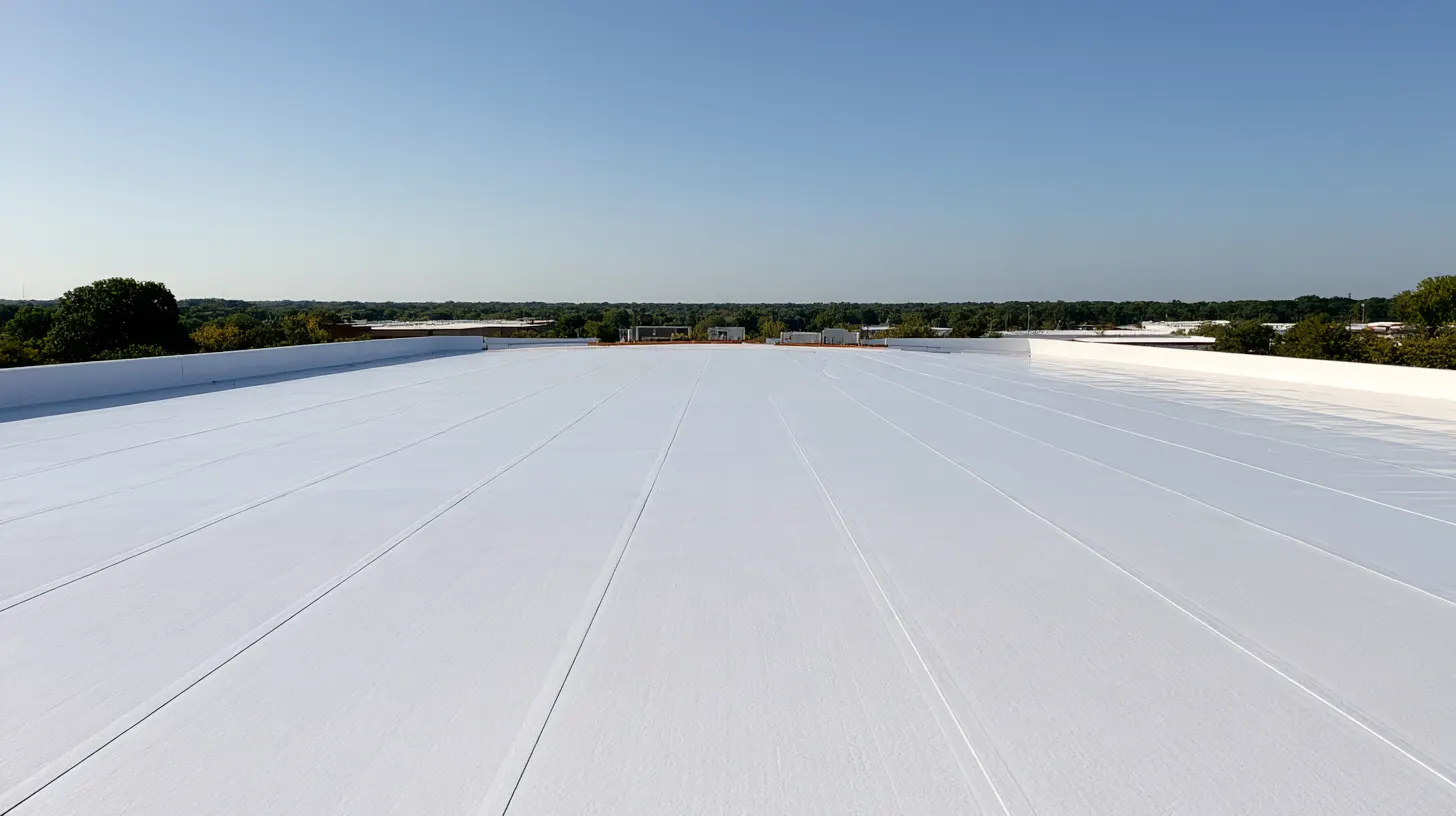
Most homeowners pay $8.50 to $14.50 per square foot for professional installation. On a typical 1,500-square-foot flat roof, that comes to about $12,750 to $21,750 for tear-off, new insulation, the membrane and labor. To estimate your own range, multiply your roof's square footage by those two figures; the roofing calculator gives you the square footage.
The material itself usually costs only $1.50 to $3 per square foot. The rest depends on thickness, insulation and how many penetrations the roof has. Skylights, vents and chimneys each need detail work and extra welding, and those labor hours add up.
PVC membrane is two layers around a polyester scrim
A PVC membrane is two layers of PVC with a polyester scrim between them. Plasticizers are added to the vinyl at the factory to keep it flexible enough to unroll and to handle heat and cold, and UV stabilizers in the top layer help it reflect sunlight.
PVC is naturally fire-retardant. Chemicals, grease and animal fat do not damage it, which is why it is used both on homes and on restaurant roofs above commercial kitchens.
Labor is 40% to 60% of a PVC estimate
Labor can be 60% of the estimate in expensive cities and coastal markets, and closer to 40% in the Midwest and rural areas. A typical job takes a crew of three to five people two to four days, weather permitting.
The attachment method also affects price:
- Mechanically attached is the least expensive. The membrane is screwed through the insulation into the deck.
- Fully adhered costs more. Bonding adhesive and the time to apply it add to the bill.
- Induction welding falls in between. Electromagnetic heat bonds the membrane to plates underneath.
Tear-off adds about $1 to $1.50 per square foot per layer, and an old multi-layer built-up roof with gravel means more labor and more debris. Some codes allow a recover instead, with PVC installed over one layer of old roofing and a separator sheet between them. That avoids the tear-off cost, but trapped moisture underneath can shorten the new roof's life.
PVC beats TPO on grease, welding and fire
PVC is usually compared with TPO roofing (thermoplastic polyolefin), since both are white and heat-welded. TPO is usually a little cheaper. PVC has been in use since the 1960s, while TPO is newer and its formulation has been revised several times over the last twenty years.
PVC has three main advantages:
- Grease resistance. Oils and fats do not break it down, so roofs near restaurant exhaust or with heavy maintenance traffic should usually be PVC.
- Long-term weldability. Old TPO can turn brittle and hard to patch, while PVC can often be cleaned and welded ten or fifteen years after installation.
- Built-in fire resistance. PVC self-extinguishes, while TPO needs added flame retardants to reach similar ratings, which matters in wildfire areas and on closely spaced city houses.
60 mil PVC is the usual choice for homes
PVC membranes come in 40, 50, 60 and 80 mil (thousandths of an inch), and 60 mil is the usual choice for homes.
| Thickness | Typical warranty or life | Notes |
|---|---|---|
| 40 mil | 10 or 15 years | Entry level; easier to puncture |
| 60 mil | Usually 20 years | Best balance of toughness and price |
| 80 mil | 30 years or more | Heavier and pricier; seams handle movement better |
New white PVC reflects most of the sunlight that hits it. As dirt builds up, the surface dulls and cooling costs can creep up slightly; an occasional cleaning with a soft brush and mild soap restores it. The savings are smaller in northern climates and larger in the South, where air conditioning dominates the power bill.
PVC seams are heat welded, not taped
PVC seams are fused with hot air, not taped like EPDM. A robotic walker or a handheld heat gun melts the top and bottom of the overlap so the two sheets become one.
A good weld is stronger than the sheet: when a test seam is pulled apart, the membrane should tear before the weld does. That seal is unaffected by ponding water, which matters because many flat roofs hold water for 24 to 48 hours after a storm. Ponding is not good for any building, but PVC handles it better than asphalt-based systems, which soften and break down under standing water.
Crews should calibrate their welders every day, setting air temperature and travel speed for that day's heat and wind. If the welder is too cold, the layers do not fuse; if it is too hot, the PVC scorches and damages the scrim.
Why do PVC roofs fail?
PVC roofs mostly fail through plasticizer loss. Plasticizers make rigid PVC resin flexible, and over many years they can leach out. The membrane then shrinks and turns brittle, pulls away from the edges, and leaks at the perimeter or around vents.
Cheaper membranes lose plasticizer faster. Better brands use high-molecular-weight plasticizers that stay in the vinyl longer. If a PVC roof crackles underfoot on a cold day, the plasticizers are gone and the roof is at the end of its life.
Punctures also happen. The scrim resists tearing, but dropped tools, hail and storm debris can still go through. Leaks can be hard to locate, because water may enter at one point and travel ten feet under the membrane before it drips into the house.
Maintenance is mostly drains and seams. A clogged drain causes standing water, and standing water is heavy and hard on the deck. Twice a year, have someone run a rounded metal probe along the seams to find any welds that have opened. Most small holes are fixed by welding a new patch of PVC over them.
Polyiso is the usual insulation under PVC
Polyiso (polyisocyanurate) foam board is the usual insulation under PVC, because it packs high R-value into each inch. Most codes set a minimum R-value for a new roof, which often means two layers of 2-inch or 2.5-inch board.
The layers are staggered so heat cannot escape through the joints between boards, a problem called thermal bridging. A cover board of high-density wood fiber or gypsum often goes on top. It keeps foot traffic from crushing the foam and gives the PVC a smooth, hard surface to bond or fasten to.
Cover boards add $0.70 to $1.20 per square foot and are worth it in hail country. Without one, a large hailstone can dent the soft foam and stretch the membrane over the dent until it eventually cracks.
PVC is a genuine cool roof
PVC is a genuine cool roof. It reflects sunlight, reduces the urban heat island effect and runs far cooler than black rubber or asphalt. ENERGY STAR notes that a clean white roof reflecting 80 percent of sunlight stays about 50°F cooler than a gray roof reflecting 20 percent. A cooler roof also expands and contracts less each day, which reduces thermal shock on the building.
Its environmental record is mixed. Manufacturing PVC takes less energy than many roofing materials, and its long life keeps material out of landfills. On the other hand, vinyl production uses chlorine and creates dioxins. Many PVC membranes are recyclable at the end of their life, but only some regions can collect and process old roofs.
PVC can earn LEED or other green building points for heat island reduction. Its service life also beats asphalt shingles or modified bitumen, which may be replaced twice during the life of one 80-mil PVC roof.
Hire a manufacturer-certified PVC contractor
Hire a contractor certified by the membrane manufacturer. Major manufacturers such as Sarnafil, IB Roof Systems and Carlisle require training before a contractor can offer their better warranties, and a manufacturer-backed warranty covering material and labor beats a workmanship warranty from the contractor alone.
Check these points in every bid:
- Insulation and cover board in writing. Some bids come in lower by dropping the cover board or using lower-density foam.
- Thickness in mils. The quote should state 60 mil or 80 mil, not "standard weight."
- Welding equipment. Experienced PVC crews use automatic hot-air welders on long runs and hand welders for pipes and corners. A contractor who mentions seam tape or glue for PVC seams is using the wrong method.
- Edge details. PVC-coated metal flashing lets the membrane be welded directly to the drip edge, which resists wind far better than termination bars and caulk.
PVC adds very little weight to a roof
PVC weighs only about 0.25 to 0.5 pounds per square foot, so it adds very little dead load. Replacing an old gravel-covered built-up roof with PVC reduces the load considerably.
On a plywood or OSB deck, the contractor should look for rot and soft spots and replace damaged sections before the insulation goes down. Steel decks take heavy-duty screws into the top flutes, and concrete decks may need special anchors.
A roof that looks flat should still slope at least 1/4 inch per foot to drain, and the International Residential Code sets that as the minimum design slope for thermoplastic single-ply roofs such as PVC. If water sits on the roof after every rain, tapered insulation (foam boards with the slope built in) is the best fix for a structurally flat deck. It costs more and needs a detailed shop drawing to get right.
Is PVC roofing worth it?
Usually, yes. PVC is a long-term investment. It costs more up front than EPDM or TPO, but low maintenance and strong welded seams often make it cheaper to own over 20 years, and fused seams are worth the premium over a bedroom or living room.
The building and climate decide the rest. In hot, sunny regions a white PVC roof saves real energy, and with kitchen exhaust or chemicals on the roof it is the usual single-ply choice. On a tight budget with no grease exposure, TPO may be enough, but for the longest life and fewest leaks, PVC remains the benchmark among single-ply membranes.
PVC roofing questions
How long does a PVC roof last?
Twenty to 30 years is common for a good installation, and a thick 80-mil sheet can last longer. Plasticizer quality, weld quality and drain maintenance decide where a given roof falls in that range.
How much does PVC roofing cost?
Most homeowners pay about $8.50 to $14.50 per square foot installed. On a 1,500-square-foot flat roof, that is roughly $12,750 to $21,750 including tear-off, insulation and labor. Thicker sheets and cover boards raise the price.
Is PVC roofing better than TPO?
In several ways, yes. PVC resists grease, oil and chemicals, stays flexible longer, and is easier to re-weld years later, although TPO usually costs less. If a roof has kitchen exhaust or chemical exposure, choose PVC.
Is PVC roofing good for homes?
Yes, especially for flat roofs over bedrooms, rooftop decks and additions. Welded seams resist leaks, and the white surface reflects sunlight. A small puncture can be repaired by welding a new piece of PVC over it.
What are the disadvantages of PVC roofing?
It costs more than TPO or EPDM. If plasticizers leach out over the years, it can turn brittle in severe cold. It also needs a trained crew with properly calibrated welders, and cheaper sheets shrink more.
Prices are 2026 US national averages and building codes vary by town. Materials, warranties and code adoptions change, so confirm prices with local contractors and code rules with your building department before you sign anything.
Estimate Your Roof Cost
Use our free roofing calculator. No sign-up required.