 RoofingCalculator.io
What Is a Slate Roof?
By RoofingCalculator.io. Updated October 19, 2026. Prices, ratings and code references link to their sources.
Pricing your own roof? Get squares, materials and a 2026 cost range in about two minutes. Free, no sign-up.
A slate roof is made of natural stone split into thin tiles and nailed in overlapping rows on a steep roof. It lasts longer than almost any other roofing: the National Park Service says properly installed slate roofs last 60 to 125 years or longer, depending on the slate, the roof design and the location. Installed cost runs about $15 to $35 a square foot.
A slate roof that reaches that lifespan depends on four choices.
- Buy S1-grade stone. ASTM C406 grades slate by expected service life, and S1 is rated for more than 75 years.
- Confirm the framing can carry it. Slate weighs 800 to 1,500 pounds per square, several times more than asphalt shingles.
- Use copper or stainless fasteners and copper flashing. Steel nails and aluminum or galvanized flashing fail decades before the stone.
- Hire a slate specialist. Slate is its own trade, and most shingle crews are not trained to install or repair it.
Roofing slate is metamorphic rock
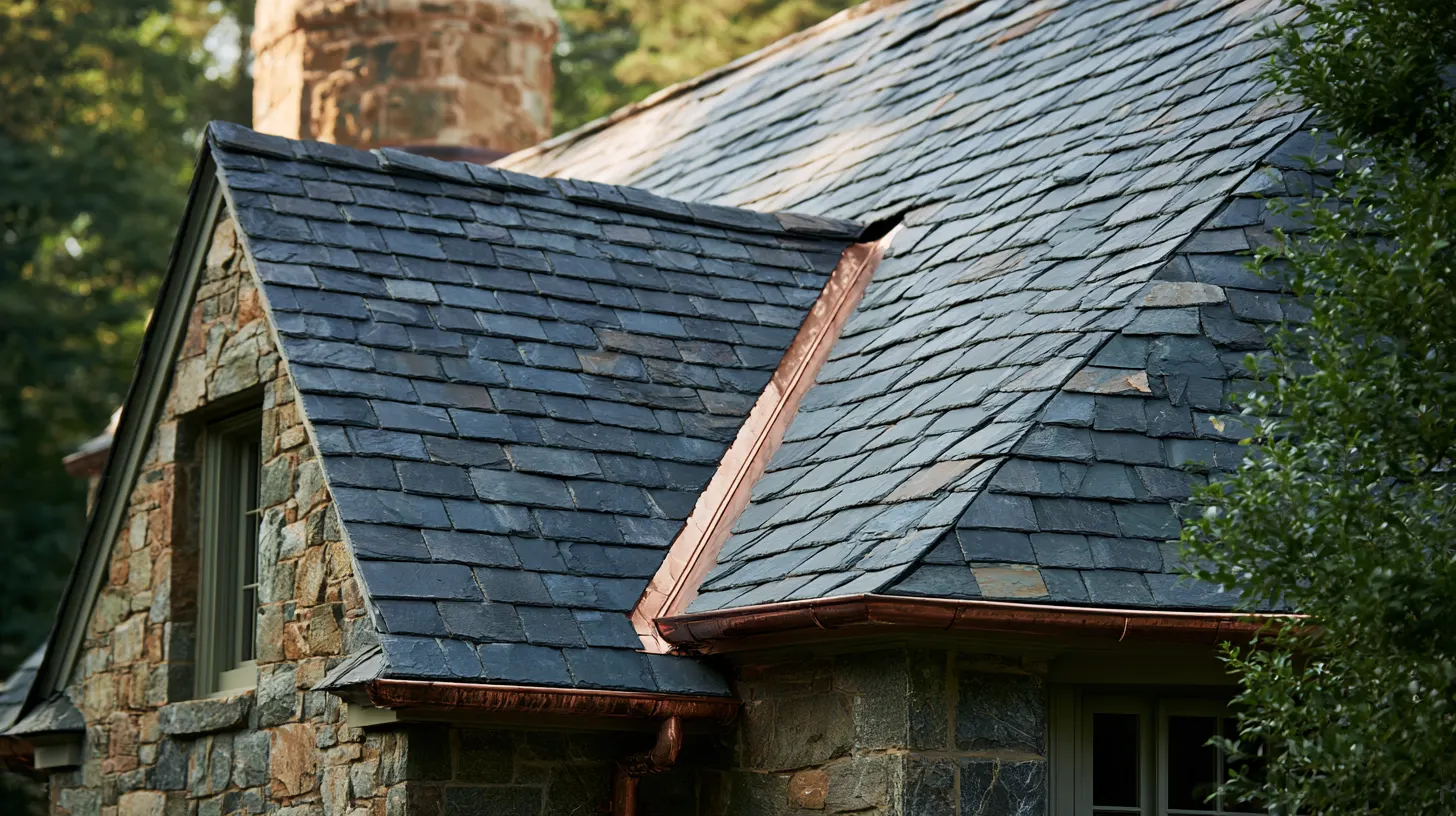
Slate is a dense, fine-grained metamorphic rock formed when layers of clay and shale are subjected to heat and pressure from shifting tectonic plates over hundreds of millions of years. It splits naturally into thin, flat sheets. Quarries cut it out in large blocks, and workers split those blocks into roofing tiles by hand with chisels.
The stone's mineral content determines how long it lasts. Good slate is mostly quartz, chlorite and mica. Calcium carbonate and carbon-rich material are the problem minerals. Slate with too much calcium reacts with acid rain and pollution in a process called gypsification, which softens and swells the stone until it peels apart in layers.
In North America, most roofing slate comes from the slate belt of Vermont and New York or from quarries in Pennsylvania and Virginia. Each region's stone has its own character. Vermont slate is known for its range of colors and its durability, while Pennsylvania black slate is softer and does not last as long.
Slate costs $15 to $35 a square foot installed
Slate is one of the most expensive roofs you can buy, at about $15 to $35 a square foot installed. On a standard 2,000-square-foot roof, that is $30,000 to $70,000 for materials and labor. Slate is bid by the square like other roofing, so convert your roof to squares with the roofing calculator and multiply by those prices to check whether a bid is reasonable.
The stone is a large share of the cost. Thin, basic slate starts around $5 to $8 a square foot, and better grades, custom sizes and rare colors exceed $15 a square foot for the stone alone. Labor is also expensive, often more than half the bill, because most shingle crews cannot do this work.
Breakage adds to the order. Slate is brittle, and some pieces crack in shipping and handling, so contractors usually order 10% extra to cover breakage and cutting at hips, valleys and ridges.
ASTM grades slate by expected service life
ASTM (the American Society for Testing and Materials) grades roofing slate under its C406 standard into three grades by expected service life. Check the grade on the pallet before installation begins.
| ASTM C406 grade | Expected service life | Notes |
|---|---|---|
| S1 | Over 75 years | Many S1 roofs last 100 to 200 years; resists acid rain and absorbs very little water |
| S2 | 40 to 75 years | Mid grade |
| S3 | 20 to 40 years | Lowest residential grade; edges crumble and faces flake early |
The stone is only part of the system. Slate can last two centuries while the nails and flashing fail much sooner. Galvanized steel nails cause nail sickness: the nails rust away and sound slates slide off the roof. The NPS slate brief is direct on this point, recommending non-ferrous slater's nails such as solid copper or stainless steel, since plain steel and galvanized nails usually rust out long before the slate.
How much does a slate roof weigh?
A square of slate (100 square feet of roof) weighs 800 to 1,500 pounds, compared with 200 to 300 pounds for a square of standard asphalt shingles.
Most house framing is not designed for that load. A home built for shingles or wood shakes usually needs reinforcement first. A structural engineer evaluates the rafters and trusses, and the fix often involves adding rafters or sistering new ones to the old.
Thickness determines weight. Standard slate is 3/16 to 1/4 inch thick, and architectural slate is 1/2 inch to 1 inch or more. Thicker stone means a heavier load and higher costs for both the stone and the framing.
Weathering and unfading slate colors
Slate colors fall into two categories, weathering and unfading. Unfading slate keeps its original color for life, which suits owners who want a uniform roof. Common unfading colors include black, gray and green.
Weathering slate changes color over time. A weathering green can start sea-green and shift toward buff, tan or brown within a few years as its iron-bearing minerals oxidize. The result is a mottled roof with several tones, which many owners prefer.
Color affects price. Rare colors such as mottled purple and red cost much more than standard gray or black. Red slate is especially expensive because it comes from a single narrow vein of rock in the New York part of the slate belt and is among the hardest slates available.
Flashing is the weak link in a slate roof
Flashing at valleys, chimneys and roof-to-wall joints is the weak link in a slate roof, so it needs to last as long as the stone. Copper is the standard because it bends easily, does not corrode and develops a protective patina. Lead-coated copper is also used so runoff does not stain light-colored slate or masonry.
Aluminum or galvanized flashing is a poor match for slate. It fails decades before the stone, and replacing it means removing and reinstalling slate, which is expensive.
Underlayment provides backup protection, especially during installation. On a long-life slate roof, it is a high-quality self-adhering modified bitumen membrane or a heavy-duty synthetic, where 30-pound or 60-pound felt was once standard. Code requires underlayment, but the slate is still meant to shed the water.
Slate roofs usually fail because of people, not stone
When a slate roof fails, the cause is usually people or other materials, not the stone.
- Foot traffic. Slate cracks under a person's weight, so inspections and repairs should be done from roof hooks and ladders or a lift.
- Nail sickness. The wrong fasteners rust through, slates slide out and leave holes. When many slates are loose, the roof often needs re-nailing, which means removing the slate, installing new underlayment and relaying the same stone with proper nails.
- Ice dams. In cold climates, snow and ice build up at the eaves, water backs up under the slate and leaks in. The fix is attic insulation and ventilation, not changes to the slate.
Can you repair a slate roof?
Yes. A single cracked slate is replaced without disturbing the slates above it. The slater slides a slate ripper, a long, thin steel blade with a hook, under the damaged piece, catches the nails and cuts them.
After the broken pieces come out, a new slate of the same size and color slides into the gap and is held by a copper tingle or a slate hook. A tingle is a thin copper strip nailed to the deck between the slates below and bent up over the new slate's bottom edge, so no nails go through the slates above. It is a long-established method.
Have a slate roof inspected every two to three years. Replacing a few cracked pieces or clearing a valley costs far less than repairing water damage and extends the life of the roof.
Synthetic slate is molded polymer made to look like stone
Synthetic slate is rubber, plastic or mineral-reinforced polymer molded to look like stone. It usually costs $9 to $18 a square foot installed, and the synthetic vs natural slate comparison covers the trade-offs in detail.
Its main advantage is weight. Synthetic slate works on standard framing without reinforcement, is easier to walk on and breaks less in transport. The trade-off is lifespan, typically 30 to 50 years.
The environmental profiles differ too. Natural slate needs little processing and lasts long enough that it rarely ends up in a landfill. Synthetic slate is petroleum-based, and its performance after decades of UV exposure is still being established, while natural stone has a long track record.
Most slate roofs need at least 3 inches of headlap
Headlap is how far a slate overlaps the slate two courses below it, and most roofs of normal pitch need at least 3 inches. Lower pitches need 4 inches or more, or wind-driven rain can blow up under the slates.
Exposure is the visible part of each slate, calculated as slate length minus headlap, divided by two. An 18-inch slate with 3 inches of headlap has 7.5 inches of exposure.
Sidelap is the offset between joints in neighboring courses. Joints in one course sit at least 3 inches from the joints above and below, so water running down a joint lands on the solid middle of the slate beneath.
Minimum roof pitch for slate
Slate needs a steep pitch because it sheds water by gravity, and it does not work on flat or low-slope roofs. The International Residential Code allows slate shingles only on slopes of 4:12 or greater, meaning the roof rises at least 4 inches for every 12 inches of horizontal run.
At exactly 4:12, headlap must increase significantly and heavy-duty underlayment is essential. A pitch of 8:12 or steeper is better: water drains faster, less snow accumulates and the stone is more visible from the street.
Low-slope sections such as porches or dormers need a different material, often flat-seam copper. Copper sections within a slate roof are a long-proven way to handle a change in slope.
Slate does not burn and stands up to weather
Slate does not burn. The IRC treats slate over underlayment on a combustible deck as a Class A roof assembly, the highest fire classification. In wildfire areas this matters a great deal, because embers that would ignite wood shakes or even asphalt burn out on slate.
Heat and cold barely affect slate, so it does not crack or warp the way other materials can. Mold, algae and insects cannot damage it. Moss may grow on slate in damp shade, but it does not penetrate the stone or cause rot.
A well-installed slate roof also holds up in strong wind because the tiles are heavy and securely fastened, which makes it a good fit for coastal areas and severe-weather regions.
Slate adds resale value slowly
Slate adds value slowly. At two to four times the price of a premium shingle roof, it only pays off if you stay several decades.
The right buyer will notice it. A slate roof signals quality construction and means the new owner may never need to replace the roof. In historic districts it is often the only roofing allowed, so it may be required to preserve the property's historic status.
Talk to your insurer before installing. Some offer discounts for slate's fire and wind resistance, while others are cautious about covering full replacement at slate prices. Keep documentation of the slate's grade and the contractor's credentials in case you need to negotiate coverage.
How roofing slate is made
Roofing slate is quarried underground or in open pits. Wire saws or controlled blasting free blocks weighing several tons each, which are trucked to a mill.
At the mill, the blocks are sculped or sawn into smaller pieces. The key step is hand splitting: a splitter taps a mallet and a wide chisel along the stone's natural cleavage, and a skilled splitter produces tiles of even thickness with little waste.
A slate cutter (a heavy blade) or rotary trimmer then sizes each piece. Edges are often beveled into a dressed edge that sheds water better and looks finished. Finally, two nail holes are punched or drilled in each slate. Punching is the traditional method and leaves a small crater on the back so the nail head sits flush.
Questions to ask a slate roofer
Hire a slate specialist rather than a general roofing company, and ask these questions:
- How many slate roofs have you installed in the last three years? Get the addresses and look at the work.
- What fasteners will you use? If galvanized nails or staples come up, find another slater.
- How will you flash the roof? An experienced slater works comfortably with copper and often bends their own flashing.
- How will you work on the roof without breaking slate? Listen for roof ladders, padding and scaffolding.
- Where is the stone from? A good contractor names the quarry and shows ASTM C406 test results confirming S1 grade rather than an unproven import.
A slate roof costs a lot up front and needs only occasional maintenance, and in return it offers appearance, durability and lifespan that few roofs match. Have the structure checked, choose S1 stone from a reputable North American quarry and hire a contractor whose main business is slate, and the roof will likely outlast everyone who paid for it.
Slate roof questions
How long does a slate roof last?
Usually 60 to 125 years or longer. The National Park Service gives that range for a properly installed slate roof, depending on the slate. Hard Vermont and Virginia stone lasts toward the top of the range, while softer slate fails sooner.
How much does a slate roof cost?
Usually $15 to $35 a square foot installed, or about $30,000 to $70,000 for a 2,000-square-foot roof. Structural reinforcement, copper flashing or a rare color can push the price higher.
Is a slate roof worth it?
Yes, if you plan to stay for decades or own a historic house, since one slate roof can outlast several shingle roofs. If you expect to move in 10 or 15 years, synthetic slate or architectural shingles are the better value.
Can you walk on a slate roof?
No, you should avoid it. Slate is brittle and cracks under foot, so slaters work from roof hooks, ladders, scaffolding or a lift. Many slate repairs are needed only because someone walked on the roof to fix something else.
What is the difference between natural and synthetic slate?
Natural slate is quarried, split stone that is heavy and can last a century. Synthetic slate is made of rubber or polymer, weighs much less, costs about $9 to $18 a square foot installed and typically lasts 30 to 50 years.
Prices are 2026 US national averages and building codes vary by town. Materials, warranties and code adoptions change, so confirm prices with local contractors and code rules with your building department before you sign anything.
Estimate Your Roof Cost
Use our free roofing calculator. No sign-up required.