 RoofingCalculator.io
Synthetic Slate vs Natural Slate
By RoofingCalculator.io. Updated October 14, 2026. Prices, ratings and code references link to their sources.
Pricing your own roof? Get squares, materials and a 2026 cost range in about two minutes. Free, no sign-up.
Synthetic slate is a molded polymer or rubber tile made to look like stone, while natural slate is quarried rock that can stay on a roof for 100 years or more. The biggest difference is weight: synthetic runs roughly 250 to 400 pounds per square and suits normal framing, while natural slate weighs about 800 to 1,500 pounds per square and costs much more to buy and install.
Most homeowners settle the choice on four points.
- Natural slate lasts longest. InterNACHI lists slate roofing at 60 to 150 years, against 40 to 50 year warranties for most synthetics.
- Synthetic slate costs about half as much. Expect roughly $9 to $18 per square foot installed, compared with $15 to $35 or more for stone.
- Framing often decides it. Natural slate usually needs an engineer and added structure on a house built for shingles, and synthetic usually does not.
- Climate matters. Synthetics handle hail better, while stone holds up better in hot, sunny regions and always carries a Class A fire rating.
Natural slate is real stone that splits along its grain
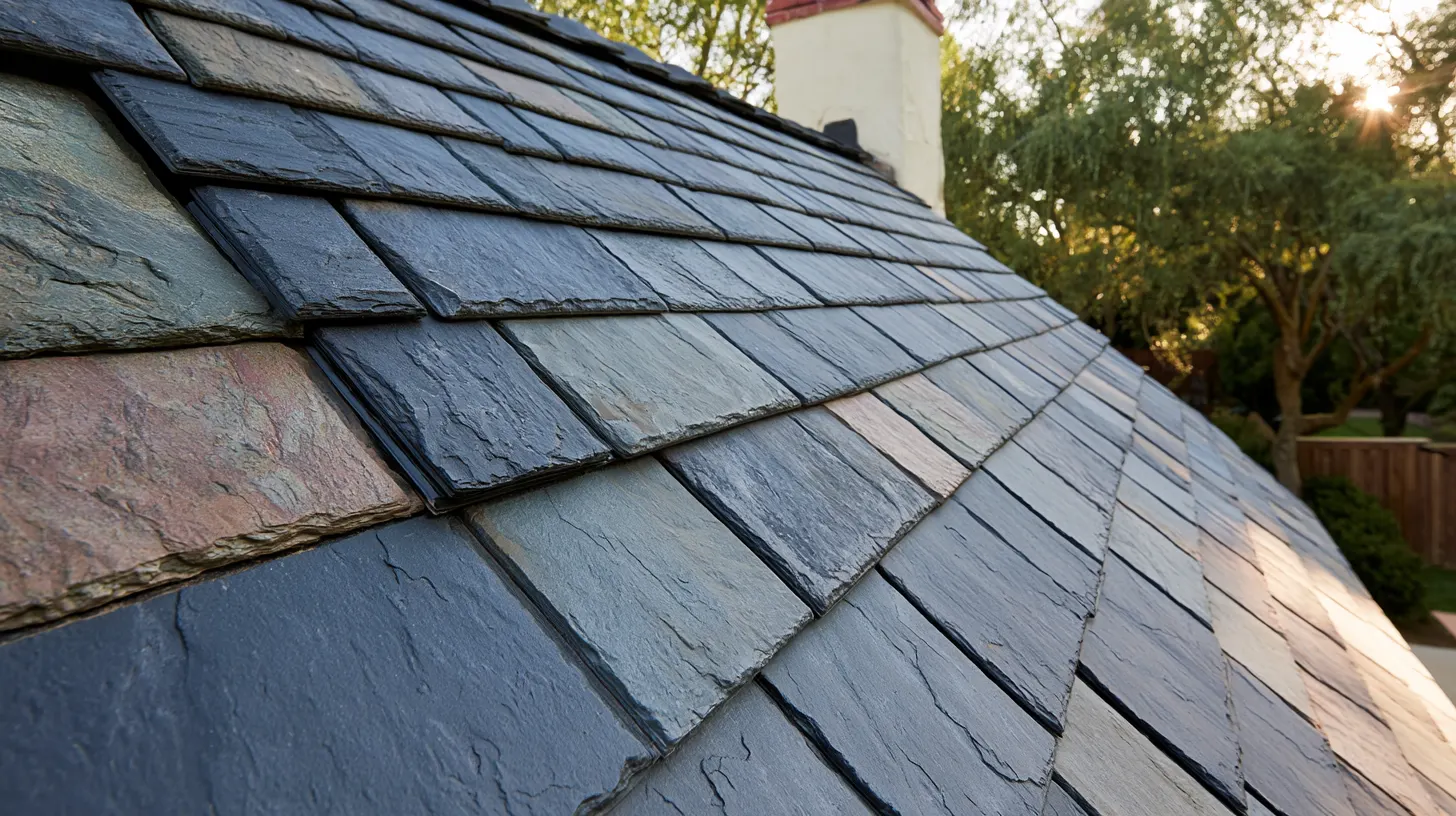
Natural slate is a metamorphic rock that forms when shale is buried, compressed and heated over millions of years (the guide to slate roofs covers its history and styles). That pressure gives the rock a grain, so it splits into thin, flat sheets, and every piece differs slightly. Minerals set the color: dark grays and blacks from Pennsylvania and Virginia, and greens, purples and reds from the Vermont slate valley.
The quality standard, ASTM C406, sorts slate into three grades by expected life. S1 is rated for more than 75 years and often lasts past 100, S2 typically lasts 40 to 75 years, and S3 often lasts 20 to 40. The grade depends on water absorption, weather resistance and modulus of rupture, which measures how far the stone bends before it breaks.
Slate is dense and absorbs less water than almost any other roofing material, so it does not rot and fungus cannot take hold. One exception is slate with a high iron pyrite content. As those minerals oxidize, the slate can "bleed" or "rust," leaving brown or orange streaks down the roof.
Synthetic slate is a factory-made copy of stone
Synthetic (or composite) slate is a factory product designed to give the look of stone without its weight or price. Premium versions mostly blend virgin or recycled polymers, such as polyethylene or polypropylene, with mineral fillers like limestone. Others are made of rubber, usually from recycled tires, though polymer is now more common at the high end.
The tiles are injection molded in molds cast from real slate, so they carry the cleft lines and chiseled edges of stone. Plastic breaks down after decades in the sun, so manufacturers add UV stabilizers and carbon black to protect it. Without them, the tiles would fail quickly.
Synthetic color is more even and flatter than stone. The pigment runs all the way through, so a scratch shows the same shade underneath. Real slate mellows with age, and although synthetics are made to hold their color, some shift appears after about 30 years.
Natural slate often needs stronger framing
A standard natural slate roof weighs 800 to 1,500 pounds per square (100 square feet), and thick architectural slate can exceed 2,000. Most houses were framed for something like asphalt shingles, which weigh roughly 230 to 420 pounds per square. Weight therefore settles more slate decisions than appearance does.
Putting real slate on a house built for shingles usually means reinforcing the structure. An engineer inspects the rafters, trusses and bearing walls, and the fix may include sistered rafters, extra knee walls or collar ties. That work can cost thousands of dollars before any slate goes on.
Synthetic slate mostly weighs 250 to 400 pounds per square, which ordinary modern framing already carries. Switching from asphalt to a synthetic slate look is usually a direct swap, with no engineer, no added lumber and lighter bundles to carry up the ladder.
How much does a slate roof cost to install?
Natural slate costs about $15 to $35 or more per square foot installed. S1 Vermont slate typically runs $10 to $20 per square foot for the stone alone, and labor costs more still, because the work involves hand cutting, slate hammers and careful headlap. On a 2,000-square-foot roof with structural work, $30,000 to $80,000 or more is not unusual.
Synthetic slate is still a premium product, at roughly $9 to $18 per square foot installed. The tiles often cost $5 to $10 per square foot and go on faster, with printed nail marks and cuts made with a utility knife or circular saw instead of a slate cutter. Slate jobs are bid by the square, and the roofing calculator shows how many squares you are covering, including steep pitch.
Labor differs because stone cracks when stepped on wrong. Crews on natural slate need special ladders or roof hooks to move around. Synthetic tiles flex and absorb impact, so installers can walk on them, finish sooner and bid lower.
How long does a natural slate roof last?
InterNACHI lists slate roofing at 60 to 150 years, and an S1 roof can last 100 years or more. Some roofs in Europe and the Northeast have lasted two centuries. Because the stone barely ages, nails and flashing usually fail first, and a slate warranty often just guarantees the quarry did not ship soft stone that splits early.
Synthetics have a shorter record, with most current formulas on the market for about 20 to 30 years. Warranties tend to run 40 to 50 years, often prorated, against defects such as serious fading, curling or cracking. The tiles are durable, but years of sun and temperature swings still wear the plastic down, so plan on a 40-year roof rather than a 100-year one.
Fasteners need to match the roof's life. Natural slate needs copper or stainless steel nails, because galvanized nails rust through in 20 to 30 years and sound slates then slide off. Synthetics go on with good galvanized or stainless fasteners, which is enough for a 40-year life.
Slate resists fire but can crack in large hail
Natural slate does not burn and carries a Class A fire rating, the highest available, which matters in wildfire country. Thick slate with proper headlap also holds up well in wind. Its weakness is brittleness: large hail can crack or puncture it, and a misplaced foot can snap it.
Synthetics were designed with hail in mind. Most premium products carry a Class 4 impact rating, meaning the tile does not crack when a 2-inch steel ball is dropped on it from 20 feet. On the Great Plains, where hail is a yearly event, synthetic often outperforms stone because it flexes and absorbs the hit.
Fire ratings vary more among synthetics. Plastic burns, so manufacturers add flame retardants to reach Class A, but some products only reach Class C unless installed over a specific fire-resistant underlayment. Check the rating for the exact product you are buying.
Most slate failures come from poor installation
Natural slate usually fails because of poor installation. Nails driven too tight crack the slate as it expands and contracts, and nails left too loose let it rattle until it slides out of its course. A nail head left standing (over-nailing) props up the slate above it, and wind-driven rain gets into the gap.
Low-grade stone can delaminate. S3 slate absorbs more water, and in cold climates that water freezes between the layers and flakes the slate apart. For a roof meant to last, buying from a reputable quarry in Vermont or Virginia is essential.
Synthetics tend to curl or cup. A poor polymer blend, or tiles that were not properly annealed at the plant, lets the sun lift the edges off the deck, which looks wrong and gives wind something to catch. Older formulas also faded badly and turned brittle, though modern UV inhibitors have largely solved that.
Flashing can fail on both. Valley, chimney and drip edge metal has to last as long as the roof, and thin aluminum or galvanized steel corrodes within 20 years. Replacing it then means a flash-over or pulling good slate to reach the metal, so 16-ounce copper or heavy-gauge stainless steel belongs there.
Inspect a slate roof once a year
Inspect a natural slate roof once a year, because one cracked or missing piece can let in a lot of water before anyone notices. To replace a slate, a roofer uses a slate ripper to cut the old nails, slides the new slate in and holds it with a copper tab or slate hook. This is a job for a professional. Gutter cleaners and chimney sweeps should stay off the roof.
Synthetic slate is easier to maintain. A fallen branch or a footstep rarely breaks a tile, though valleys still need clearing. Replacing a tile means pulling the fasteners and setting a new one, and the material tolerates mistakes that stone will not.
Moss and algae grow on both, mostly on north slopes and under trees. Clean either one with low pressure and a mild antimicrobial wash. Do not use a pressure washer on either, since it can force water under the tiles and roughen the surface of synthetics.
Neither type of slate belongs on a low slope
Neither type of slate belongs on a low slope. The International Residential Code limits slate shingles to slopes of 4:12 or steeper. Between 4:12 and 8:12 the headlap, the distance the third course overlaps the first, increases. Three inches is typical on a steep roof, while a lower slope may need 4 inches or more so capillary action cannot pull water over the top of the slates.
Natural slate also needs a solid deck. Most slate specialists recommend 3/4-inch exterior plywood or 1-inch tongue-and-groove boards, and they advise against thin OSB (oriented strand board), which does not hold nails well enough under that much weight for that many years. Synthetics work on standard 1/2-inch or 5/8-inch OSB or plywood.
What to ask a contractor
Vet a slate contractor more closely than an asphalt crew. These questions show whether a crew knows the material.
- What nails will you use? On natural slate the answer should be copper or stainless steel. A crew that suggests galvanized nails to save money does not know slate.
- What underlayment goes under synthetic slate? These tiles can run hot, and a high-temperature ice and water shield is often called for.
- How will you set the starter course? Every slate roof needs a cant strip at the eave to tilt the first course to the right angle so the second course lies flat. A crew unfamiliar with cant strips has likely done few slate roofs.
- How will you build the valleys? On stone, best practice is an open valley lined with copper (the comparison of open and closed valleys explains why), because woven slate valleys are hard to get right and tend to leak.
- How will you allow for movement? Synthetic tiles expand and contract with temperature and buckle without the correct gaps.
Your timeline and framing decide which slate fits
The choice comes down to how long you plan to stay and whether the house can carry the weight. Natural slate is the right call for a historic restoration or a house that will be passed down. It costs a lot up front and may never need replacing.
Synthetic slate is the practical choice for most modern houses. It gives the slate look with no structural work, better hail performance and a much smaller bill. It will not last 100 years, but at 40 to 50 years it still outlasts a standard asphalt roof by a wide margin.
Climate can settle the question. Hot, sunny places like Arizona or Florida may wear synthetics out faster, which makes stone the safer bet despite its weight. In the hail belt through the middle of the country, synthetic is usually the better choice, because brittle stone does not stand up to repeated hail.
Synthetic slate vs natural slate questions
Is synthetic slate as good as real slate?
In looks it comes close, and it is far lighter and usually tougher in a hailstorm. It does not last as long as stone. A good natural slate roof can go a century, while synthetics mostly carry 40 to 50 year warranties, so real slate remains the better choice for a historic house or one that will stay in the family.
How much does synthetic slate cost compared to natural slate?
Synthetic slate costs roughly $9 to $18 per square foot installed, and natural slate about $15 to $35 or more. Natural slate may also need structural reinforcing first, which adds thousands. Synthetic usually goes on the existing framing.
How long does synthetic slate last?
Most warranties run 40 to 50 years. No product has been on a roof that long yet, because these materials have only been sold for a few decades. Sun and heat are what eventually wear the polymer out.
Does natural slate need extra roof support?
Often, yes. At roughly 800 to 1,500 pounds per square it is several times heavier than asphalt, so a house framed for shingles often needs an engineer's review and added lumber. Synthetic slate rarely does.
What is the minimum roof pitch for slate?
The minimum is 4:12, the International Residential Code's limit for slate and slate-type shingles. Near that low end the headlap increases so water cannot creep over the top of the slates. With synthetics, you also follow the manufacturer's rules.
Prices are 2026 US national averages and building codes vary by town. Materials, warranties and code adoptions change, so confirm prices with local contractors and code rules with your building department before you sign anything.
Estimate Your Roof Cost
Use our free roofing calculator. No sign-up required.