 RoofingCalculator.io
How Many Shingles in a Bundle?
By RoofingCalculator.io. Updated October 14, 2026. Prices, ratings and code references link to their sources.
Pricing your own roof? Get squares, materials and a 2026 cost range in about two minutes. Free, no sign-up.
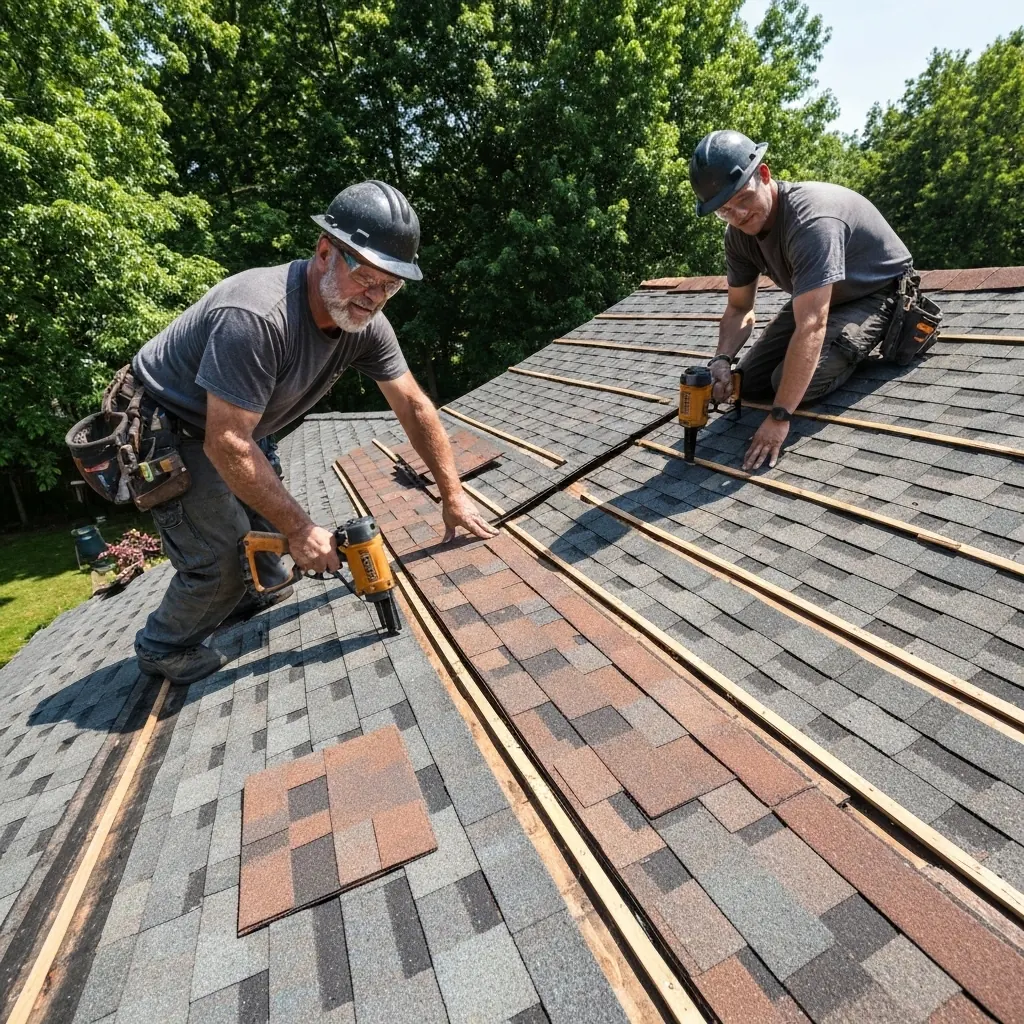
A bundle of standard three-tab asphalt shingles holds about 26 shingles, and a bundle of thicker architectural shingles usually holds 20 to 22. Either way, the bundle covers roughly 33.3 square feet, so three bundles make one square, the 100-square-foot unit roofers order and price by.
Ordering the right amount takes four steps.
- Measure the roof surface, not the footprint. Pitch adds area, so divide the true roof area by 100 to get net squares.
- Add a waste factor. Use about 10 percent for a simple gable and 15 to 20 percent for roofs with hips, valleys and dormers.
- Multiply by the bundles per square on the label. Standard shingles take three; some luxury shingles take four or five.
- Order starter, ridge cap, nails and underlayment separately. Field-shingle bundles do not include them.
| Shingle type | Shingles per bundle | Bundles per square | Price per bundle |
|---|---|---|---|
| 3-tab | 26 to 29 | 3 | $30 to $40 |
| Architectural | 20 to 22 | 3 | $35 to $55 |
| Luxury or designer | Varies (check label) | 4 or 5 | $60 to $100 |
Bundle counts differ because shingle sizes differ
Bundles hold different numbers of shingles because the shingles are different sizes. A classic 3-tab is about 12 by 36 inches with 5 inches exposed. Most architectural shingles are a little over 13 by 39 inches with about five and five-eighths inches exposed, so fewer are needed to cover the same area. The coverage is printed on every wrapper.
Manufacturers set counts to keep coverage consistent and weight manageable. An architectural bundle usually weighs 60 to 80 pounds, about what one person can carry up a ladder or across a deck, and 3-tab bundles are slightly lighter. A bundle's footprint matches the shingle size, while its thickness depends on how thick the shingles are and how many are stacked inside.
Luxury and designer shingles are the exception. They are much thicker and heavier, made to look like slate or wood shake, so manufacturers often split a square into four or five bundles. At four bundles a square, each covers 25 square feet; at five, each covers 20.
Three bundles usually make one square
One square equals 100 square feet of roof surface, and every roofing order is based on it. Divide the roof's total square footage by 100 to get squares. With standard shingles at three bundles a square, the bundle count is squares times three.
Roofers order gross area, not net area: the measured surface plus a waste factor. A plain gable roof with two flat planes needs about 10 percent extra. A complicated roof with hips, valleys, dormers and multiple ridges needs 15 to 20 percent extra to cover shingles trimmed at the valleys and the overlap at the starter course and ridge.
Coverage and exposure are different things. Exposure is the part of each shingle still visible after installation, usually five and five-eighths inches on a standard architectural shingle. Changing it changes the bundle count, so stick to the manufacturer's exposure, which keeps the roof looking right and the warranty valid.
A 30-square roof carries three tons or more of shingles
A square of architectural shingles weighs 200 to 240 pounds, which is why shingles come in bundles rather than loose or in large crates. A 30-square roof, typical for an average American house, carries 6,000 to 7,200 pounds of shingles alone on its rafters or trusses and plywood deck.
Triple-laminate luxury shingles can exceed 400 pounds a square, or 12,000 pounds on the same 30-square roof. Have the structure checked before upgrading, since it must carry that dead load for decades. Most modern code-built homes handle standard architectural shingles easily, but older houses or homes originally framed for a metal roof may need reinforcement for heavy asphalt products.
Weight also shapes delivery. A standard pallet holds 30 to 48 bundles, or 10 to 16 squares. A truck with a boom arm or a Moffett forklift sets the pallets on the driveway or directly on the roof. On the roof, bundles must be spread out along the ridge, because piling them in one spot can crack a rafter or collapse part of the deck.
How many shingles are in a bundle?
Three-tab shingles hold 26 to 29 per bundle. Each is a single flat layer of fiberglass mat coated in asphalt and granules, so they stack tightly. They are less common on new roofs because of their lower wind resistance and shorter life; the InterNACHI life expectancy chart lists about 20 years for 3-tab against 30 for architectural. They remain a common choice for budget repairs and sheds.
Architectural shingles, also called laminated or dimensional, hold 20 to 22 per bundle and are today's standard. Their two bonded layers add depth and texture but mean fewer fit in a bundle of the same height. They are installed in a staggered pattern that also hides small dips and waves in the deck.
Designer and luxury shingles vary widely. Some brands make shingles nearly three times as thick as a regular architectural shingle, with bundles covering only 20 square feet. Always read the label, because assuming three bundles a square on a high-end shingle will leave the crew short partway through the job.
How do you calculate how many bundles you need?
The roofing calculator gives a bundle count with waste already included. To do it by hand, take a 2,500-square-foot roof: dividing by 100 gives 25 squares. With several valleys and hips, add 15 percent waste for 28.75 squares.
Bundles are sold whole, so at three per square, 28.75 squares means 86.25 bundles, rounded up to 87. Buying one or two extra beyond the waste factor is worthwhile. Stored in the garage, they give you an exact color match years later when a storm damages a small area and that color may no longer be sold.
Starter shingles and ridge cap are ordered separately from field shingles. Starter shingles run along the eaves and rakes and seal down the first course. Ridge caps are thick, pre-bent pieces that cover the peaks. Some roofers cut 3-tab shingles into ridge caps, but architectural shingles cannot be cut that way. Dedicated ridge cap is sold by the linear foot, with one bundle covering about 25 linear feet (GAF Seal-A-Ridge, for example).
How much does a bundle of shingles cost?
A bundle of standard architectural shingles costs about $35 to $55 at major home improvement stores, or $105 to $165 a square. On a typical 25-square roof, field shingles alone cost $2,625 to $4,125. Asphalt is a byproduct of oil refining, so shingle prices move with petroleum prices.
Three-tab costs less, around $30 to $40 a bundle or $90 to $120 a square. Its shorter life and lower wind rating can offset the savings through repairs or an earlier replacement.
Luxury shingles cost $60 to $100 a bundle. With four or five bundles per square, that comes to $300 to $500 a square, and on a 25-square roof the shingles alone can exceed $10,000. None of these figures include underlayment, ice and water shield, drip edge, flashing or nails.
Measure the roof, not the footprint
The most common mistakes are miscounting starter and waste, and measuring the house footprint instead of the roof. Roof pitch adds surface area, so of two 2,000-square-foot houses, one with a steep 12:12 roof has far more roof to cover than one with a gentle 4:12.
Mixed dye lots are another. Shingles are made in batches, and two batches with the same color name can differ slightly in granule color or blend. Mixed across one large roof plane, they create visible shading that looks like stripes. Check the batch numbers on the side of each bundle before installation.
Ordering short is the third. Running out with 10 square feet left stops the job while someone drives to the supplier, which may no longer have that dye lot. Professionals round up and keep a cushion, and most suppliers accept returns of clean, unopened bundles.
Store bundles flat and level
Store bundles flat and level, and do not stack them too high. Heavy stacks press the lower shingles together until they stick, especially on hot days when the sealant strips soften.
Keep bundles off bare ground, where moisture wicks into the wrapper and shingles and can cause mold or weaken the fiberglass mat. Use pallets, and outdoors cover them with a breathable tarp rather than clear plastic. Clear plastic traps heat and moisture like a greenhouse and can damage shingles before they reach the roof.
Cold makes shingles brittle, and a dropped cold bundle can crack. Below 40 degrees Fahrenheit, keep bundles in a heated space such as a garage until installation. Warm shingles bend, cut cleanly and take nails without the edges breaking.
Questions to ask your contractor
- How many squares did you measure, and what waste percentage did you use? If one roofer says 25 squares and another says 30 for the same house, someone measured differently or added extra waste, and you should get an explanation.
- What exact brand and product line will you use? "Architectural shingles" is too vague, since brands differ in bundle count and coverage. With the product name, you can check the weight per square and wind rating yourself.
- Where will materials be delivered? A heavy truck can crack a residential driveway, so the company should have a delivery plan.
- Are starter and ridge cap manufactured products or cut from field bundles? The answer affects how the roof looks and can affect the warranty.
The installation pattern changes the count
The installation pattern also affects the count. Shingles are offset, usually by 4 to 8 inches, so the seams do not line up. Aligned seams give water a direct path to the deck, while a proper offset keeps the water barrier continuous.
Exposure is set mainly by the manufacturer's markings, a "nail line" or "common bond" area where the layers overlap. Nails placed outside that zone reduce wind resistance and lead to blow-offs. High-wind areas may require more nails per shingle, which does not change the bundle count but does raise the material bill.
Very steep roofs may need a different exposure or extra fasteners. On low slopes between 2:12 and 4:12, shingles need a double layer of underlayment or a shorter exposure so water does not back up underneath. Adjustments like these change how many bundles the job uses.
Valleys, where two planes meet in a V, carry more water than any other part of the roof. They can be shingled closed-cut or woven. Woven valleys use more shingles because both sides lap across the center, and closed-cut valleys also involve heavy overlap and trimming, which is part of the 15 to 20 percent waste factor.
Hips are the outside corners where planes meet, and each needs ridge cap. Because hips run diagonally, every shingle that meets one is cut at an angle, leaving small triangles too small to reuse, so more hips mean more bundles. Dormers, skylights and chimneys add more, since each needs cutting and flashing and its edges act like a small valley or rake with starter, sealant and extra cuts.
The starter course is often left off the order
The starter course is the row of shingles most often left out of an order. The first row cannot sit directly at the eave, because the gaps between shingles and the nail holes would let water reach the deck. A starter course goes underneath, made of either purpose-built starter shingles or regular shingles with the tabs cut off, laid upside down or offset.
Dedicated starter is the better choice. It comes in its own bundles with a wide strip of sealant at the eave edge. As the Asphalt Roofing Manufacturers Association explains, "Most asphalt shingles include thermally activated asphalt sealant," which bonds each course down once the sun warms the roof and keeps wind from lifting the first row. A typical starter bundle covers about 100 linear feet. If your roofer uses field shingles as starter, order extra field bundles for the edges.
Final ordering checklist
- Calculate net squares. Divide the roof area by 100.
- Add 10 to 20 percent for waste. Use the higher end for hips, valleys and dormers.
- Multiply by bundles per square. Use the number on your shingle's label.
- Measure ridge and starter in linear feet. Convert those lengths into specialty bundles.
- Count nails. At four nails per shingle, a square of architectural shingles uses roughly 260 nails, or about 390 with a six-nail high-wind pattern. A 25-square roof needs about 6,500 to 9,750 nails before starter and ridge cap, and a standard box holds 7,200.
- Add underlayment. A roll of standard synthetic usually covers 10 squares, so a 25-square roof needs three rolls. Ice and water shield, required along the eaves and in valleys in cold climates, typically comes in 3-by-33-foot rolls covering about 100 square feet, or one square.
Put everything on the same delivery as the bundles so the crew is never waiting on a half-finished roof.
Shingle bundle questions
How many bundles of shingles do I need for 1,000 square feet?
You need 30 bundles before waste, since 1,000 square feet is 10 squares at three bundles each. Adding 10 to 15 percent for waste brings it to roughly 33 to 35 bundles. Starter and ridge cap are ordered on top of that.
How many square feet does a bundle of shingles cover?
A bundle of standard 3-tab or architectural shingles covers about 33.3 square feet, so three bundles make one 100-square-foot square. Some heavy designer shingles split a square into four or five bundles, so each covers 25 or 20 square feet instead.
How much does a bundle of shingles weigh?
An architectural bundle usually weighs around 60 to 80 pounds, and 3-tab bundles are a little lighter. Heavy luxury shingles are split into more bundles per square to keep each one manageable on a ladder.
How many shingles are in a square?
A square holds roughly 78 to 80 standard 3-tab shingles, or about 64 to 66 of most architectural shingles. The exact number depends on the shingle's size and exposure, and the bundle label gives the count.
Prices are 2026 US national averages and building codes vary by town. Materials, warranties and code adoptions change, so confirm prices with local contractors and code rules with your building department before you sign anything.
Estimate Your Roof Cost
Use our free roofing calculator. No sign-up required.