 RoofingCalculator.io
Standing Seam Metal Roof
By RoofingCalculator.io. Updated October 14, 2026. Prices, ratings and code references link to their sources.
Pricing your own roof? Get squares, materials and a 2026 cost range in about two minutes. Free, no sign-up.
A standing seam roof is made of long vertical metal panels joined by raised seams, with the fasteners hidden under the panels instead of driven through them. Installed steel usually costs about $10 to $16 per square foot, roughly double the cost of architectural shingles. In return, it can last decades with very little maintenance.
Five choices determine how well a standing seam roof performs.
- Pick the right seam for your slope. Snap-lock suits pitches of 3:12 and steeper, and double-lock mechanical seams handle low slopes.
- Choose 24-gauge steel. It resists oil canning and denting better than 26-gauge.
- Pay for a PVDF finish. It holds its color for decades, while cheaper SMP paint fades within 10 to 15 years.
- Use high-temperature underlayment. Standard asphalt-based membranes can soften under hot metal.
- Hire a metal specialist. Most failures come from poor flashing, pinned panels or mismatched metals.
Standing seam hides the fasteners
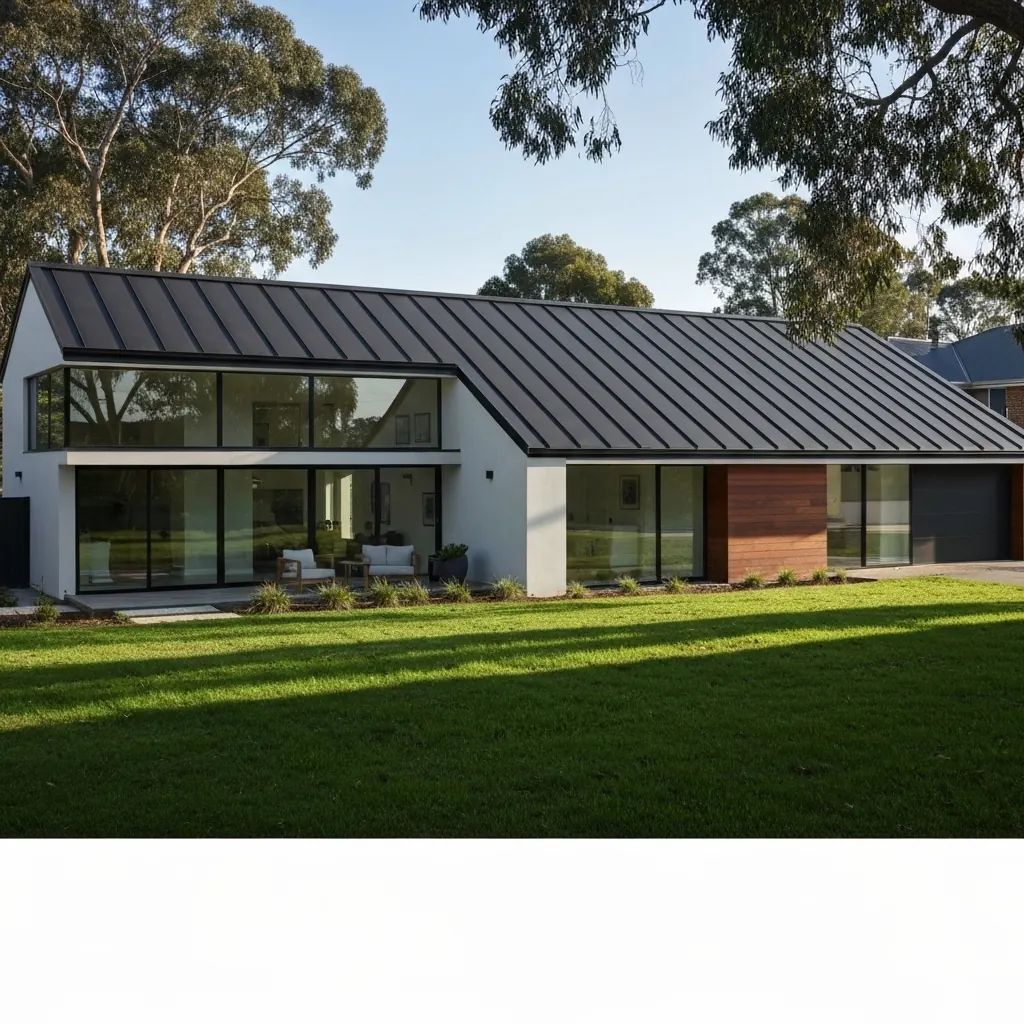
Standing seam hides the fasteners. Corrugated and ribbed panels are held down by thousands of screws driven through the face of the metal, and each hole is a potential leak. Standing seam panels are held by clips fastened to the deck underneath, which removes the most common failure point in metal roofing, the fastener hole.
The seams, also called legs, usually stand 1 to 2 inches tall and keep water out of the joints. Because the fasteners are protected from rain, snow and UV, there are no leaks from screws backing out or rubber washers cracking. The panels also run in one piece from ridge to eave, so there are no horizontal laps where water can wick uphill by capillary action.
The clips also handle thermal movement. Metal expands in heat and contracts in cold, and over a single day a 50-foot steel panel can change length by half an inch or more. The clips let each panel slide without pulling on the fasteners or buckling, which makes the system well suited to climates with large temperature swings.
Standing seam costs about twice as much as shingles
A professionally installed steel system costs roughly $10 to $16 per square foot, often about twice the price of architectural asphalt shingles. A standard 2,000-square-foot roof comes to about $20,000 to $32,000, including tear-off, underlayment, panels, trim and labor. Once the roofing calculator gives your house's square count, multiply it by $1,000 to $1,600 for a rough steel price.
| Metal | Material cost | Notes |
|---|---|---|
| 24-gauge steel, Galvalume with PVDF finish | $4 to $6 per square foot | The usual choice for houses |
| Aluminum | Often 20 to 30 percent more than steel | Best near the ocean, where salt spray corrodes steel |
| Copper and zinc | Often more than $15 to $20 per square foot | Premium tier, material only |
Labor causes the biggest price swings. Standing seam requires specialized skills and tools. A simple gable with no valleys or dormers sits at the low end, while multiple slopes, skylights and chimneys require extensive custom flashing and can push labor above $12 per square foot. Contractors also charge more in cities and high-cost regions.
Slope and climate decide snap-lock vs mechanical lock
Residential standing seam comes in two main panel types, snap-lock and mechanical lock, and the right one depends on your roof's slope and climate.
- Snap-lock. Panels have a male leg and a female leg that click together. They install faster and need no electric seaming machine, so they are common on homes. They work well on roofs pitched 3:12 or steeper, where water runs off quickly, but they are not designed for standing water on a nearly flat roof.
- Mechanical lock. The panel edges are folded together with a hand or power seamer. A single-lock seam folds 90 degrees, and a double-lock folds a full 180 degrees, which makes it watertight and standard on low slopes. The International Residential Code allows standing-seam roof systems down to a 1/4:12 slope, subject to the manufacturer's rating. Mechanical lock also resists wind uplift better and is often required in hurricane regions and on commercial buildings with long spans.
Panel width usually ranges from 12 to 18 inches. Narrow panels are stiffer and less prone to oil canning. Wide panels look cleaner and more modern but need thicker metal or stiffening ribs to keep the flat area from turning wavy.
Choose 24-gauge steel for a house
Residential standing seam is mostly 24-gauge or 26-gauge steel, and professionals generally recommend 24. Gauge measures thickness in reverse, so a lower number means thicker metal. 24-gauge is thick enough to resist oil canning and stiff enough for the hidden clips to work properly.
26-gauge costs less, but thinner metal shows surface ripples more and dents more easily from large hail or falling branches. Aluminum is measured in inches rather than gauge, and .032 inches is the residential standard, giving a weight-to-strength balance close to 24-gauge steel.
The metallic coating under the paint matters just as much. Most steel panels use Galvalume, an alloy of 55 percent aluminum and about 43.4 percent zinc. The aluminum acts as a barrier and the zinc corrodes sacrificially to protect the steel, so Galvalume holds up much better than traditional galvanized coatings, which are zinc only and rust sooner.
PVDF paint resists fading best
The paint protects the metal from oxidizing as well as giving it color. High-end residential roofs use PVDF (polyvinylidene fluoride), often sold as Kynar 500 or Hylar 5000, which resists UV, chalking and fading. The guide to metal roof colors and finishes compares the options.
PVDF keeps its color for decades, and most manufacturers warranty it against fading for 30 or 40 years. Cheaper SMP (silicone modified polyester), common on barns and farm buildings, tends to turn brittle and lose color within 10 to 15 years. A roof meant to last 50 years needs PVDF.
Many of these paints include cool-roof pigments that reflect infrared sunlight before it heats the attic, which can noticeably lower summer cooling costs in hot, sunny climates. Lighter colors score higher on the solar reflectance index (SRI), improving the energy efficiency of the whole building envelope.
The layers under the panels decide performance
What goes under the panels largely decides how a standing seam roof performs. The deck must be smooth, dry and solid. Some metal roofs can go over old shingles, but standing seam generally should not, because every lump in the old roof can telegraph through and make the panels look wavy.
Synthetic underlayment is standard between the metal and the deck, because it is tougher than organic felt and will not rot or tear. In areas with ice dams, or on low-slope sections, add a high-temperature ice and water shield, a self-adhering membrane that seals around the clip fasteners as a backup waterproof layer. It needs to be rated for high temperatures because a metal roof in full sun gets hot enough to soften a standard asphalt-based membrane.
Flashing is the most technical part of the job. Valley, chimney and eave flashings are custom-bent from the same metal as the panels and should expand and contract with them. Watch for caulk-only seals at pipe penetrations, a common failure point. Good installations use EPDM rubber boots and metal collars integrated into the seam structure rather than a boot glued on top.
What is oil canning on a metal roof?
Oil canning is a slight rippled appearance across the flat areas of a metal roof. It is cosmetic, not structural, and comes from stress in the metal or from how the panels were fastened. During factory rolling, small thickness variations can leave more material in the middle of a panel than at the edges, and that middle section ripples.
Poor installation makes it worse. Clips fastened too tightly keep the panel from expanding, so it bows, and an uneven deck makes panels follow every dip in the wood. To reduce it:
- Choose 24-gauge metal. Thicker panels resist rippling.
- Choose narrower panels. They are stiffer across the flat area.
- Choose striated or ribbed profiles. Small lengthwise lines pressed into the flat area break up reflected light and hide waviness.
- Choose a lighter, matte color. Dark colors and high gloss show oil canning more.
Almost every metal roof shows some oil canning in low-angle light, early in the morning or late in the evening.
Most failures start at badly flashed penetrations
Standing seam installed by an inexperienced crew can fail early, most often at badly flashed penetrations. If a contractor relies on silicone or roofing cement instead of proper metal-to-metal interlocking joints, the seal eventually dries and cracks. The leak can stay hidden for years, with water running along the underside of the panel before it reaches the deck.
Pinning is another common error. The system needs one fixed point, usually the ridge, and the panel must be free to expand downward toward the eave. If a panel is screwed down at both the top and bottom, the metal has nowhere to go when it heats up, so it tears at the screw holes or the seams pull apart. A pinned roof is also noisy, groaning and popping through the afternoon.
Galvanic corrosion is the third. When two different metals touch in the presence of moisture, one corrodes the other. Copper flashing on a steel roof or lead-based pipe jacks can corrode steel quickly, and even runoff from a copper air conditioning line can strip the coating from a Galvalume panel. Using compatible metals is basic practice, and ignoring it shortens the roof's life.
Finding a qualified installer is the hardest part
Finding the right installer is the hardest part. Many roofing companies are shingle contractors that occasionally install metal, and standing seam requires metal brakes, seaming machines and specialized snips that a mostly-shingle company may not own or know how to use well.
- Panel forming. Ask whether panels are formed on site or at a factory. On-site roll forming produces continuous panels without seams even on very long runs, while factory-cut panels must be measured precisely and shipped in crates.
- Thermal expansion plan. Ask how they handle expansion and contraction. A contractor who never mentions floating clips or a fixed-point plan may not understand the system.
- Insurance and certification. Many high-end metal manufacturers run certified installer programs, and certification often unlocks better coverage, including weathertightness warranties that pay for both materials and labor when a leak occurs.
- Older jobs. Ask for standing seam projects completed at least five years ago and go see them, so you can judge how the oil canning and color have held up.
Does a standing seam roof need maintenance?
Standing seam needs little maintenance because it has no granules to shed and nothing organic to rot. Have it inspected once a year, with attention to gutters, ridge vents and anywhere debris collects.
- Clear debris. Leaves and pine needles hold moisture against the metal, and wet debris left long enough can soften even PVDF paint or let moss and algae take hold in the seams. Keep the gutters clear so water does not back up under the eave trim.
- Install snow guards in heavy snow areas. Snow slides off metal in large sheets that can crush shrubs or injure someone below. Snow guards should clamp onto the seams, never screw through the roof.
- Touch up scratches correctly. Use the manufacturer's paint pen, which contains the same PVDF resin as the original coating; ordinary spray paint will not match and fades at a different rate.
- Rinse coastal roofs. Near the ocean, hose the roof with fresh water twice a year to remove salt that can work past the coating over time.
Standing seam pays off if you stay 15 years or more
Standing seam suits homeowners who plan to stay a long time, because the break-even point against asphalt shingles usually falls around 15 to 20 years. If you move within a decade, you may not recover the cost through energy savings or resale. For a long-term home, standing seam is often the least expensive choice over 50 years; InterNACHI puts metal roofing at 40 to 80 years, and the metal roof vs shingles comparison runs the numbers.
House style also matters. The strong vertical lines suit modern, farmhouse and contemporary homes but can look out of place on a traditional colonial or Mediterranean-style house. Many owners consider the curb appeal and premium look worth the price on their own. Standing seam also carries a Class A fire rating and may lower insurance premiums in hail-prone areas.
It is one of the most environmentally sound roofing choices. Steel panels usually contain recycled metal and are recycled again at the end of their life, while most torn-off asphalt shingles still go to landfills. Because a standing seam roof is installed once and lasts for decades, its long-term footprint is much smaller.
Questions for your contractor
- What gauge steel do you install on homes? The answer you want is 24-gauge.
- Do you use PVDF (Kynar 500) or SMP paint? Insist on PVDF.
- How does your panel layout handle thermal expansion and contraction?
- Will high-temperature underlayment cover the whole deck?
- Can I see local standing seam jobs more than five years old?
- Are your installers employees or subcontractors?
- Do you offer a workmanship warranty in addition to the manufacturer's material warranty?
Standing seam metal roof questions
How much does a standing seam metal roof cost?
Installed steel usually costs about $10 to $16 per square foot, or $1,000 to $1,600 per roofing square. A 2,000-square-foot roof typically comes to about $20,000 to $32,000. Aluminum, copper, zinc or a complex roof shape raise the price.
How long does a standing seam metal roof last?
Properly installed steel with a PVDF finish commonly lasts 40 years or more, and InterNACHI gives metal roofing 40 to 80 years. Paint finish warranties often run 30 to 40 years. Installation quality and exposure to salt air matter most.
What is the minimum slope for standing seam metal roofing?
The International Residential Code allows standing-seam systems down to a 1/4:12 slope. In practice, snap-lock panels are mostly used on steeper roofs, often 3:12 and up, while double-lock mechanical seams handle very low slopes. Always follow the panel manufacturer's rating.
Is snap-lock or mechanical lock standing seam better?
It depends on the roof. Snap-lock installs faster and suits most homes at moderate to steep pitches. Mechanical lock, especially double-lock, is folded shut with a seaming tool, so it is more watertight on low slopes and resists wind uplift better.
Are standing seam metal roofs worth it?
Usually yes if you plan to stay 15 to 20 years or longer, since it can outlast two or more shingle roofs with little maintenance. If you plan to move within a decade, the high upfront cost is hard to recover.
Prices are 2026 US national averages and building codes vary by town. Materials, warranties and code adoptions change, so confirm prices with local contractors and code rules with your building department before you sign anything.
Estimate Your Roof Cost
Use our free roofing calculator. No sign-up required.