 RoofingCalculator.io
Blistering Shingles
By RoofingCalculator.io. Updated October 14, 2026. Prices, ratings and code references link to their sources.
Pricing your own roof? Get squares, materials and a 2026 cost range in about two minutes. Free, no sign-up.
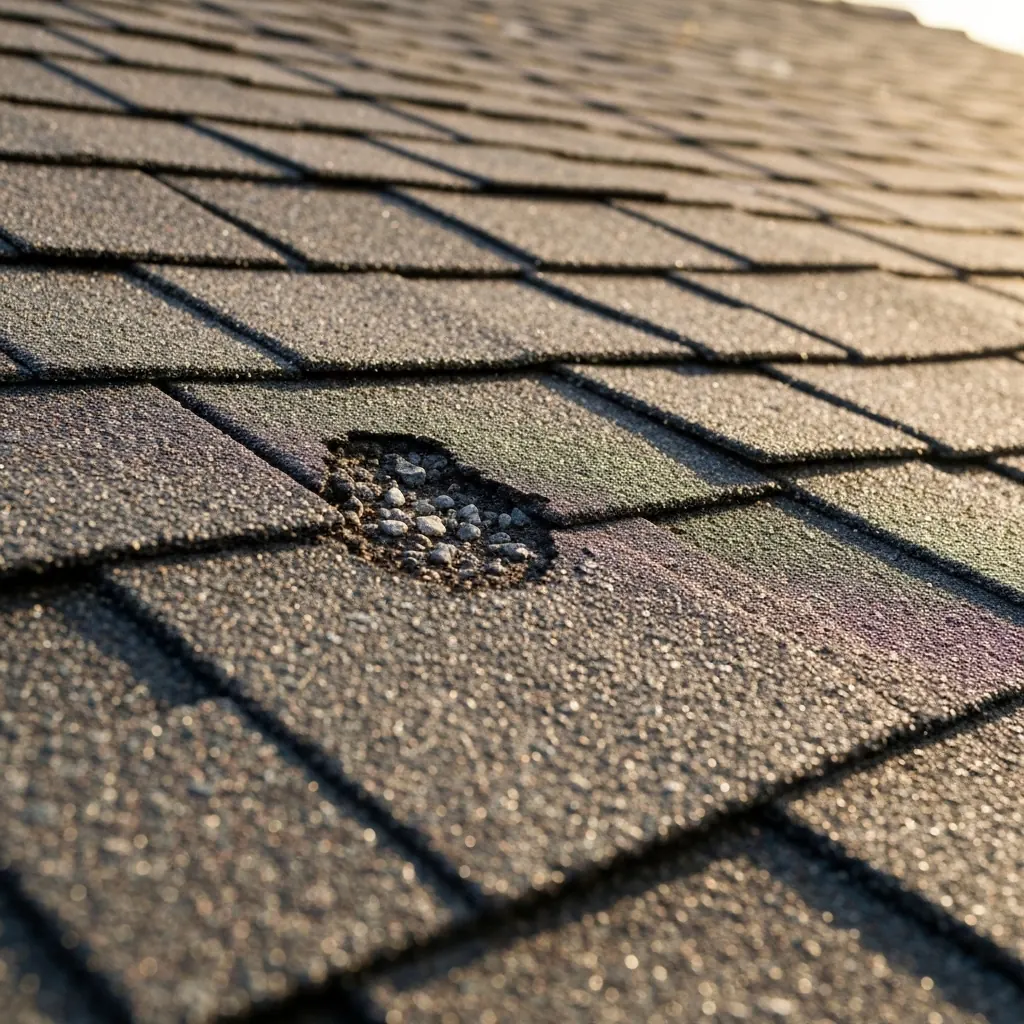
Shingle blisters are small bumps, from pinhead size up to about the size of a quarter, formed when moisture or gas trapped inside the shingle expands in the heat. They almost always trace back to a manufacturing defect or an attic that runs hot because it lacks ventilation. Blisters are more than cosmetic: once one pops, the asphalt underneath is exposed to the sun.
Here is what matters most if you find them.
- Find the cause. Ask a roofer to check attic ventilation as well as the shingles, since poor airflow can blister even well-made shingles.
- Rule out hail. Blisters push up and hail pushes down, and the difference decides whether insurance applies.
- Leave closed blisters alone. A blister that hasn't popped still sheds water, so a few can simply be monitored.
- Replace when open pits are widespread. Patching a roof that is failing everywhere wastes money better spent on a full replacement with proper ventilation.
Blistering usually shows first as loose granules
Blistering usually shows first as loose granules. The granules are the ceramic-coated bits on the shingle surface that shade the asphalt from UV light. Without them the asphalt bakes, cracks and eventually leaks. Most homeowners notice blistering in the hottest part of summer, when the trapped gas expands the most.
There are two kinds. A closed blister is a bump that still has its granules. An open blister has popped and left a small round crater of bare black asphalt, which lets in UV light and eventually water. A few open blisters are worth watching; hundreds of them across a roof mean the shingles are failing.
Blisters start with moisture sealed in at the factory
Every asphalt shingle starts as a mat of fiberglass or organic felt that is soaked in hot asphalt to make it waterproof. The mat should be completely dry before that step. When it isn't, the leftover moisture is sealed in under the asphalt.
On a 90-degree day, a dark shingle can exceed 150 degrees Fahrenheit. At that temperature the damp pockets, or pockets of volatile gas, expand, and the warm, soft asphalt stretches into a bubble.
Poor quality control at the plant is a common cause. A fiberglass mat stored in damp conditions or asphalt applied at the wrong temperature both raise the risk. Factory standards are high today, but a bad batch still gets through occasionally, and blisters typically appear three to five years after installation.
Attic heat is what makes blisters form
Heat is what makes blisters form. The sun heats the shingle from above and a poorly ventilated attic heats it from below, so the shingle is caught between two heat sources at once.
In a properly vented attic, cool air enters through soffit vents at the eaves, moves up along the underside of the roof deck and exits through a ridge vent or static vents near the peak. That keeps the deck close to the outdoor temperature. Without that airflow, the attic can reach 160 degrees or more, which makes trapped moisture expand quickly.
The standard target is the 1/150 rule. The Asphalt Roofing Manufacturers Association describes it as one square foot of net free vent area per 150 square feet of attic floor, and it lists "premature failure of the roofing system" as one consequence of getting it wrong. With a vapor barrier or balanced intake and exhaust, 1/300 can sometimes be enough, as the roof ventilation guide explains. If a roof is blistering early, a good contractor measures intake and exhaust before recommending anything, because an under-ventilated attic can blister a well-made shingle over enough summers.
Blisters and hail damage look different up close
Telling blisters from hail decides most insurance disputes over damaged shingles. Hail is a covered peril, while blistering is usually classed as a manufacturing flaw or a maintenance issue. From a distance they look similar, but up close they are different.
Hail strikes from above. It drives the granules and mat downward and leaves a bruise that feels soft when pressed, similar to the soft spot on a dropped apple. Hail marks are rarely perfectly round, and they tend to line up in one direction depending on the wind. Hail also dents the soft metal on gutters, downspouts and vents.
Blisters push outward. A popped blister leaves a pit with steep, straight walls, and the mat underneath is not pushed in. Blisters also tend to spread evenly across a roof plane or cluster where the sun is strongest, mostly on south-facing slopes. If the shingles are bumpy but the lead pipe flashings and aluminum vents are smooth, the cause is almost certainly blistering. For comparison, the IBHS Roof 101 guide grades hail damage by dents, granule loss and tears, all of which start with an impact on the top of the shingle.
How much does it cost to fix blistered shingles?
A blister can't be repaired in place, so fixes run from $300 to $800 for a small patch up to $11,000 to $18,000 for a full replacement. It can't be pressed flat, and lost granules can't be glued back on, so the damaged shingle has to be replaced.
| Scope | Typical cost | When it fits |
|---|---|---|
| Small patch in one area | $300 to $800 | A few damaged shingles; a stopgap if the cause is a defect or attic heat |
| One slope | $2,000 to $5,000 | Damage limited to one side, usually the south-facing slope |
| Full replacement, 20 squares | $11,000 to $18,000 | Widespread blistering; complex roofs can exceed $20,000 |
A patch pays a roofer to lift the surrounding shingles, remove the bad ones and slip new ones in. If the cause is a factory defect or a hot attic, the shingles left on the roof will probably blister next. The one-slope price depends on square footage and pitch.
Most widespread cases end in a full replacement. Architectural shingles cost roughly $450 to $750 a square installed, plus $100 to $150 a square for each old layer removed, which puts a 20-square roof (2,000 square feet) at about $11,000 to $18,000. Labor is usually more than half the bill. The roofing calculator works out how many squares your roof has, which is worth knowing before anyone quotes a full tear-off.
How do you spot shingle blisters early?
From the ground, blisters can look like dark spots or slight texture. From a ladder they are obvious as small raised mounds on the shingle surface.
Roofers use a simple press test. A blister feels hollow and may collapse with a puff of dust or gas when pressed lightly. A hail strike is already a dent, so there is nothing to collapse.
Check the gutters as well. Every new roof sheds some granules in its first year, which is normal. An older roof that is blistering sheds far more, and they collect like coarse sand. Gutters full of granules combined with round black pits on the shingles mean the roof is near the end of its life.
The pattern points to the cause. Blisters in a straight line across several shingles suggest a bad production run. Blisters scattered randomly across the roof are more likely caused by attic heat.
Insurance almost never covers blistering
Homeowners insurance covers sudden, accidental damage such as windstorms, fire and hail. Blistering almost never qualifies. Adjusters treat it as cosmetic, wear and tear or a manufacturing flaw, so once damage is identified as blistering rather than hail, expect a denial.
The manufacturer warranty is the other option, and it is difficult to claim. Most shingle warranties cover defects that cause leaks, so if the roof isn't leaking yet, the manufacturer can argue the shingles are still performing. Most warranties are also void if the attic ventilation doesn't meet the manufacturer's own requirements.
For a suspected factory defect, you will usually need to send in a sample. That means paying a roofer to remove a shingle and patch the gap, after which the manufacturer tests the asphalt and its moisture content in a lab. Approved claims often provide replacement shingles but rarely cover labor, so installation can still cost thousands of dollars.
Attic ventilation by the numbers
Getting the ventilation right the first time is the best way to keep a new roof from blistering, and it can be calculated rather than guessed.
- Balance intake and exhaust. If the ridge has 500 square inches of exhaust, the soffits need 500 square inches of intake. When intake is restricted, the ridge vent can't draw air out, and superheated air sits against the deck all afternoon.
- Keep soffits clear. Insulation is often piled over the soffit vents. Baffles, also called wind dams, are plastic or foam channels installed between the rafters to hold insulation back so air can move from the eaves into the attic.
- Choose ridge vents where possible. Ridge vents usually outperform static "turtle" vents because they sit at the peak, where heat collects. They need a slot cut in the deck, typically about two inches total (one inch on each side of the ridge board); a slot that is too narrow makes the vent ineffective.
Closed blisters eventually open
Closed blisters eventually open. Daily heating and cooling makes the asphalt expand and contract until the thin skin over the gas pocket wears through and pops.
Once the mat is exposed, UV light breaks down the long-chain polymers in the asphalt, which becomes brittle and cracks. Water then reaches the fiberglass mat. The mat can tolerate some water for a time, but the cracks keep spreading until they go all the way through.
This usually takes years. A roof with closed blisters may have five to seven years left, while a roof covered in thousands of open ones may have only a year or two before leaks are certain. Climate sets the pace, and in the South, strong sun turns closed blisters into open ones much faster than in the North.
Roof age decides whether to repair or replace
The decision depends on the roof's age and the extent of the damage. On a roof under five years old, file warranty claims with both the manufacturer and the original installer. On a roof around fifteen years old, blistering signals that the shingles are near the end of a twenty-year life.
If only a few dozen spots appear across the whole roof, monitoring is often the sensible choice. Closed blisters still shed water, so have a roofer inspect once a year to see whether any have opened.
Widespread open pits call for replacement. Spending $2,000 on patches for a roof that is failing everywhere wastes money that would go further toward a full replacement with better ventilation.
If you plan to sell soon, keep inspections in mind. Home inspectors treat blistering as a significant defect and often write it up, which leads buyers to ask for a new roof or a large credit at closing. Fixing it before listing usually costs less.
Hire a roofer who diagnoses rather than sells
Not every roofer diagnoses blistering accurately, and some will label it hail in hopes of an insurance job. Look for a contractor who gives a technical assessment rather than a sales pitch.
A good contractor brings a moisture meter and a camera and photographs the blisters from the side so the raised bumps are visible. They also inspect the attic for heat damage on the underside of the deck, such as darkened wood or sap bleeding from the rafters.
Ask for a ventilation calculation. A qualified roofer can tell you how many square inches of intake and exhaust you have now and how many you need. A contractor who proposes a new roof without addressing ventilation is likely to install one that blisters the same way.
Check that the contractor is certified by the manufacturer of the shingles they install. GAF, Owens Corning and CertainTeed all run certification programs that train contractors to install to warranty requirements, which gives you extra protection if a factory defect appears later.
Questions for the roofer
Use these questions when interviewing contractors about a blistering roof.
- Does the estimate include a ventilation audit? The contractor should measure the soffits and the ridge or static vents rather than assume the existing vents are enough.
- How will you fix the intake? Older homes often have soffits painted shut or buried under insulation, and blocked intake makes the exhaust vents useless.
- Can you document in writing why the shingles are blistering? A written diagnosis that notes where the blisters are and the condition of the granules helps with a later warranty claim.
- Will you use a proper starter strip and high-wind nailing? These don't affect blistering directly, but a crew that skips them is likely to skip ventilation details too.
- What does the manufacturer say about blistering on this shingle? Some products blister more than others, and a knowledgeable roofer can recommend one with a good record in hot climates.
- How will you handle cleanup? Blistered shingles are brittle and shatter during tear-off, so tarps and a magnetic sweep for nails should be included.
Blistering is a symptom. The lasting fix is quality shingles installed over an attic with balanced ventilation.
Blistering shingles questions
What causes shingles to blister?
Moisture or gas trapped inside the shingle, usually left over from manufacturing. Heat makes it expand and push the asphalt up into a bubble. A hot, poorly ventilated attic heats the shingle from underneath and makes blistering worse.
Are blistered shingles covered by insurance?
Usually not. Homeowners insurance covers sudden damage such as hail and wind, and adjusters classify blistering as wear or a manufacturing defect. On a young roof, the manufacturer warranty is the better route.
How can you tell blisters from hail damage?
Blisters push up, and a popped one leaves a pit with steep walls. Hail pushes down and leaves a soft bruise. Hail also dents nearby soft metal such as gutters, vents and pipe flashings, so check those as well.
Should you pop shingle blisters?
No. A closed blister still has its granules and still sheds water. Popping it exposes bare asphalt to the sun.
Can blistered shingles be repaired?
Individual shingles can be replaced, but a blister can't be flattened and lost granules can't be reattached. If blisters cover the roof or the attic lacks ventilation, the fix is a replacement plus a ventilation upgrade.
Prices are 2026 US national averages and building codes vary by town. Materials, warranties and code adoptions change, so confirm prices with local contractors and code rules with your building department before you sign anything.
Estimate Your Roof Cost
Use our free roofing calculator. No sign-up required.